Someone got Doom in an SQL database
Source Entity
Kyle Orland
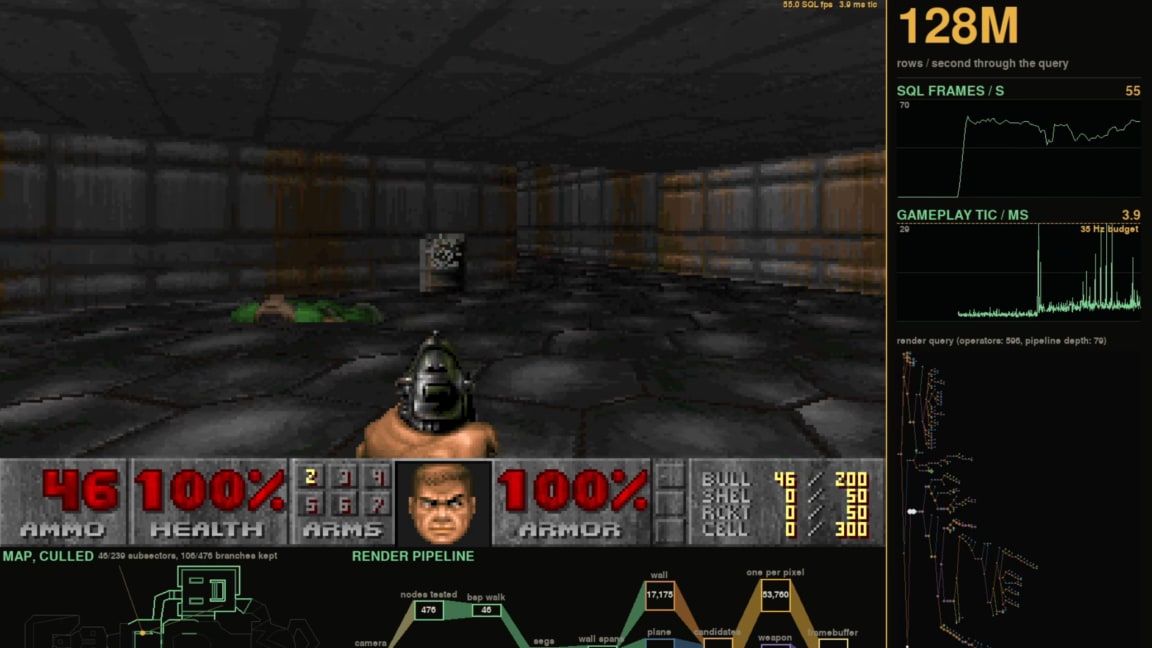
Developer Lukas Vogel has successfully rendered the classic game Doom using SQL queries within CedarDB. This project utilizes 1,300 lines of SQL to generate 35 frames per second, showcasing a significant technical leap over previous attempts.
The Intersection of Database Logic and Gaming: SQLDoom Explained
In a remarkable display of technical ingenuity, developer Lukas Vogel has achieved what many would consider impossible: rendering the classic video game Doom using an SQL database. While the project, dubbed "SQLDoom," is inherently impractical for standard gaming, it serves as a profound stress test for database performance and relational query logic. By utilizing approximately 1,300 lines of SQL code spread across 89 common table expressions (CTEs), Vogel has successfully pushed the boundaries of how we perceive database functionality.
The Architecture of a Database-Rendered World
The technical framework behind SQLDoom is a masterclass in hybrid architecture. While the core game logic, geometry tracking, and state management are handled entirely within the CedarDB environment, the system relies on a small Python client to bridge the gap between the database and the user. This client is responsible for essential tasks such as capturing player input, maintaining the game’s internal timing, and ultimately displaying the generated bitmapped framebuffers to the screen at a consistent rate of 35 frames per second.
Evolution from DoomQL
This project represents a significant evolution from Vogel’s earlier work, "DoomQL." That previous iteration, which attempted to create a multiplayer shooter entirely within SQL, was limited by the constraints of raycasting and a grayscale visual output. The leap to SQLDoom demonstrates how refined query structures and more efficient data handling can overcome the limitations that previously hindered "game-in-a-database" experiments. It highlights a maturing understanding of how complex state machines can be mapped to relational tables.
Database Performance and Computational Limits
The primary implication of SQLDoom is not the creation of a new gaming platform, but rather the demonstration of CedarDB’s raw processing capabilities. Rendering 35 frames per second through a series of complex SQL queries requires immense efficiency in data retrieval and calculation. This experiment effectively proves that modern analytical databases are capable of handling high-frequency, logic-intensive operations that were previously thought to be outside their design parameters.
Future Trends in SQL Utility
While rendering Doom is fundamentally a "bad idea" for practical gaming, it opens doors for creative engineering. As databases become faster and more capable of handling real-time data streams, developers will likely continue to push the boundaries of what is possible within SQL environments. We may see these "SQL-as-a-compute-engine" experiments evolve into more practical tools for real-time analytics, complex simulation, or high-speed data visualization in fields where latency and consistency are critical.
Conclusion
Lukas Vogel’s SQLDoom is a fascinating case study in technical curiosity. It bridges the gap between the rigid, structural world of database management systems and the dynamic, reactive nature of real-time software. By successfully rendering a classic title through database queries, Vogel has provided the tech community with a unique benchmark for performance, proving that even the most unlikely tools can be bent to serve creative and complex ends.