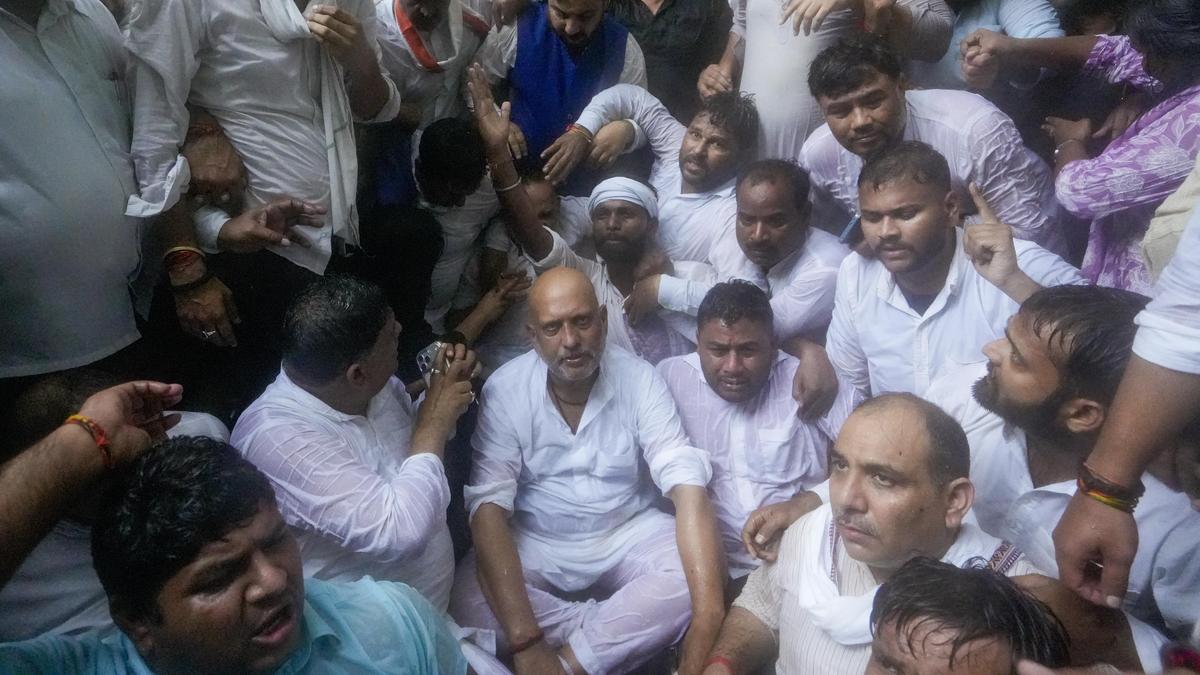
U.P. Congress leaders clash with police, detained during protest against Chief Election Commissioner
Source Entity
India Latest News: Top National Headlines Today & Breaking News | The Hindu
Union Minister Chirag Paswan has urged the Election Commission to address public doubts regarding its neutrality amid controversy over a postponed event involving Election Commissioner Gyanesh Kumar. The poll body attributed the change to routine logistical factors, while Paswan emphasized that the Commission must proactively defend its institutional integrity.
The Imperative of Institutional Trust in India's Electoral Process
Recent developments surrounding the Election Commission of India (ECI) have brought the delicate balance between administrative autonomy and public perception into sharp focus. The controversy, sparked by the postponement of an event involving Election Commissioner Gyanesh Kumar in Uttar Pradesh, has provided a focal point for broader discussions on the transparency of constitutional bodies. While the poll body has characterized the rescheduling as a routine matter stemming from logistical and administrative necessities, the event has nonetheless triggered a wave of public and political scrutiny.
The Role of Independent Constitutional Bodies
At the heart of this discourse is the vital requirement for the Election Commission to maintain the absolute trust of the electorate. As a constitutional authority tasked with overseeing the democratic process, any perceived ambiguity in its operations can be exploited to cast doubt on the integrity of the electoral system. Union Cabinet Minister Chirag Paswan has underscored this necessity, asserting that the burden of maintaining credibility rests squarely on the shoulders of the ECI leadership, particularly Chief Election Commissioner Gyanesh Kumar.
Political Accountability vs. Institutional Autonomy
Paswan’s stance highlights a nuanced distinction in the political landscape: the separation between government intervention and institutional self-defense. By stating that it is not the role of political parties or the government to defend the ECI, Paswan reinforces the principle of institutional independence. He argues that because political entities lack access to the internal deliberations and administrative rationale of the Commission, the ECI must be the primary agent in clarifying its own actions to the public.
Addressing Public Suspicion
Public discourse in a vibrant democracy often involves the questioning of official narratives. When fingers are raised against a body as critical as the Election Commission, silence or minimal administrative explanations can sometimes exacerbate suspicion. Paswan’s call for the ECI to address these doubts proactively suggests that in the current political climate, transparency is not just an administrative preference but a defensive necessity to protect the sanctity of the institution.
Looking Toward Future Democratic Trends
As India continues to navigate complex electoral cycles, the pressure on the Election Commission to provide clear, timely communication will likely increase. The trend toward digital scrutiny and real-time political commentary means that even minor logistical shifts can be amplified into significant narratives. Moving forward, the ECI may need to adopt more rigorous communication strategies to preemptively address concerns, ensuring that the 'iota percent of suspicion' mentioned by Minister Paswan does not take root in the public consciousness.
Conclusion
The ongoing debate serves as a reminder that the health of a democracy is inextricably linked to the perceived neutrality of its electoral referees. Whether the postponement of the event in Uttar Pradesh was purely logistical or symptomatic of wider administrative challenges, the response from the Election Commission will be a defining factor in its ongoing relationship with the public. To preserve the high standard of trust required for free and fair elections, the Commission must balance its administrative autonomy with a commitment to clear, transparent engagement with the concerns of all stakeholders.
Multiple Citing Sources
Verification Required?