Edward Hopper's Iconic Painting, "Nighthawks
Source Entity
Hacker News
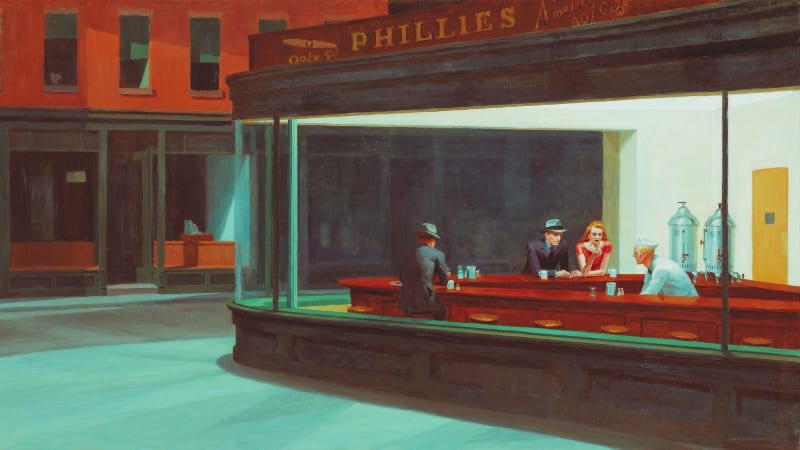
Edward Hopper's 1942 masterpiece, Nighthawks, remains a quintessential study of urban isolation and artificial light. The painting's creation process began in late 1941, documented by preparatory sketches and historical photography.
The Genesis of an American Icon: Edward Hopper’s Nighthawks
Edward Hopper’s Nighthawks (1942) stands as one of the most recognizable and analyzed works in the canon of 20th-century American art. Housed at The Art Institute of Chicago, this oil-on-canvas masterpiece captures a profound sense of urban alienation. The painting depicts a late-night diner, bathed in the stark, clinical glow of artificial light, contrasting sharply with the darkened, deserted street outside. This visual narrative of isolation has resonated with audiences for over eight decades, solidifying its status as a cultural touchstone.
Documenting the Creative Process
The historical record provides clear evidence regarding the timeline of this work's creation. By late November 1941, Hopper had already commenced work on the canvas. A pivotal moment in this timeline is captured by photographer Arnold Newman, who documented the artist standing before the then-empty canvas. This photographic evidence serves as a critical link between the finished masterpiece and the artist’s initial conceptualization, proving that the dimensions and fundamental composition were firmly established during that autumn period.
Preparatory Rigor and Artistic Vision
Hopper’s meticulous nature is evidenced by the nineteen known preparatory sketches in pencil and chalk created during the development of Nighthawks. These sketches reveal an artist deeply concerned with the geometry of the diner and the interplay of shadow and light. By the time the photograph with Arnold Newman was taken, it is probable that a significant portion of these studies had already been completed, allowing Hopper to approach the final canvas with a clear, calculated vision of the scene’s spatial dynamics.
Historical and Institutional Context
The painting was acquired by The Art Institute of Chicago in 1942, shortly after its completion, through the Friends of American Art fund. Its rapid acquisition by such a prestigious institution highlights the immediate impact the work had on the American art scene. Today, it remains protected under the copyright of the Heirs of Josephine N. Hopper, managed by the Artists Rights Society, ensuring that the legacy of both Edward and Josephine Hopper remains preserved in the public consciousness.
The Broader Implications of Urban Solitude
Beyond its technical mastery, Nighthawks functions as a historical document of mid-century American life. The diner, an iconic setting for the "night owl," serves as a liminal space where the boundaries of public and private life blur. The painting’s enduring popularity suggests that the themes of urban loneliness and the anonymity of the modern city, which Hopper captured so effectively in 1942, remain as relevant in the contemporary era as they were during the uncertainty of the early 1940s.
Conclusion: A Lasting Legacy
In summary, Nighthawks is more than a painting; it is a meticulously planned exploration of human existence. From the nineteen preparatory sketches to the final acquisition by the Art Institute of Chicago, the history of the work reflects a deliberate artistic process. As we continue to study Hopper’s vision, we find that the light emanating from that late-night diner continues to illuminate the complexities of the human condition, ensuring the painting's place in history for generations to come.