Show HN: Eigendrum - Draw any shape and hear what it sounds like as a drum
Source Entity
Hacker News
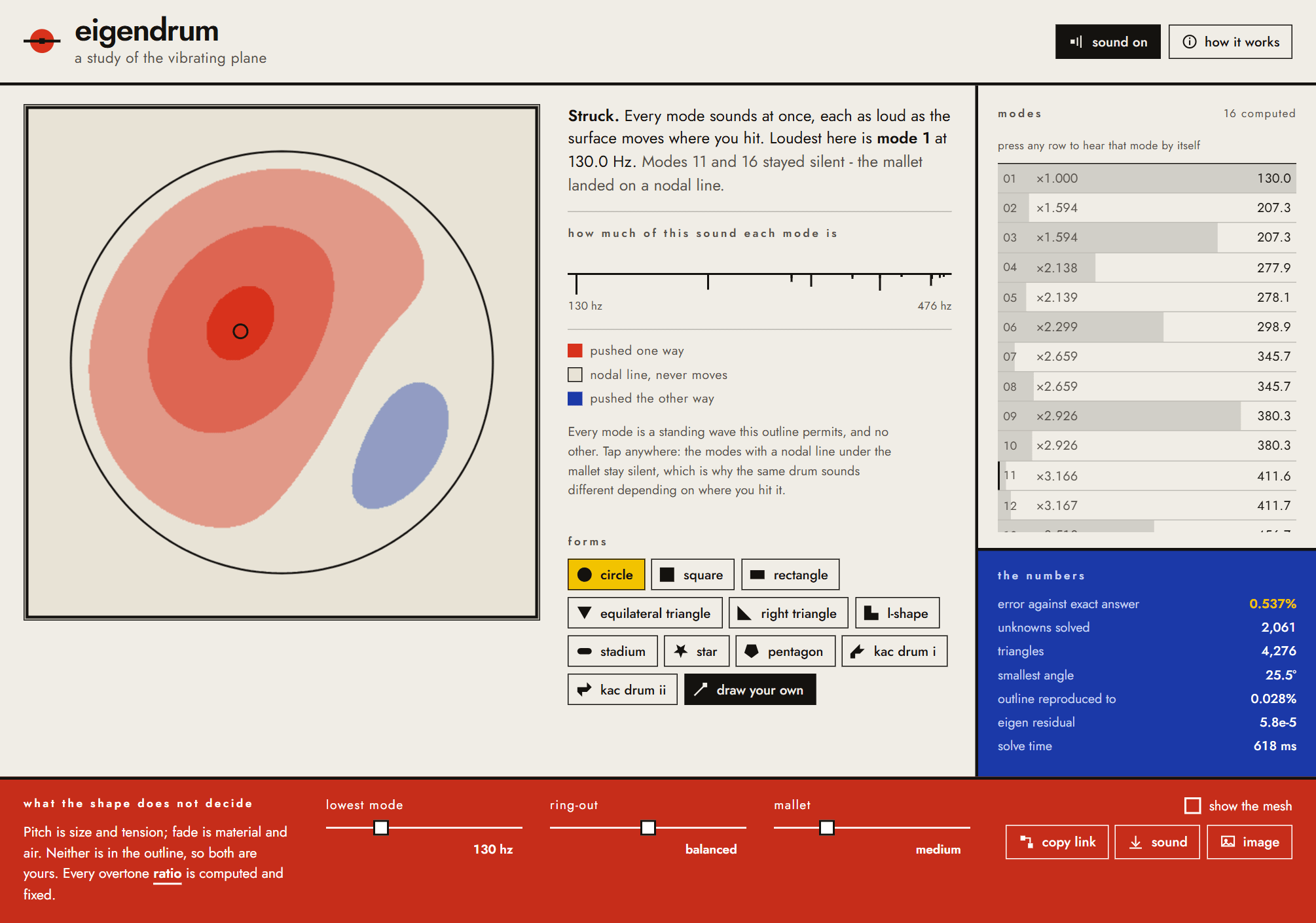
Eigendrum is a novel web-based tool that uses finite element analysis to simulate the acoustic properties of custom-drawn drum shapes. By solving the wave equation numerically, it allows users to hear how unique geometries vibrate as percussive instruments.
Bridging Geometry and Acoustics: An Analysis of Eigendrum
Eigendrum represents a fascinating intersection of computational physics and music technology, offering users the ability to visualize and audition the acoustic properties of arbitrary drum shapes. At its core, the project explores the mathematical relationship between the physical geometry of a membrane and the resulting harmonic frequencies it produces when struck.
The Physics of Vibration
The project is grounded in the classic eigenvalue problem defined by the wave equation, specifically looking at the behavior of a drumhead clamped at its rim. By solving the equation −∇²u = λu (where u equals zero at the boundary), the system identifies the specific modes or standing waves that a shape can support. Because these solutions rarely have a closed-form algebraic formula for complex geometries, Eigendrum employs numerical methods to approximate the physical reality of these vibrations.
Computational Implementation
To translate these abstract mathematical principles into an interactive user experience, Eigendrum utilizes a finite element method. The software discretizes the user-drawn shape into a mesh of triangles, constructing stiffness and mass matrices. By solving the generalized eigenvalue problem Kφ = λMφ, the system extracts the lowest eigenvalues, which correspond to the fundamental frequencies of the drum. This approach allows for high-fidelity simulations of shapes that would be impossible to analyze using traditional analytical geometry.
Verification and Reliability
One of the most critical aspects of scientific software is the validation of its results. Eigendrum addresses this by continuously testing its numerical solver against shapes with known analytical solutions. By comparing its output against the zeros of Bessel functions for circular membranes and the established harmonic series for rectangular membranes, the developers ensure that the numerical approximation remains accurate and consistent across various iterations of the software.
Implications and Future Trends
Tools like Eigendrum highlight a growing trend in 'generative physics' applications, where complex mathematical modeling is made accessible through intuitive, creative interfaces. As computational power increases, we may see similar tools integrated into professional music production environments, allowing percussionists and sound designers to create bespoke acoustic instruments with precise, mathematically defined timbres that were previously confined to theoretical research.
Conclusion
Ultimately, Eigendrum serves as an excellent case study for how advanced mathematical concepts—often reserved for academic physics—can be democratized. By turning the wave equation into a creative tool, it provides both an educational glimpse into the nature of resonance and a functional platform for experimental sound design.