An hour of audio transcribed in about 13s on MacBook Air
Source Entity
Hacker News
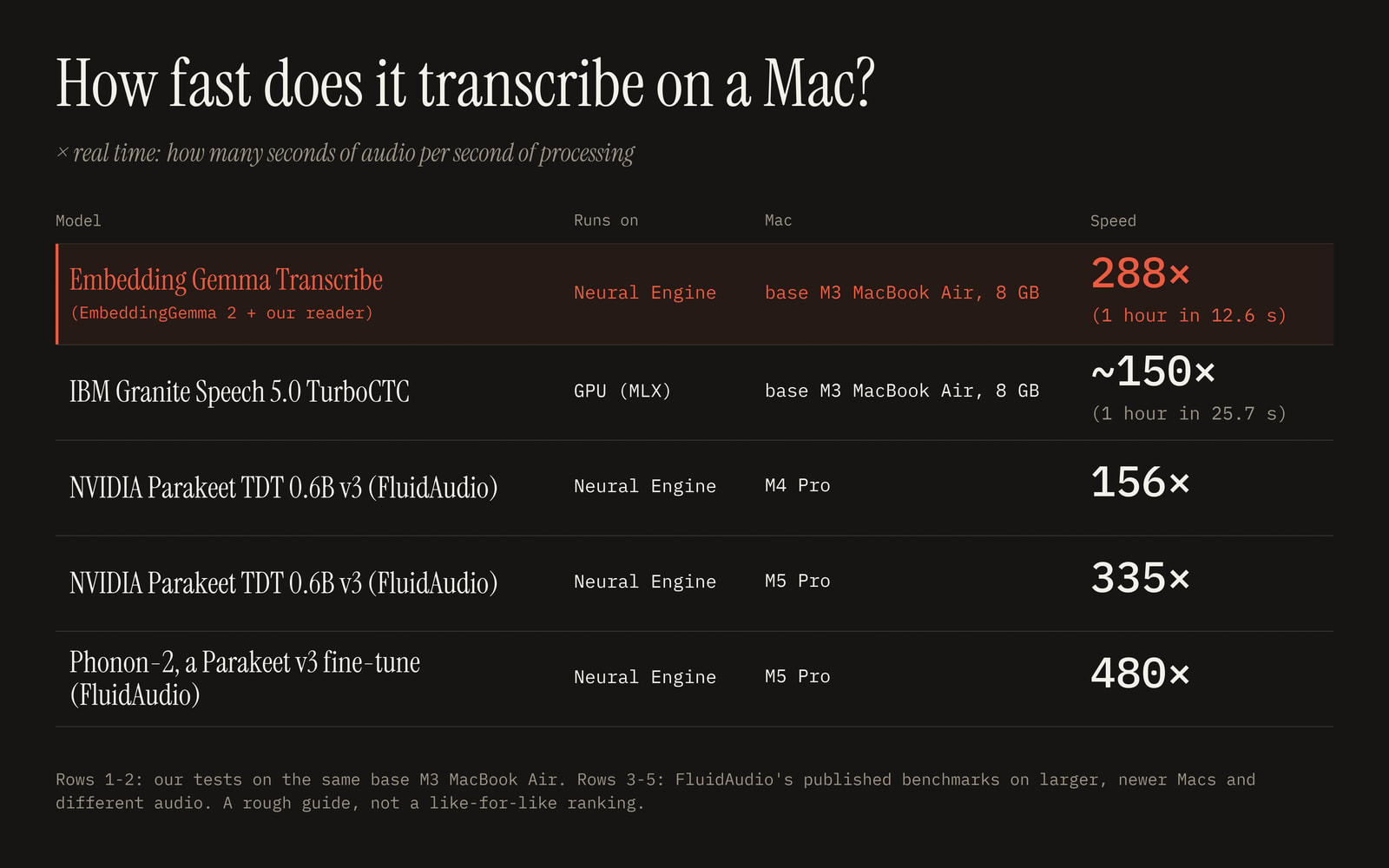
A new tool leverages Google's EmbeddingGemma 2 model to perform high-speed, on-device speech-to-text transcription. By mapping audio directly into a pre-existing text-embedding space, it achieves remarkable efficiency on standard Apple Silicon hardware.
Breakthrough in On-Device Audio Processing
Recent developments have introduced a novel approach to speech-to-text technology by repurposing Google’s EmbeddingGemma 2 model. Traditionally, transcription models require massive computational resources and extensive training to convert acoustic signals into legible text. However, this implementation demonstrates that an hour of audio can be transcribed in approximately 13 seconds on a base-model MacBook Air, showcasing the incredible efficiency of running inference locally on Apple Silicon.
The Mechanism: Mapping Audio to Text Space
The core innovation lies in the multimodal nature of EmbeddingGemma 2, which maps text, images, audio, and video into a shared high-dimensional vector space. By design, the model ensures that the acoustic representation of a word occupies a coordinate space proximal to its written equivalent. Instead of traditional acoustic modeling, this tool utilizes a small reader mechanism that maps audio slices directly into this shared space, identifying the closest match from a vocabulary of approximately 229,000 English words to generate a transcript.
Efficiency and Hardware Optimization
The performance metrics observed on macOS 14+ hardware are significant. By avoiding heavy cloud-based processing, the tool ensures user privacy and reduces latency, allowing for instantaneous transcription without an internet connection. The requirement of only 715 MB for model downloads highlights how optimized, specialized embedding models can outperform general-purpose, bloated transcription architectures when deployed on consumer-grade hardware.
Broader Implications for AI Accessibility
This project signals a shift toward 'edge AI,' where complex multimodal models are being repurposed for specific utility tasks. By utilizing existing embedding spaces rather than training new models from scratch, developers can achieve high performance with minimal overhead. This democratizes access to sophisticated AI tools, as users no longer require expensive enterprise-grade GPUs to handle large-scale transcription tasks efficiently.
Future Trends in Multimodal Models
The success of this implementation suggests that the future of AI may rely less on training larger models and more on the clever utilization of existing multimodal embedding spaces. As these models become more refined, we can expect to see further applications where 'reading' directly from vector space becomes a standard method for cross-modal translation, potentially revolutionizing how we interact with media, search, and real-time data analysis.
Conclusion
The ability to transcribe an hour of audio in seconds on a standard MacBook Air marks a milestone in local AI processing. By bridging the gap between acoustic audio and semantic text through EmbeddingGemma 2, this tool provides a fast, private, and highly efficient solution for users, setting a new benchmark for what is possible with on-device multimodal models.