GPT-6 Astra on OpenRouter
Source Entity
Hacker News
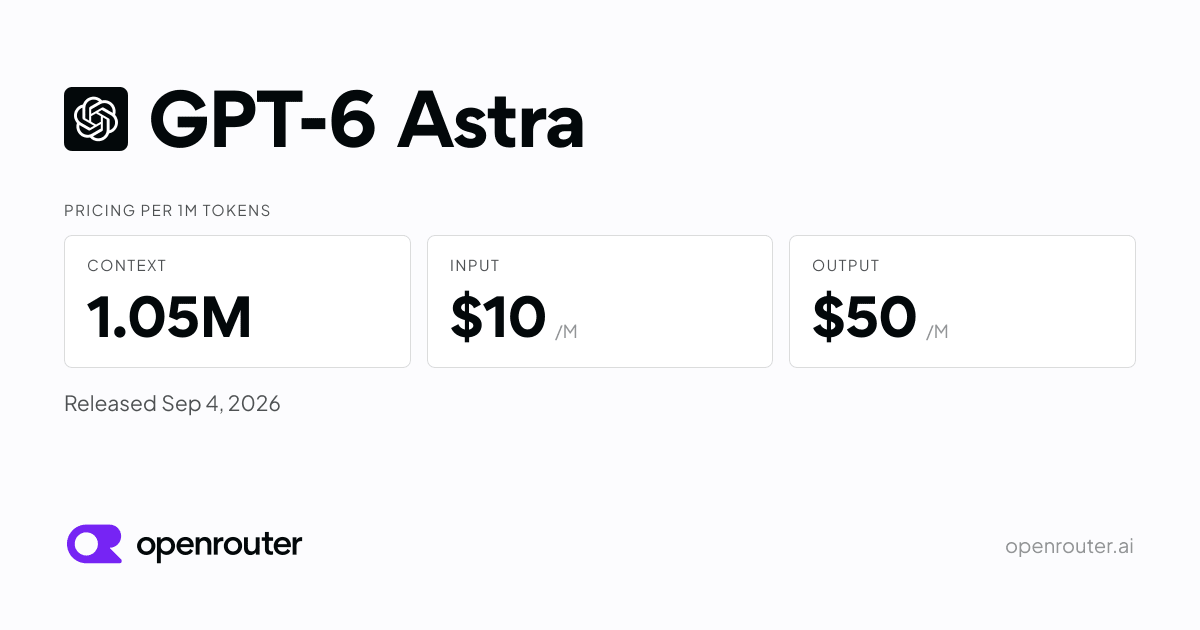
GPT-6 Astra represents a significant advancement in AI reasoning, particularly in complex cross-file code reviews and technical bug detection. Through platforms like OpenRouter, users can now access this model with optimized routing for speed, cost, and tool-calling precision.
The Emergence of GPT-6 Astra
The landscape of artificial intelligence has shifted with the introduction of GPT-6 Astra, a model positioned as the most intelligent and aligned iteration to date. Designed to excel in high-stakes domains such as computer use, cybersecurity, scientific research, and complex coding, Astra represents a distinct generational leap over previous models like GPT-5.6 Sol and Opus 5. By prioritizing alignment and state-of-the-art reasoning, the model aims to solve tasks that require a deeper understanding of context beyond simple syntax.
Advancements in Code Review and Bug Detection
A critical area where GPT-6 Astra demonstrates its superiority is in software engineering, specifically within the nuanced process of code review. Traditional models often struggle to identify errors that exist outside of immediate, localized changes. Astra, however, has shown a 4% improvement in catching labeled, actionable bugs compared to its predecessor, Sol, and a 22% improvement over Opus 5. These metrics underscore a fundamental shift in how AI assists developers, moving from simple pattern matching to comprehensive systemic analysis.
The Power of Cross-File Context
Perhaps the most impressive technical achievement of GPT-6 Astra is its performance in cross-file reviews. In environments where changes in one file can inadvertently break interconnected modules elsewhere, Astra has achieved gains of 20% over Sol and 33% over Opus 5. This ability to maintain a 'global' understanding of a codebase is essential for enterprise-level software development, where technical debt and regression errors are costly. By catching these complex bugs, Astra effectively functions as a force multiplier for engineering teams.
Operational Flexibility via OpenRouter
Beyond its core capabilities, the accessibility of GPT-6 Astra is facilitated by platforms like OpenRouter, which provide a decentralized approach to model hosting. This allows users to select specific routing modes—Balanced, Nitro, or Exacto—depending on whether their priority is cost-efficiency, raw speed, or high-precision tool-calling. This ecosystem allows developers to leverage Astra’s power while mitigating the inherent challenges of high-latency, large-scale model deployment.
Economic and Performance Considerations
Integrating advanced models into a production environment requires a careful balance of performance metrics and economic viability. Performance is measured through throughput (tokens per second), latency, and Time-To-First-Token (TTFT), all of which are critical for user experience. Because OpenRouter tracks the actual price paid versus listed prices—factoring in caching and volume discounts—it provides a transparent framework for companies to assess the ROI of deploying Astra for large-scale operations.
Future Implications and Conclusion
As AI models continue to evolve toward higher reasoning capabilities, the focus will increasingly shift toward security, data privacy, and cost-effective scaling. GPT-6 Astra sets a new benchmark for what developers can expect from automated code review tools. By combining superior cross-file analysis with flexible deployment options, Astra is poised to become a staple in the modern software development lifecycle, ultimately driving higher code quality and faster development cycles across the industry.