Hot Chips 2026: Applying High Bandwidth Flash (HBF)
Source Entity
Hacker News
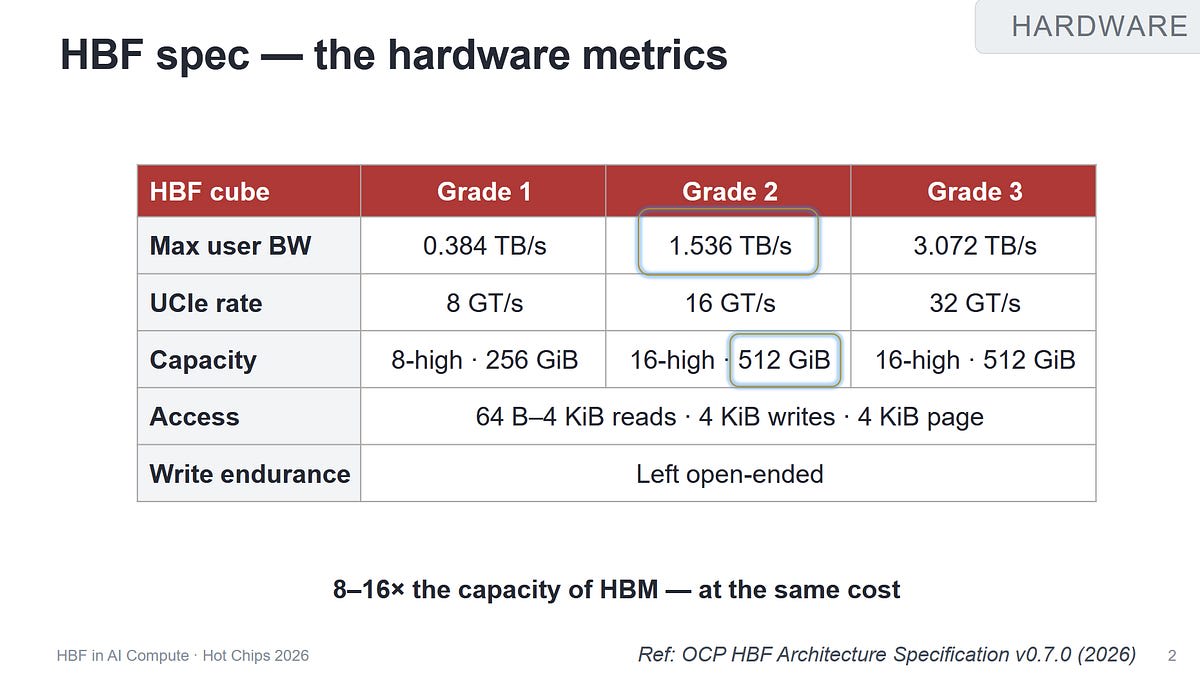
Hot Chips 2026 introduced the concept of High Bandwidth Flash (HBF), a memory architecture designed to bridge the gap between high-capacity storage and high-speed memory. By integrating flash technology into an HBM-like package, HBF aims to optimize machine learning workloads through superior capacity and specialized access patterns.
The Emergence of High Bandwidth Flash (HBF)
At the recent Hot Chips 2026 tutorials, industry experts Anurag Agarwal and Radhakrishna Giduthuri introduced a novel architectural concept: High Bandwidth Flash (HBF). As the demand for machine learning (ML) models continues to scale, traditional memory hierarchies are facing significant bottlenecks. HBF is presented as a strategic solution, utilizing the foundational technology of standard SSD flash memory while adopting the physical packaging and integration strategies typically reserved for High Bandwidth Memory (HBM).
Bridging the Capacity-Bandwidth Gap
The primary innovation behind HBF lies in its placement. By positioning HBF cubes directly on the same package as a compute chip—potentially alongside existing HBM modules—engineers are attempting to solve the 'memory wall' problem. While HBM provides exceptional speed, it is limited by its capacity. HBF aims to complement this by offering significantly higher storage density while maintaining bandwidth levels sufficient for specific data-intensive ML operations.
Architectural Divergence from Legacy Tech
It is critical to distinguish HBF from previous attempts at specialized memory, such as Intel’s Optane. While Optane sought to create a persistent memory tier that acted like a hybrid of RAM and storage, HBF is fundamentally rooted in flash memory technology. Despite sharing a similar physical form factor to HBM, HBF functions differently under the hood, prioritizing massive access granularity and capacity over the byte-addressable latency characteristics of traditional DRAM-based solutions.
Implications for Machine Learning Workloads
For the ML ecosystem, the introduction of HBF represents a shift toward data-centric computing. Large language models and massive neural networks require loading enormous datasets that often exceed the capacity of standard HBM. HBF allows these large models to reside closer to the compute engine, potentially reducing the latency associated with fetching data from traditional NVMe storage interfaces. The focus on simulations and projections at Hot Chips 2026 underscores that this technology is currently in the conceptual and validation stage.
The Path to Commercialization
As noted during the Hot Chips presentation, no commercial HBF products currently exist. The current phase of development is centered on rigorous simulations and defining how software stacks must evolve to exploit this unique hardware. Future developers will need to adapt their data management strategies to handle the 'giant access granularity' inherent in HBF cubes, ensuring that the software layer can effectively bridge the gap between the compute unit and the high-capacity flash storage.
Future Outlook
Looking ahead, the successful implementation of HBF could redefine hardware design for AI hardware. If simulations prove that HBF can reliably provide high-capacity, high-bandwidth data access, it will likely become a standard component in next-generation AI accelerators. The industry is clearly moving toward heterogeneous memory architectures, and HBF stands as a frontrunner in the quest to balance capacity needs with the relentless demand for processing power.