IBM releases SOTA Granite Time Series PatchTST-FM-r2 model with commercial-friendly license
Source Entity
Hugging Face - Blog
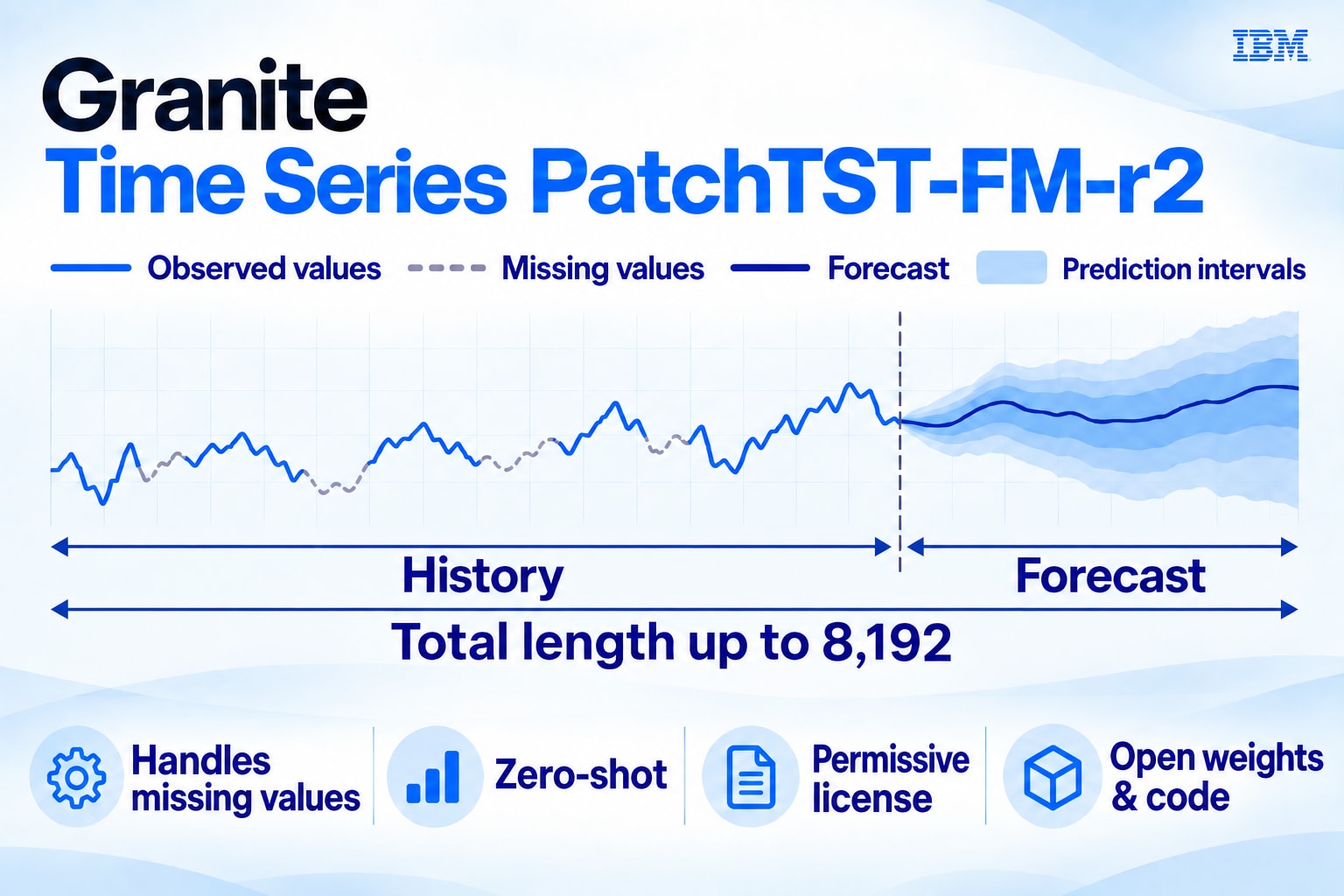
IBM has launched the Granite Time Series PatchTST-FM-r2, a 385M-parameter foundation model for zero-shot forecasting. This release offers enhanced architectural capabilities and a commercial-friendly license, positioning it as a leader in time-series predictive analytics.
The Evolution of Predictive Analytics with IBM Granite
IBM’s recent release of the Granite Time Series PatchTST-FM-r2 marks a significant milestone in the evolution of time-series analysis. By shifting away from the traditional, labor-intensive paradigm of training individual models for every unique dataset, this foundation model approach allows for high-performance zero-shot forecasting. This transition represents a fundamental change in how data science teams approach predictive modeling, prioritizing scalability and efficiency over bespoke, narrow-use-case development.
Architectural Advancements and Capabilities
The PatchTST-FM-r2 builds upon its predecessor, the r1 version, by integrating a more sophisticated architecture and expanding its pretraining corpus. With approximately 385 million parameters, the model is designed to handle complex temporal patterns that smaller, specialized models often miss. Beyond basic point forecasting, the r2 model introduces probabilistic forecasting and robust support for the imputation of missing values, addressing two of the most persistent hurdles in real-world time-series data management.
The Impact of Commercial-Friendly Licensing
A critical factor in the adoption of foundation models is the accessibility of their licensing. As of September 8, 2026, IBM has positioned this model as a leader in the open-source space by providing it under a permissive, commercial-friendly license. This decision is strategically significant, as it lowers the barrier to entry for enterprises looking to integrate advanced AI forecasting into their production pipelines without the legal and financial friction often associated with proprietary or restrictive AI frameworks.
Shifting from Bespoke to Foundation Models
The move toward foundation models in the time-series domain suggests a broader trend in machine learning where general-purpose architectures are increasingly outperforming domain-specific ones. By leveraging large-scale pretraining, models like PatchTST-FM-r2 can generalize patterns across diverse datasets, which previously would have required extensive fine-tuning. This shift allows organizations to reduce their infrastructure overhead, as they no longer need to train and maintain a separate model for every individual business variable.
Future Trends and Market Implications
As we look toward the future, the success of the Granite TSFM family suggests that the industry will continue to favor models that prioritize zero-shot performance and architectural versatility. The ability to perform imputation and probabilistic forecasting out-of-the-box makes this model particularly useful for industries such as finance, supply chain management, and energy, where data is often noisy or incomplete. The release of this model likely signals a competitive push among major tech players to standardize foundation models for time-series, potentially standardizing how global markets and logistics chains are forecasted in the coming years.