Laser weapon to shoot down drones at low cost: How close is India to deploying it?
Source Entity
DHRUV YADAV
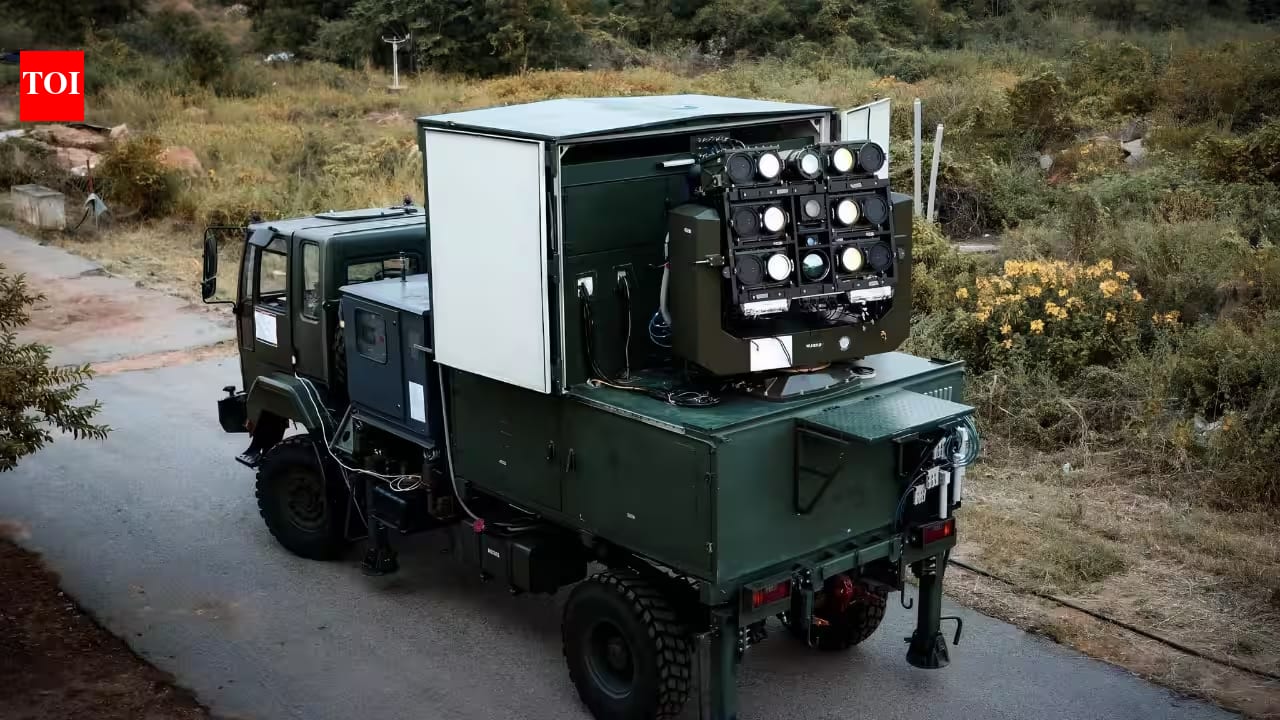
India's DRDO is advancing its Directed-Energy Weapon (DEW) program, successfully testing vehicle-mounted laser systems against drones. While these systems offer cost-effective, high-capacity defense, they currently face significant environmental and operational deployment challenges.
India’s Strategic Leap in Directed-Energy Weapons
India has made significant strides in modernizing its defense capabilities, most notably through the Defence Research and Development Organisation (DRDO) and its ambitious Directed-Energy Weapon (DEW) program. The recent successful demonstration of the DEW MK-II(A) in Kurnool, where a vehicle-mounted laser system effectively neutralized a drone, marks a pivotal moment for indigenous military technology. This achievement underscores India's commitment to countering the evolving threat posed by unmanned aerial vehicles (UAVs) on the modern battlefield.
The Mechanics of Laser-Based Defense
At its core, a laser weapon operates by focusing high-energy beams to destroy or disable targets. Unlike traditional kinetic munitions that rely on physical projectiles, these systems function at the speed of light, offering near-instantaneous engagement. The integration of these lasers onto mobile platforms provides the Indian military with a flexible, reactive defense mechanism capable of tracking and intercepting agile aerial threats that might otherwise evade conventional radar-guided anti-aircraft systems.
Economic and Tactical Advantages
One of the primary drivers behind the global pursuit of DEWs is their inherent cost-effectiveness. In an era where sophisticated drones can be produced relatively cheaply, using million-dollar missiles to intercept them is financially unsustainable. Laser systems offer an 'unlimited magazine depth,' limited only by power supply, allowing for sustained engagement without the logistical burden of reloading physical ammunition. This shift represents a fundamental change in how defensive perimeters are established and maintained against swarm attacks.
Navigating Operational Challenges
Despite the promise, the transition from successful testing to widespread deployment is fraught with technical hurdles. Environmental factors—such as dust, fog, humidity, and atmospheric turbulence—can significantly degrade laser beam coherence and intensity, reducing their effective range and lethality. Furthermore, the heat management of such high-energy systems remains a critical engineering constraint that must be solved before these weapons can be considered reliable for long-term, high-intensity combat operations.
Future Outlook and Strategic Integration
While the DRDO is actively establishing production partnerships to scale these technologies, the path forward requires rigorous validation under hostile conditions. The current focus on developmental stages indicates a cautious, methodical approach to ensuring that these weapons are not just laboratory successes, but battlefield-ready assets. As India continues to refine its DEW program, it will likely influence regional security dynamics, positioning the nation as a key developer of next-generation, non-kinetic warfare technology.