Hill-climbing Inkling 2 Mini inference on one RTX PRO 6000
Source Entity
Hugging Face - Blog
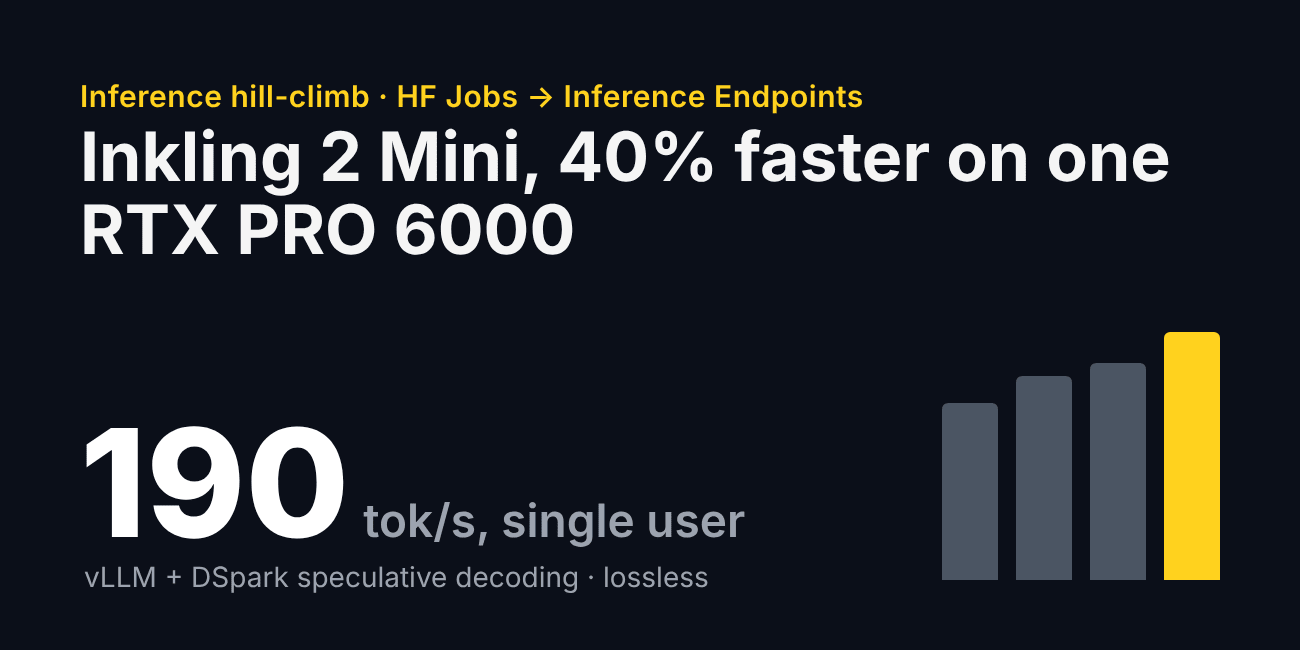
Inkling 2 Mini has emerged as a new leader in local AI, utilizing a unique looped Mixture-of-Experts architecture. With a 1M-token context window and efficient parameter usage, it outperforms competitors like Gemma 4 and Qwen3.8 on key benchmarks.
The Rise of Inkling 2 Mini: A New Benchmark for Local AI
The recent release of Inkling 2 Mini marks a significant milestone in the evolution of open-source artificial intelligence. By successfully balancing a massive 1-million-token context window with a highly efficient parameter structure, the model has established a new state-of-the-art for local inference. Achieving top-tier performance on the Artificial Analysis Intelligence Index v5, it effectively challenges established models such as Gemma 4 31B and Qwen3.8-27B, proving that smaller, optimized architectures can compete with their larger counterparts.
Architectural Innovation: The Looped MoE Approach
What distinguishes Inkling 2 Mini from its predecessors is its unconventional looped Mixture-of-Experts (MoE) architecture. By utilizing 24 physical layers where the middle 12 layers are executed three times, the model achieves a total parameter count of ~26B while maintaining only 3B active parameters per token. This design choice represents a sophisticated shift in how developers approach compute efficiency, allowing for high-level reasoning and tool use on modest hardware like the RTX PRO 6000.
Multimodality and Contextual Mastery
Beyond its architectural novelty, the inclusion of multimodal inputs significantly broadens the utility of Inkling 2 Mini. In an era where AI must process diverse data types—from codebases to visual inputs—the 1M-token context window serves as a critical differentiator. This capacity allows users to ingest massive datasets or entire software repositories, enabling the model to perform complex reasoning tasks that were previously restricted to cloud-based, proprietary models.
Democratizing High-Performance AI
By integrating seamlessly into the Hugging Face ecosystem, the creators of Inkling 2 Mini have prioritized accessibility. This focus on developer experience ensures that researchers and hobbyists alike can leverage state-of-the-art reasoning capabilities without requiring enterprise-grade server clusters. The model's dominance across 32 of 48 benchmarks suggests that the barrier to entry for high-performance, local AI is rapidly lowering.
Broader Implications for the Open-Source Ecosystem
The success of Inkling 2 Mini signals a broader trend in the AI industry: the move toward 'small but mighty' models. As organizations look to reduce reliance on massive, monolithic models, the ability to fine-tune and deploy efficient, specialized architectures becomes paramount. We can expect future development cycles to focus heavily on this balance of active parameter optimization and extended context windows, further cementing the role of open-source solutions in the global technological landscape.
Future Trends and Conclusion
As we look forward, the ability to run such powerful models on hardware like the RTX PRO 6000 suggests a future where AI becomes truly ubiquitous and private. By keeping compute local, users gain control over their data while maintaining high performance. Inkling 2 Mini is not just an incremental improvement; it is a blueprint for the next generation of efficient, multimodal reasoning engines that will define the local AI ecosystem for years to come.