Watch: Was Trump smuggled out of Air Force One in a catering truck?
Source Entity
BBC News
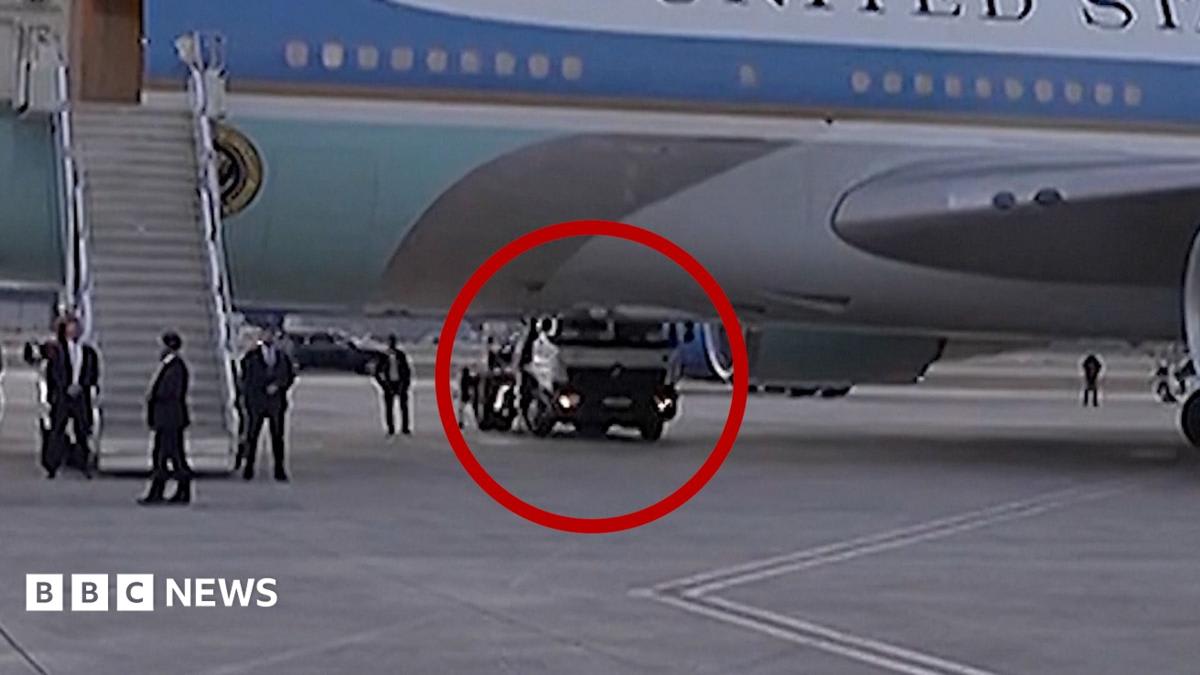
Iranian state media has mocked Donald Trump following reports that he covertly switched planes while leaving a NATO summit in Turkey. The maneuver was reportedly executed to mitigate a credible threat of an Iranian missile strike against the presidential aircraft.
The Geopolitical Fallout of a Clandestine Aircraft Switch
Recent reports detailing a secret aircraft transfer involving former President Donald Trump following a NATO summit in Turkey have sparked significant international discourse. According to reports from the Washington Post and CBS News, the President was moved from the traditional Air Force One to a military aircraft via an elevated catering truck. This maneuver was allegedly necessitated by intelligence indicating a credible threat from Iran to target the presidential plane with a missile strike.
The Iranian Perspective and State Media Narrative
In the wake of these revelations, Iranian state television has aggressively framed the incident as a sign of American weakness. By characterizing the plane switch as a result of 'fear' of Iran’s military capabilities, Iranian officials have leveraged the event to project strength on the global stage. This narrative serves to boost domestic morale in Iran and signals to the international community that the Islamic Republic remains a significant strategic adversary capable of disrupting high-level U.S. movements.
Strategic Implications of Secret Movements
The logistical complexity of this operation—moving the President in a catering truck to avoid both public and media scrutiny—highlights the extreme measures required to maintain security in volatile regions. The fact that journalists and some White House staff were reportedly unaware of the swap underscores the severity of the threat assessment at the time. This incident serves as a stark reminder of the fragile security environment in which world leaders operate when diplomatic tensions, particularly those between the U.S. and Iran, reach a boiling point.
Contextualizing the Threat Environment
The decision to switch planes occurred against the backdrop of renewed military strikes and a total breakdown in diplomatic negotiations between Washington and Tehran. Trump’s own public statements, in which he identified himself as Iran’s 'number one target' during the summit in Ankara, corroborate the high-stakes atmosphere of the visit. This environment of heightened hostility likely influenced the Secret Service's decision to prioritize stealth over the traditional protocols of presidential travel.
Historical Precedents and Security Protocol
While the White House has notably refrained from confirming the details of the secret switch, such clandestine maneuvers are rare but grounded in the necessity of protecting the head of state from asymmetric warfare threats. Historically, the use of decoy aircraft and stealth transport is a staple of presidential security, yet the public exposure of these methods often invites mockery from geopolitical rivals. The incident highlights the ongoing struggle for narrative control between the U.S. and Iran, where security precautions are frequently reinterpreted as tactical retreats.
Future Trends in Presidential Diplomacy
Looking forward, this event marks a shift in how presidential security must account for regional military threats. As drone and missile technology becomes more accessible to non-state actors and regional powers, future administrations will likely face increased scrutiny regarding their travel logistics. The incident in Turkey illustrates that in an era of persistent digital and physical surveillance, the ability to move a leader undetected is becoming as important as the diplomatic objectives of the summit itself.
Multiple Citing Sources