Brics declaration unlikely to name any nation but condemn unilateral war imposition: Report
Source Entity
KANCHAN YADAV
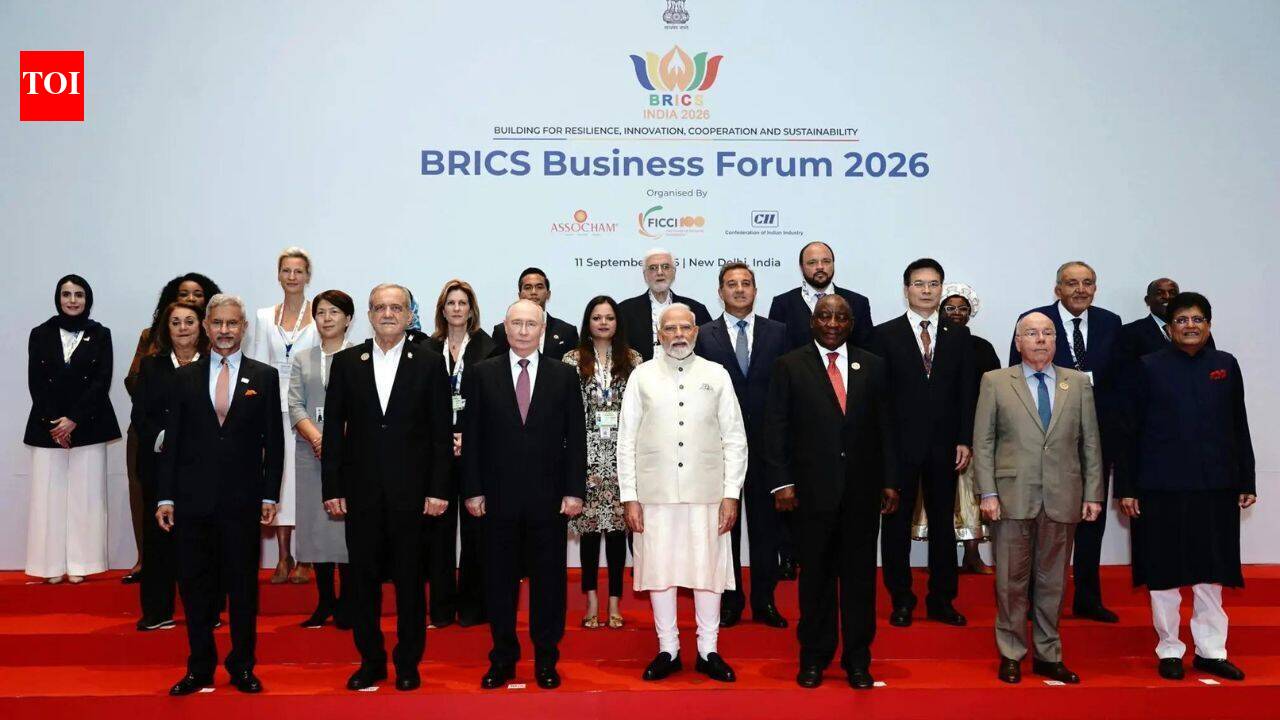
Iranian President Masoud Pezeshkian visited New Delhi for the 18th BRICS summit, criticizing US and Israeli 'aggression' amid severe economic sanctions. Prime Minister Narendra Modi urged for diplomatic conflict resolution and emphasized the necessity of secure energy supply chains through the Strait of Hormuz.
Tensions Escalate: Pezeshkian’s BRICS Address
Iranian President Masoud Pezeshkian’s arrival in New Delhi for the 18th BRICS summit marks a critical juncture in international diplomacy. Speaking at the BRICS Business Forum, Pezeshkian characterized the recent escalation of economic sanctions by the United States as entering a 'far more dangerous phase.' This rhetoric highlights the deepening rift between Iran and the U.S.-Israel coalition, which has been intensified by the military actions that commenced on February 28, 2026.
The Intersection of Security and Economics
Pezeshkian underscored a fundamental premise: that national and regional security are inextricably linked to economic stability. By framing the current economic sanctions as a form of 'active aggression,' the Iranian President is signaling to the BRICS bloc that Tehran views its current financial isolation as a direct threat to its sovereignty. This perspective challenges the traditional separation of economic policy from military conflict, suggesting that for Iran, the 'bullies'—a term he explicitly used for the U.S. and Israel—are utilizing financial tools as a weapon of war.
The Strait of Hormuz: A Global Chokehold
Prime Minister Narendra Modi’s meeting with President Pezeshkian highlighted the significant anxiety felt by the international community regarding the disruption of global energy supply chains. Central to these concerns is the Strait of Hormuz, a vital maritime artery that has been effectively paralyzed since the February 28 conflict. The Prime Minister’s call for 'freedom of navigation' is a direct response to the reality that a large percentage of the world's oil transits through these contested waters, making the current regional instability a global economic risk rather than a localized geopolitical issue.
The Role of Diplomacy in a Polarized Environment
Despite the harsh language exchanged between Iran and its adversaries, Prime Minister Modi’s emphasis on 'dialogue and diplomacy' serves as a critical moderating influence. By hosting this summit, India is positioning itself as a neutral arbiter capable of maintaining relations with both the Western bloc and nations like Iran. The dialogue between Modi and Pezeshkian suggests that while the rhetoric is heated, there remains a functional desire to preserve energy and commercial ties that are essential for the economic health of the region.
Future Trends and Regional Stability
The trajectory of the Iran-U.S.-Israel conflict remains volatile, particularly as the 'punitive economic measures' continue to squeeze Tehran. If these tensions do not de-escalate, the global economy may face sustained volatility in energy markets. The 18th BRICS summit provides a platform for Iran to seek alternatives to Western-dominated financial systems, potentially accelerating a shift toward non-dollar-based trade. However, until the security concerns regarding the Strait of Hormuz are addressed, regional stability will likely remain elusive, keeping the global community in a state of high alert.
Multiple Citing Sources