Who is Jens Galschiøt? Danish sculptor behind Trump's ‘The Orange Plague’ statue outside EU parliament
Source Entity
Latest News: Todays Latest News Headlines from India & World | Hindustan Times | Hindustan Times
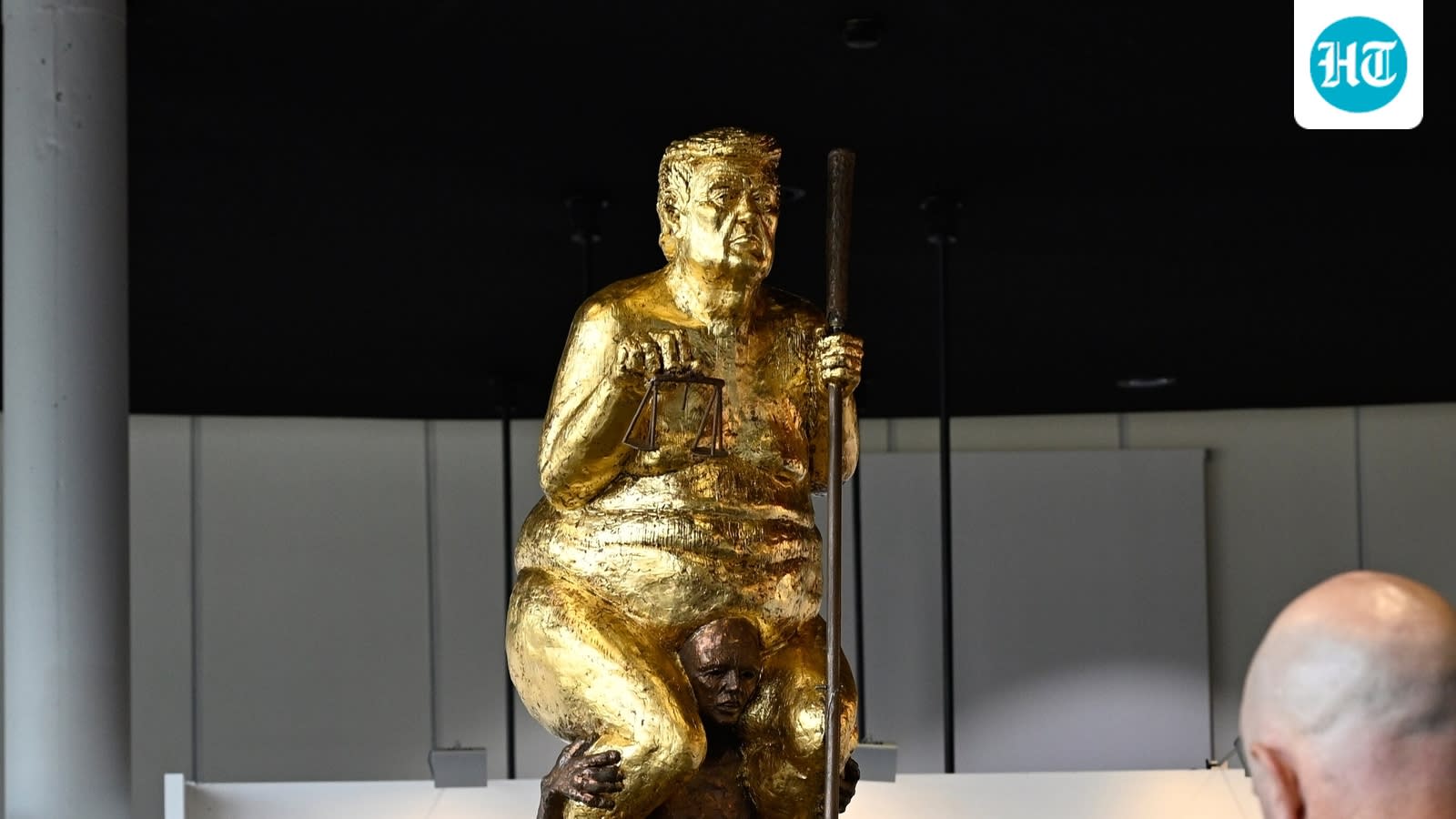
Danish sculptor Jens Galschiøt has installed an eight-foot gold-leaf statue titled 'The Orange Plague' outside the EU Parliament. The satirical piece criticizes Donald Trump's foreign policy and perceived global influence.
The Artistic Critique of Power: Analyzing 'The Orange Plague'
Danish sculptor Jens Galschiøt has garnered international attention with the unveiling of his latest installation, 'The Orange Plague,' situated prominently outside the European Union Parliament in Strasbourg, France. The eight-foot, gold-covered sculpture depicts former U.S. President Donald Trump in a provocative state, serving as a visceral visual commentary on political power dynamics and the perceived consequences of his foreign policy tenure.
Symbolism and Artistic Intent
At the core of the installation is a complex array of symbols. Galschiøt has chosen to depict the figure naked, holding a golf club and a set of scales, while perched atop the shoulders of a burdened, smaller man. The juxtaposition of the gold leaf—traditionally a symbol of wealth and divinity—with the raw, satirical posture of the figure underscores a critique of systemic injustice. The inclusion of a world-shaped ball near the golf club further emphasizes the artist’s intent to link the figure's actions to global environmental and geopolitical outcomes.
The Satirical Narrative
The installation is accompanied by a biting inscription: “I am sitting on the back of a man. He is sinking under my burden. I will do anything to help him. Except stepping down from his back.” This text serves as the thematic anchor for the piece, framing the sculpture as a critique of elitism and political hubris. By labeling it 'The King of Injustice,' Galschiøt invites viewers to consider the weight of political decisions on the common citizen, suggesting that the burdens of policy often fall disproportionately on those least equipped to carry them.
Historical Context of Provocative Art
Jens Galschiøt is no stranger to using public space as a canvas for political discourse. His history of creating large-scale, activist-oriented sculptures aligns with a long tradition of European artists using public installations to challenge institutional power. By placing this work outside the EU Parliament—a seat of significant political influence—the artist ensures that the debate surrounding Trump’s legacy remains at the forefront of the legislative consciousness in Europe.
Broader Implications and Future Trends
This installation highlights a growing trend of 'protest art' becoming a primary vehicle for public dissent in the digital age. As political polarization increases globally, artists are increasingly turning to monumental, high-visibility works to capture the attention of an often-distracted public. 'The Orange Plague' is likely to serve as a lightning rod for discussions regarding the intersection of art, free speech, and diplomatic decorum within international political hubs.
Conclusion
Ultimately, the statue stands as a physical manifestation of the tensions between the United States and various European stakeholders during and after the Trump administration. Whether viewed as an insightful critique or a provocative stunt, Galschiøt’s work succeeds in its primary goal: forcing the public to engage with the symbolic weight of political leadership. As the discourse continues, the statue will likely remain a focal point for those examining the lingering impact of populist rhetoric on the global stage.
Verification Required?