Meet Kevin Sun, 17, who built a dissolvable wireless tag to sort plastic
Source Entity
TIMESOFINDIA.COM
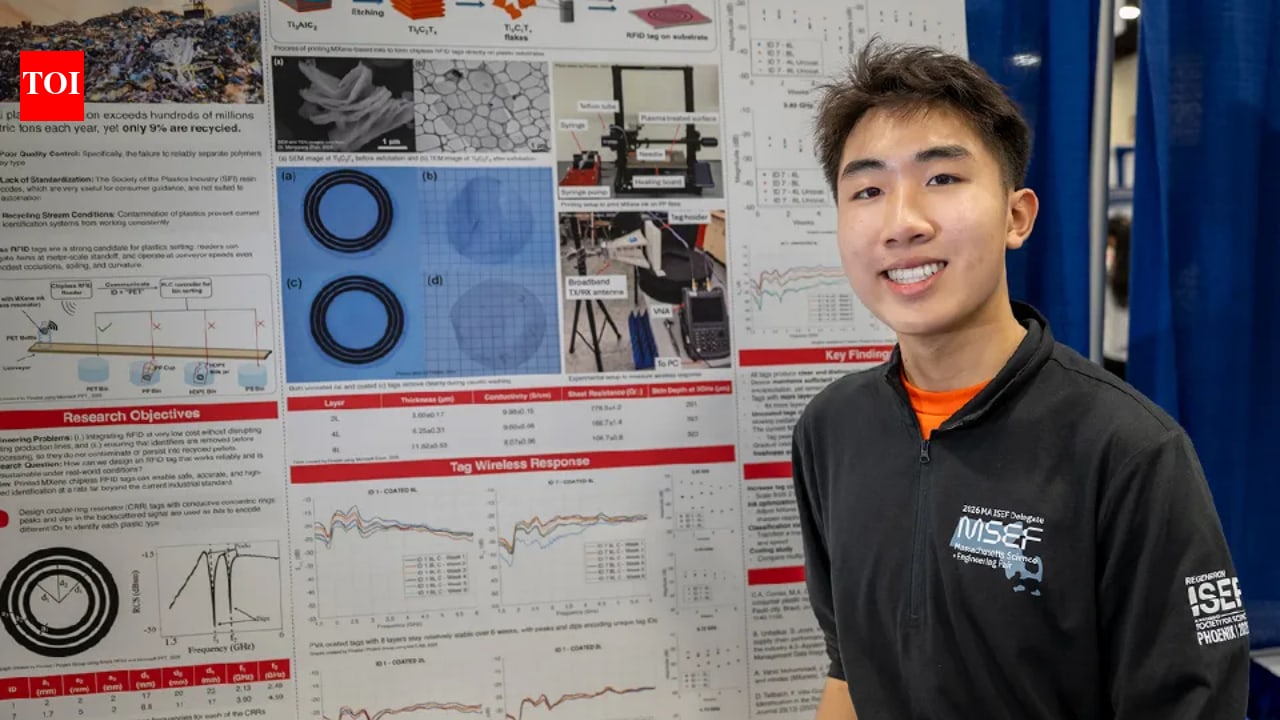
17-year-old innovator Kevin Sun has developed a dissolvable radio-frequency tag to improve plastic sorting in recycling. This technology ensures accurate classification without contaminating recycled materials, earning him the prestigious 2026 Craig R. Barrett Award.
Revolutionizing Recycling: The Breakthrough of Kevin Sun
In a significant advancement for environmental technology, 17-year-old Massachusetts student Kevin Sun has engineered a novel solution to one of the most persistent hurdles in the recycling industry: the precise identification and sorting of plastic polymers. His development of a dissolvable radio-frequency (RF) tag functions as a sophisticated wireless barcode, enabling automated systems to classify plastic types with unprecedented accuracy. This innovation addresses the systemic inefficiencies that currently plague global waste management infrastructures.
The Problem with Plastic Identification
Recycling efficacy is frequently undermined by the difficulty of distinguishing between various plastic types, such as PET, HDPE, and PVC, which often look identical but require different processing methods. Traditional labeling methods often fail or become detached, and permanent adhesives or plastic labels can introduce contaminants into the recycling stream. Sun’s approach shifts the paradigm by introducing a transient, intelligent tracking mechanism that bridges the gap between raw waste and high-quality recycled material.
Mechanism and Material Intelligence
What sets Sun’s invention apart is its 'dissolvable' nature. During the standard industrial hot washing cycle—a critical step in plastic reclamation—the tags disappear, ensuring that the final recycled product remains pure and free of electronic or adhesive interference. This solves the 'contamination' paradox, where the very labels used to track waste often degrade the quality of the raw material, ultimately making the recycled product less viable for high-end manufacturing.
Recognition and Future Implications
Sun’s project earned him the 2026 Craig R. Barrett Award for Innovation at the Regeneron International Science and Engineering Fair (ISEF), along with a $10,000 prize. This recognition underscores the growing importance of youth-led innovation in solving the climate crisis. By providing a scalable, cost-effective, and clean method for material identification, this technology has the potential to be integrated into existing supply chains, significantly increasing the yield of high-quality recycled plastics.
Broadening the Circular Economy
The implications of this technology extend far beyond a science fair project. As global regulations tighten regarding plastic waste and producers are held increasingly accountable for the end-of-life cycle of their packaging, innovations like Sun’s offer a viable pathway to a truly circular economy. By ensuring that plastic is correctly sorted the first time, we reduce the energy expenditure of recycling plants and increase the economic value of recovered materials, making sustainable practices more profitable and accessible globally.