The Kimi K3 Moment
Source Entity
Hacker News
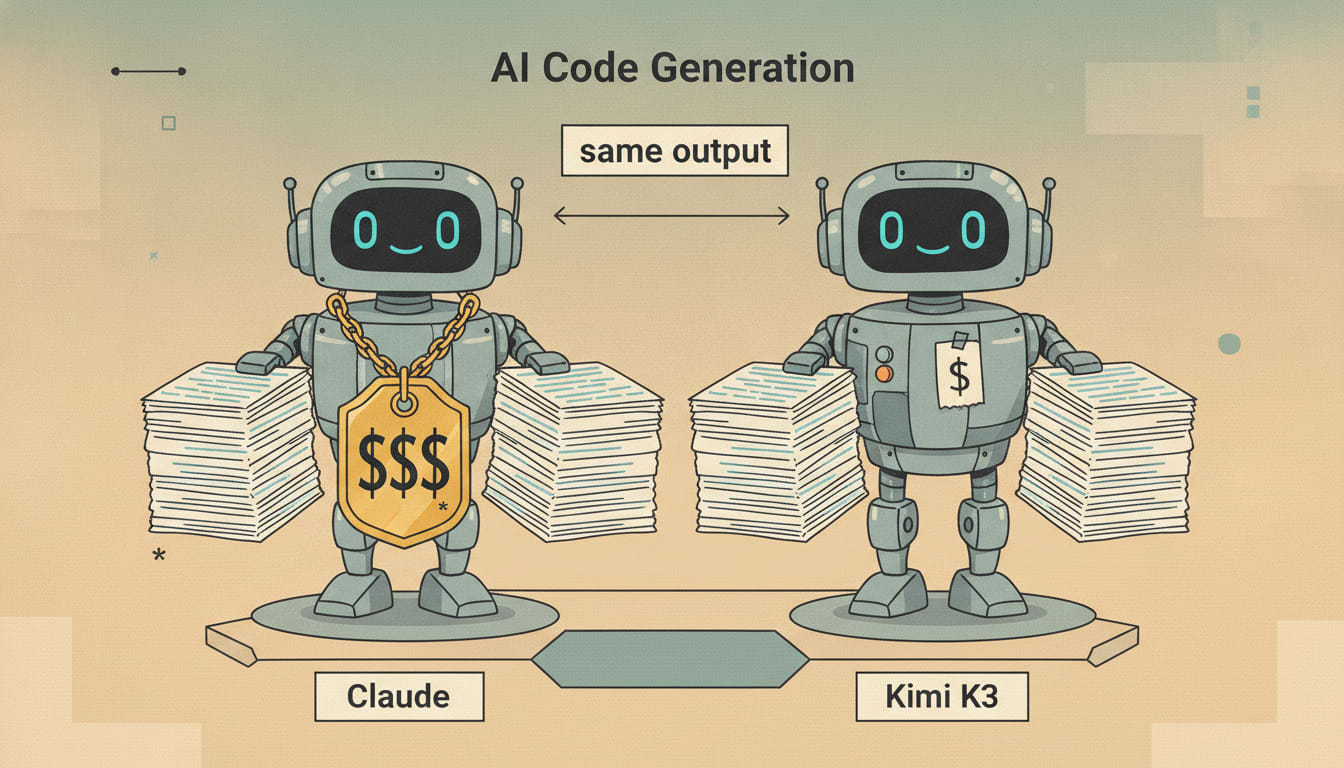
Kimi K3 is emerging as a highly competitive alternative to Claude for coding, offering comparable output quality and token efficiency. It significantly undercuts Claude on both API pricing and subscription costs, providing a more generous experience for developers.
The Kimi K3 Moment: A Shift in the AI Competitive Landscape
The emergence of the "Kimi K3 moment" represents a pivotal shift in the accessibility of high-tier artificial intelligence, specifically within the specialized domain of software development. For a long period, a handful of proprietary models, such as those from Anthropic (Claude), have maintained a perceived monopoly on high-quality coding logic and reasoning. However, recent user benchmarks indicate that Kimi K3 has achieved performance parity with these industry leaders, delivering identical output quality and utilizing similar token counts to resolve complex coding tasks. This suggests that the gap between elite proprietary models and more accessible alternatives is closing rapidly.
Technical Parity and Token Efficiency
One of the most critical findings in the comparison between Kimi K3 and Claude is the lack of a "performance tax" often associated with more affordable or open models. Typically, users expect a trade-off where a cheaper model might be "sloppier" or require significantly more tokens—and thus more processing time and cost—to reach the same logical conclusion as a premium model. The data indicates that Kimi K3 avoids this pitfall, matching Claude's precision and efficiency. In the context of coding, where token efficiency directly impacts latency and cost, this parity makes Kimi K3 a viable primary driver for professional development workflows.
The Economics of API Disruption
Beyond performance, the most striking divergence lies in the pricing architecture. Kimi K3's API pricing is aggressively positioned to disrupt the market, costing $3 per million input tokens and $15 per million output tokens. In stark contrast, Claude's top-tier model is priced at $10 per million input and $50 per million output. This represents a massive cost reduction for developers and enterprises; Kimi K3 is roughly one-third the price of its competitor. Such a price delta fundamentally alters the ROI calculations for companies integrating LLMs into their production pipelines, allowing for more extensive testing and deployment without the prohibitive overhead of premium APIs.
Subscription Accessibility and the Developer Experience
The disruption extends from the API level to the end-user subscription model. Kimi's entry-level paid plans start at $19 per month, while its specialized $39 coding tier is described as far more generous than Claude's offerings. This is particularly relevant for "agentic" workflows—where an AI operates autonomously over long periods to solve complex problems. Claude's plans are noted for being tightly metered, meaning a single day of intensive agent work can exhaust a user's allowance. By offering a more lenient quota, Kimi K3 removes the "metering anxiety" that often hinders the productivity of power users and professional coders.
Broader Implications for the AI Market
This development signals a broader trend toward the commoditization of high-level intelligence. When models of equal capability are available at vastly different price points, the "moat" for proprietary AI companies shifts from raw capability to ecosystem lock-in or brand loyalty. The fact that a more affordable model can match the quality of a top-tier proprietary one suggests that the industry is entering a phase where efficiency and pricing will become the primary battlegrounds, rather than just the pursuit of marginally better benchmarks.
Conclusion
In summary, Kimi K3 is positioning itself not just as a cheaper alternative, but as a functional equivalent to Claude in the coding space. By combining performance parity with a pricing strategy that is significantly more accessible—both in API costs and subscription limits—Kimi K3 is lowering the barrier to entry for high-end AI-assisted development. For the professional developer, this transition means more power and less financial friction, potentially accelerating the pace of software iteration across the industry.