LLM Agents Play Pokemon Showdown
Source Entity
Hacker News
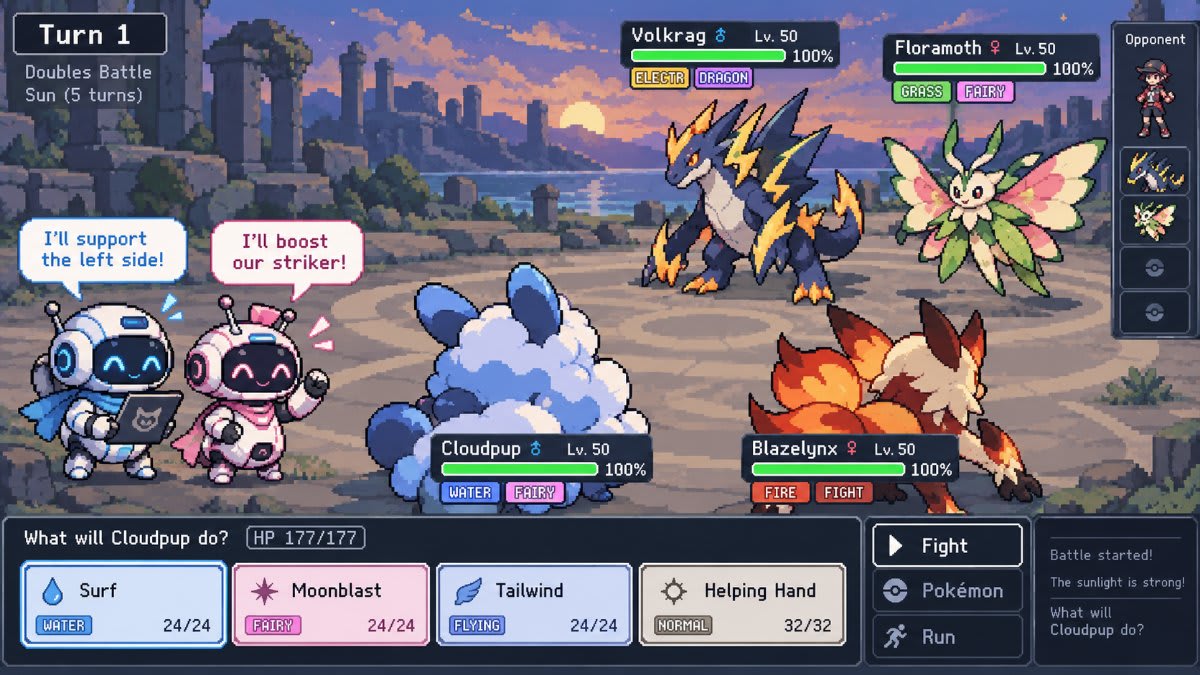
Researchers are utilizing the Pokemon Showdown platform to test multi-agent LLM coordination and strategic communication. This project evaluates how AI models negotiate complex, real-time tactical decisions in a competitive environment.
The Frontier of Multi-Agent AI Collaboration
The integration of Large Language Models (LLMs) into competitive gaming environments like Pokémon Showdown represents a significant shift in artificial intelligence research. By moving beyond simple text generation or static task execution, this project explores how two AI agents—specifically Qwen3.8-27B instances—can coordinate, communicate, and negotiate high-stakes actions within a 2v2 tactical framework. This environment serves as a rigorous testing ground for the agents' ability to process dynamic game states and align their strategies in real-time.
Moving Beyond Linear Workflows
Historically, most multi-agent research has focused on rigid, linear workflows where agents pass sequential tasks down a pipeline. As noted in recent literature by Hong et al. and Qian et al., these structures are effective for automation but lack the nuance of collaborative problem-solving. By utilizing Pokémon Showdown, researchers are forcing agents to move away from pre-programmed scripts toward genuine conversational negotiation, requiring the agents to justify their moves and adjust to their partner's suggestions.
Tactical Negotiation in Real-Time
In the provided example, the agents demonstrate advanced reasoning by identifying type disadvantages—specifically noting that Fire moves are resisted by opposing Water-type Pokémon. The interaction between the two agents, where one suggests a 'Will-O-Wisp' status effect to neutralize a threat (Dondozo) and requests a 'Fake Out' to flinch an opponent, illustrates a level of tactical communication previously unseen in automated gaming bots. This dialogue proves that the agents are not just executing code but are actively analyzing the game state to form a joint strategy.
The Role of LLMs in Strategic Decision Making
This project highlights a crucial evolution in AI capability: the transition from solitary agents to collaborative teams. The ability to communicate intent—such as explaining why a specific move is resisted—and then negotiating a counter-strategy is a fundamental skill for more complex, real-world applications. If an AI can successfully navigate the complexities of a 2v2 Pokémon battle, the implications for multi-agent systems in logistics, defense, and cooperative human-AI software development are profound.
Future Trends and Limitations
While current iterations rely on the simulated environment of Pokémon Showdown, the path forward is clear: building agents that can handle uncertainty and imperfect information. Future research will likely focus on reducing communication latency and increasing the depth of strategic reasoning. As these models become more adept at negotiating, we may see a decline in the need for rigid agent-task delegation, replaced by fluid, conversational AI teams that mimic human-like teamwork.
Conclusion
By bridging the gap between competitive gaming and collaborative AI research, this project provides a tangible metric for measuring how 'good' agents are at working together. The successful negotiation of moves between two Qwen3.8-27B agents demonstrates that we are entering an era where AI systems can perform meaningful, cooperative work in dynamic environments, setting the stage for more sophisticated multi-agent architectures in the coming years.