SCO must confront countries using terrorism as instrument of state policy: PM Modi
Source Entity
India Latest News: Top National Headlines Today & Breaking News | The Hindu
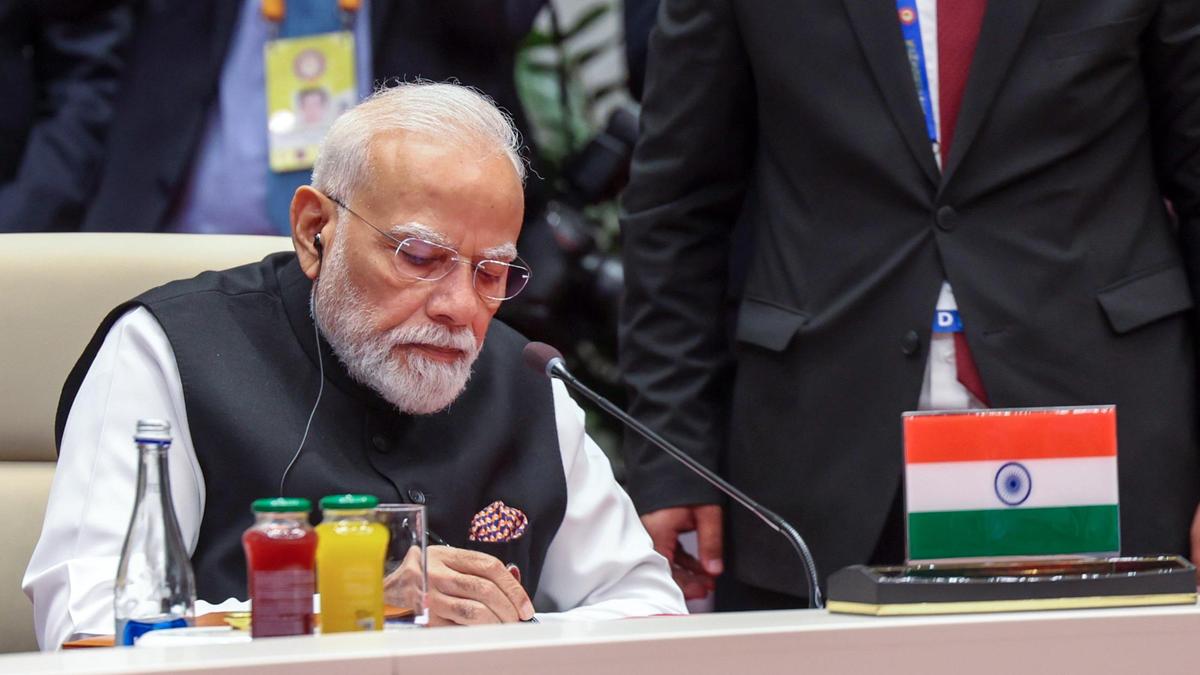
Prime Minister Narendra Modi has leveraged the SCO summit in Bishkek to advocate for global conflict resolution, urging both Russia and Iran to pursue peace. His diplomatic efforts focused on ending the Ukraine war and fostering regional maritime stability through enhanced economic collaboration with Tehran.
India’s Diplomatic Pivot: Advocating Peace at the SCO Summit
During the recent Shanghai Cooperation Organization (SCO) summit held in Bishkek, Prime Minister Narendra Modi engaged in a series of critical bilateral meetings that underscore India’s growing role as a pragmatic mediator in global affairs. By interacting with leaders from Russia and Iran, Modi has positioned India as a voice of stability, explicitly calling for a transition from "endless war" to a definitive cessation of hostilities in ongoing regional conflicts.
Engaging with Moscow on the Ukraine Conflict
PM Modi’s dialogue with Russian President Vladimir Putin serves as a continuation of his long-standing stance on the Russia-Ukraine war. Having previously declared that "this is not the era of war" in 2022 and emphasizing that solutions cannot be found "on the battlefield" during his July 2024 visit to Moscow, Modi’s latest appeal in Bishkek reiterates a consistent diplomatic trajectory. His assertion that "every day that the war continues, humanity takes a step backwards" highlights India's concern regarding the prolonged humanitarian and economic costs of the conflict.
Strengthening Ties with Tehran Amidst Sanctions
Simultaneously, the meeting with Iranian President Masoud Pezeshkian highlights the complexity of India’s foreign policy, which balances bilateral economic interests with international geopolitical constraints. Despite the looming threat of US sanctions, both leaders reaffirmed their commitment to expanding trade ties. A central pillar of this cooperation remains the Chabahar port, a strategic asset that India views as essential for enhancing connectivity and economic integration across Central Asia and the Middle East.
Prioritizing Maritime Security and Trade
Beyond economic development, the discussion between Modi and Pezeshkian emphasized the necessity of maritime freedom. The leaders acknowledged that the stability of trade routes is paramount for regional prosperity. Modi specifically highlighted that civilian infrastructure and commercial shipping must remain protected, reflecting India’s broader commitment to ensuring that global supply chains are shielded from the volatility of regional tensions.
The Strategic Rationale for Indian Mediation
President Pezeshkian’s request for India to mediate for peace signals a significant recognition of New Delhi’s unique diplomatic leverage. Because India maintains a policy of strategic autonomy—maintaining strong ties with diverse global powers—it is uniquely positioned to facilitate dialogue in spaces where other nations may be viewed with suspicion. By pushing for peace in West Asia and Europe, India is not merely acting as a bystander but is actively shaping the discourse toward de-escalation.
Future Implications and Conclusion
As the geopolitical landscape remains fraught with uncertainty, India’s focus on economic collaboration, such as the development of the Chabahar port, alongside its moral imperative for peace, suggests a future-oriented strategy. By prioritizing trade and stability over binary alignment, India seeks to insulate its national interests while contributing to global security. The outcomes of the Bishkek summit reflect a mature foreign policy that views economic connectivity as the strongest antidote to the cycles of conflict that currently define the international order.
Multiple Citing Sources
Verification Required?