Why were students seeking justice met with lathis, tear gas: Mallikarjun Kharge
Source Entity
Latest News: Today's Latest News Headlines from India & World | Hindustan Times | Hindustan Times
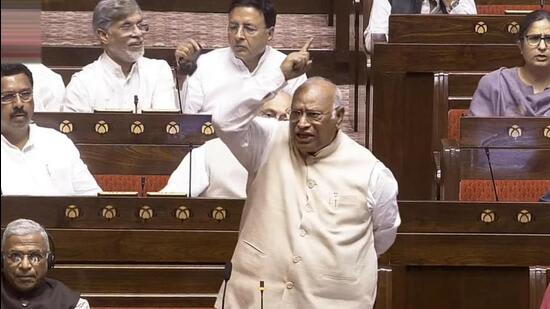
The Monsoon Session of Parliament saw a turbulent start as Opposition protests over the NEET paper leak and Ayodhya temple donation theft forced repeated adjournments. Simultaneously, massive street protests in Delhi led to police intervention as demonstrators demanded the resignation of the Education Minister.
A Turbulent Start: Monsoon Session Gridlock
The Monsoon Session of India’s Parliament commenced on July 20, 2026, under a cloud of intense political confrontation. The first day was effectively washed out as the Opposition, including the Congress, Samajwadi Party, and Trinamool Congress, disrupted proceedings in both the Lok Sabha and Rajya Sabha. The primary drivers of this unrest were allegations surrounding the NEET paper leak—a matter of significant national concern—and claims regarding the theft of donations at the Ayodhya Ram Temple. These protests highlight a deep-seated friction between the legislative agenda and the Opposition's demand for accountability.
Street Protests and Security Escalation
Beyond the walls of Parliament, the heart of Lutyens’s Delhi witnessed chaotic scenes. An estimated 50,000 protesters, led by the Cockroach Janta Party (CJP), attempted to march toward the Parliament complex. The sheer scale of the mobilization, which involved clashes across major arteries like Ashoka Road and Raisina Road, forced security forces to deploy lathicharges, tear gas, and water cannons. This external pressure directly mirrored the parliamentary disruptions, as demonstrators demanded the immediate resignation of Union Education Minister Dharmendra Pradhan, citing systemic failures in examination integrity.
Legislative Stagnation vs. Urgent Business
Despite the frequent adjournments—totaling six in the Lok Sabha alone—a critical piece of legislation was introduced. Union Law Minister Arjun Ram Meghwal tabled a Bill aimed at replacing an Ordinance that increases the total strength of Supreme Court judges from 34 to 38. This move signifies the government's intent to address judicial pendency even amidst political hostility. However, the inability of the House to conduct substantive debate on this bill suggests that legislative productivity will remain a significant challenge throughout this session.
The Fragmentation of the Opposition
While the Opposition presented a united front on issues like the NEET scandal, the political landscape remains nuanced. Notably, the DMK chose to diverge from the Congress-led strategy, focusing instead on the specific regional issue of the Mekedatu project. Simultaneously, internal parliamentary dynamics, such as the re-seating of rebel Trinamool Congress MPs, added a layer of complexity to the floor management. These fissures suggest that while the Opposition is capable of causing disruptions, a cohesive long-term strategy remains elusive.
Broader Implications and Future Trends
The convergence of mass street protests and parliamentary gridlock points to an increasingly volatile political climate. The NEET controversy, in particular, touches upon the future of millions of students, making it an emotive issue that the government will struggle to ignore. As the session progresses, the government will likely face continued pressure to balance its legislative agenda—such as judicial expansion—with the growing demand for transparency in public examinations. If the current trend of daily washouts continues, the session may conclude with little more than the bare minimum of legislative work completed, further deepening the divide between the ruling coalition and the Opposition.
Multiple Citing Sources
Verification Required?