Nagaland inks deal for first private-sector solar plant
Source Entity
India Latest News: Top National Headlines Today & Breaking News | The Hindu
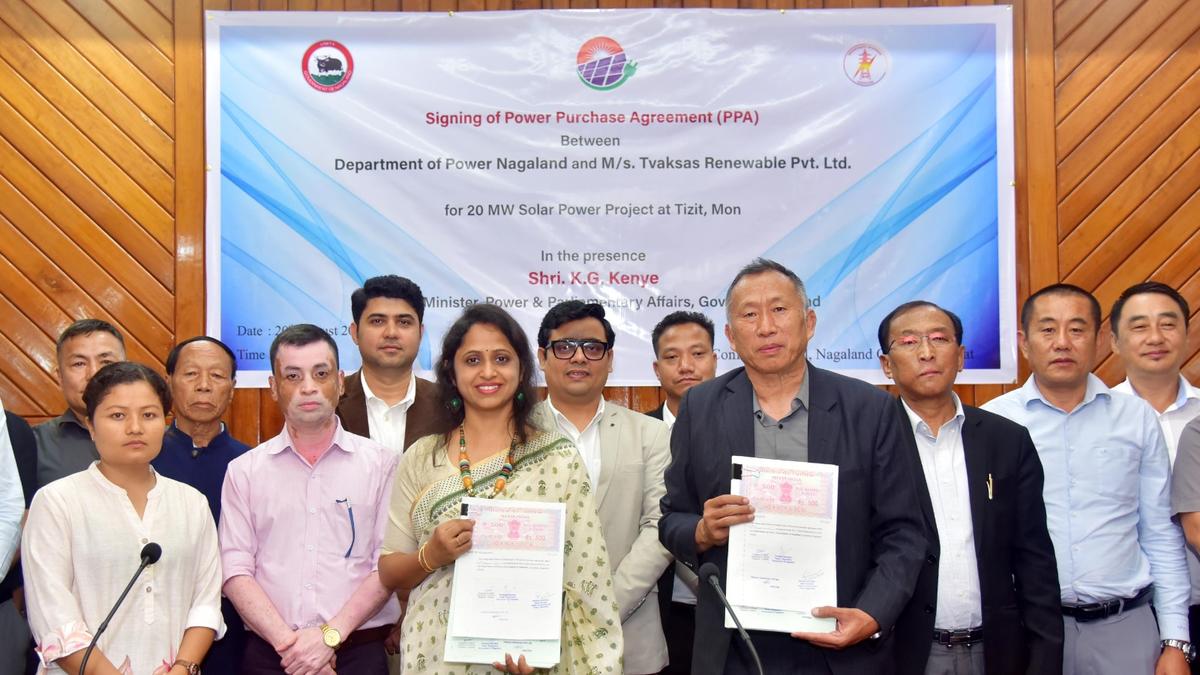
The Nagaland government has signed a landmark agreement with Tvaksas Renewable Private Limited to establish the state's first private-sector 20MW solar plant in Tizit. This project aims to enhance renewable energy capacity and reduce reliance on energy imports over a 25-year period.
A Renewable Milestone for Nagaland
On August 21, 2026, the government of Nagaland marked a significant shift in its energy infrastructure strategy by signing a power purchase agreement (PPA) with Pune-based Tvaksas Renewable Private Limited. This agreement paves the way for the construction of a 20-megawatt (MW) solar power plant situated at Lapa Lampong village in the Tizit area of Mon district. As the state’s first private-sector solar venture, this initiative represents a critical departure from traditional energy procurement models, signaling a commitment to modernization and sustainability.
Strategic Energy Independence
The fundamental objective of this project is to address Nagaland’s heavy dependence on imported power. By generating electricity locally through solar photovoltaic technology, the state can significantly bolster its renewable energy generation capacity. This shift is not merely an environmental preference but a strategic necessity, allowing Nagaland to meet its mandated renewable consumption obligations while stabilizing the local grid. Reducing energy imports provides the state with greater autonomy over its power supply, insulating it from external market fluctuations and transmission inefficiencies.
Economic and Technical Framework
The agreement is structured as a 25-year commitment, underscoring a long-term partnership between the state and the private sector. According to Bhakti Dave, director of Tvaksas Renewable Private Limited, the project is slated for commissioning within 20 months. A key component of this arrangement is the fixed tariff of ₹4.12 per kWh, which has been formally approved by the Nagaland Electricity Regulatory Commission (NERC). This fixed-rate structure provides budgetary predictability for the state government, ensuring that the transition to green energy remains fiscally sustainable.
Scaling for the Future
While the initial phase focuses on a 20MW capacity, the developers have outlined an ambitious roadmap to scale the facility up to 100MW in subsequent phases. This modular approach allows for infrastructure testing and gradual integration into the existing state grid. The promise of long-term investment is expected to catalyze local economic development, potentially creating jobs and fostering technical skill sets within the Mon district, which has historically lacked large-scale renewable energy industrialization.
Conclusion and Broader Implications
This solar project serves as a pilot model for how Northeast India can leverage its natural resources to participate in the national green energy transition. By successfully attracting private investment into the power sector, Nagaland is positioning itself as an emerging player in India’s renewable energy landscape. If the project reaches its 100MW goal, it will likely serve as a blueprint for future public-private partnerships across the region, proving that even geographically challenging terrains can become hubs for sustainable and cost-effective energy production.
Verification Required?