40 years ago October 16, 1986: PM on Pakistani military
Source Entity
The Indian Express
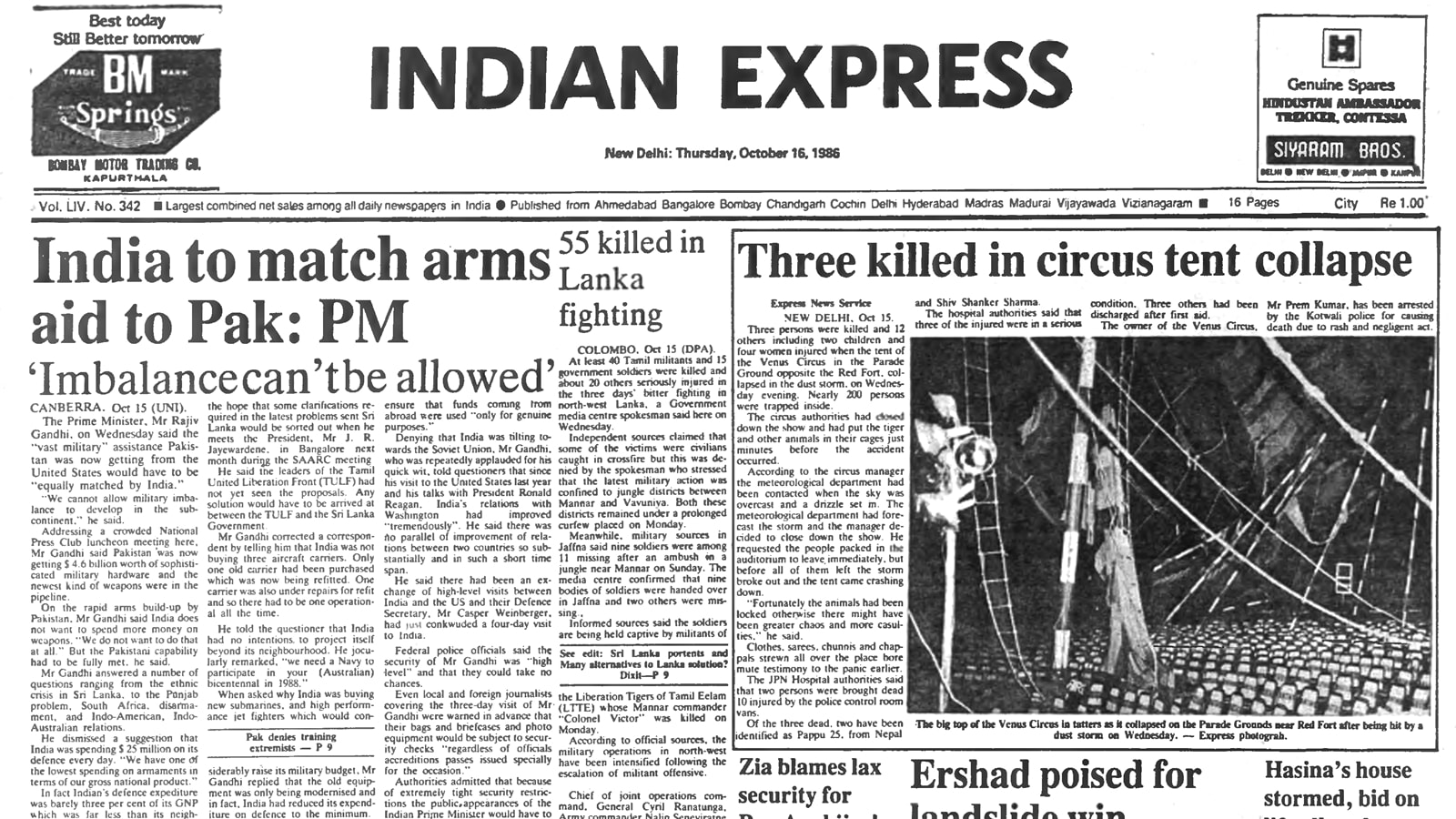
In October 1986, Prime Minister Rajiv Gandhi warned that U.S. military aid to Pakistan necessitated a matching Indian response to maintain regional stability. Meanwhile, intensifying conflict in Sri Lanka resulted in 55 deaths, highlighting the volatile geopolitical landscape of South Asia during that era.
Regional Instability: The 1986 Geopolitical Crucible
The Indo-Pakistani Arms Equilibrium
On October 16, 1986, Prime Minister Rajiv Gandhi addressed the international community in Canberra, issuing a stern warning regarding the shifting balance of power in South Asia. Gandhi identified a direct threat to regional stability stemming from the influx of $4.6 billion in sophisticated military hardware provided to Pakistan by the United States. His declaration that India would have to "equally match" this military assistance underscored a fundamental pillar of Indian foreign policy: the prevention of a military imbalance that could embolden aggressive posturing or destabilize the Subcontinent.
Historical Context of the Cold War Proxy Dynamics
The mid-1980s were characterized by the twilight of the Cold War, where South Asia served as a critical theater for superpower competition. The U.S. commitment to arming Pakistan was largely a strategic response to the Soviet occupation of Afghanistan. However, for New Delhi, these arms shipments were viewed through the lens of local security imperatives. Rajiv Gandhi’s insistence on maintaining an equilibrium was not merely rhetoric; it reflected the deep-seated anxiety that Western-supplied technology would be diverted to enhance Pakistan's conventional military capabilities against India rather than solely for the intended anti-Soviet operations.
The Escalation in Sri Lanka
Simultaneously, the regional security landscape was further complicated by the internal strife in Sri Lanka. Reports from October 1986 confirmed that 55 individuals—including 40 Tamil militants and 15 government soldiers—had perished in three days of intense combat in the island's northwest. This conflict represented the brutal reality of the Sri Lankan Civil War, where the government in Colombo struggled to contain separatist forces in the jungle districts. The death toll served as a grim indicator of the human cost of these entrenched ethnic and political divisions.
Challenges of Verification and Civilian Impact
During the 1986 hostilities in Sri Lanka, the discrepancy between official government reports and independent accounts highlighted the difficulty of monitoring such conflicts. While the government media center in Colombo asserted that military actions were strictly confined to combatants, independent observers reported that civilians were caught in the crossfire. This friction between state-sanctioned narratives and on-the-ground realities remains a recurring theme in the history of the Sri Lankan conflict, reflecting the broader challenges of humanitarian reporting during periods of intense military engagement.
Concluding Perspectives on Regional Trends
Looking back at these events, it is clear that 1986 was a year of profound volatility for South Asia. The dual pressures of a burgeoning arms race between India and Pakistan and the escalating civil war in Sri Lanka created a precarious environment. Rajiv Gandhi’s assertive stance on military parity and the tragic loss of life in the Sri Lankan jungle underscored a period where regional leaders were forced to navigate complex external influences and internal insurgencies. These incidents remain essential for understanding the historical trajectory of South Asian security policies and the enduring nature of regional conflicts.