Aerial footage shows derailed train
Source Entity
BBC News
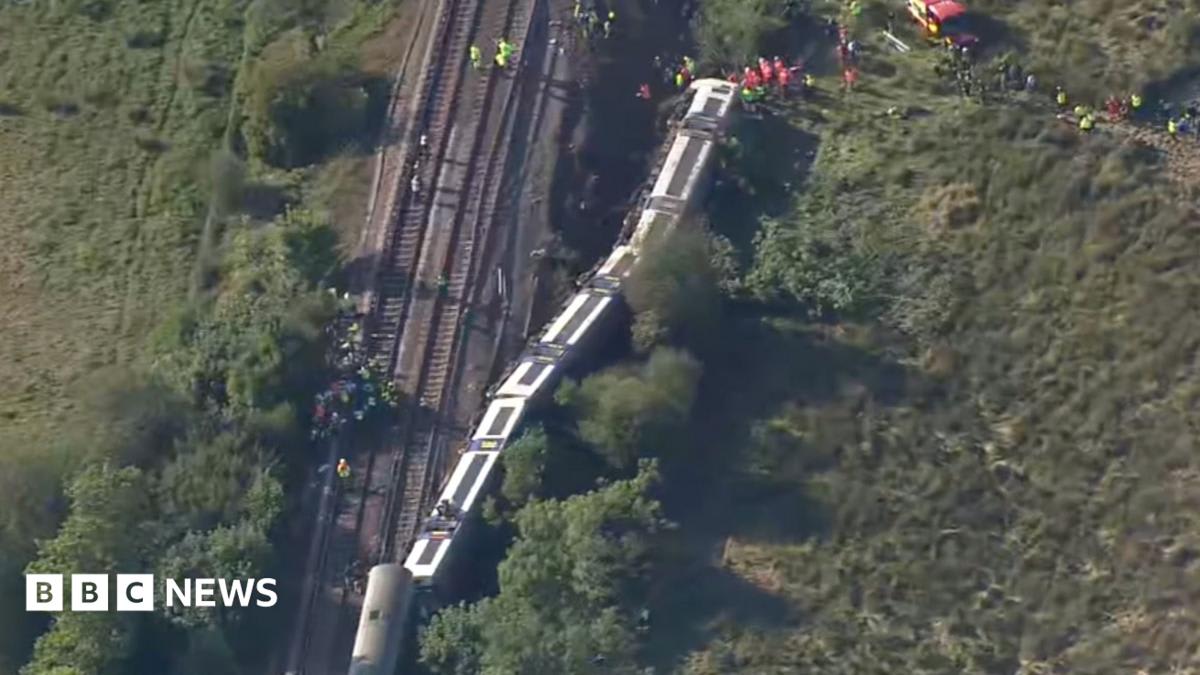
A Southern Rail passenger train traveling from London to Eastbourne derailed near Lewes, resulting in 11 injuries. Emergency services are currently on-site attending to passengers after three carriages overturned.
Train Derailment in East Sussex: An Overview
A significant rail incident occurred on Thursday when a Southern Rail passenger train traveling from London Victoria to Eastbourne derailed near the town of Lewes in East Sussex. The accident involved a train carrying approximately 150 passengers, leading to a major emergency response operation. According to the British Transport Police, three carriages overturned during the incident, leaving them lying on their side in a field adjacent to the tracks.
Impact and Emergency Response
The immediate aftermath of the derailment prompted a rapid mobilization of local emergency services. Firefighters and paramedics were deployed to the scene, where footage captured them attending to passengers in the fields surrounding the crash site. The British Transport Police have confirmed that 11 individuals sustained injuries; while nine suffered minor injuries, two passengers are reported to have been seriously injured, necessitating urgent medical attention.
Passenger Accounts of the Incident
First-hand accounts provide a harrowing perspective on the moments leading up to the derailment. Passenger Rob Bradley, who was traveling with his six-year-old daughter, described a sudden and violent change in the train's movement. According to Bradley, the train began to rock significantly as it increased speed before the carriage jumped upward, triggering an immediate engagement of the emergency brakes. The force of the sudden stop sent personal belongings flying, highlighting the intensity of the deceleration.
Broader Implications for Rail Safety
This incident near Lewes raises critical questions regarding the safety protocols and infrastructure maintenance of the Southern Rail network. Derailments of this nature, especially those resulting in overturned carriages, trigger rigorous investigations by the Rail Accident Investigation Branch (RAIB). These investigations typically analyze track integrity, mechanical failure, and potential human error to prevent future recurrences, as the safety of high-density commuter lines remains a priority for the UK Department for Transport.
Future Trends and Safety Investigations
Moving forward, the focus will shift toward the forensic analysis of the train’s black box and the track conditions at the site of the crash. As the UK continues to modernize its aging rail infrastructure, incidents like this serve as a stark reminder of the risks inherent in heavy rail transit. Future developments will likely involve enhanced safety monitoring systems and more stringent speed limit enforcement in areas known for sharp curves or complex signaling, ensuring that the rail network remains a reliable and safe mode of transport for the thousands of daily commuters traveling between London and the southern coast.
Multiple Citing Sources