No Easy Fix for Bogus Respondents in Online Opt-In Polls
Source Entity
Hacker News
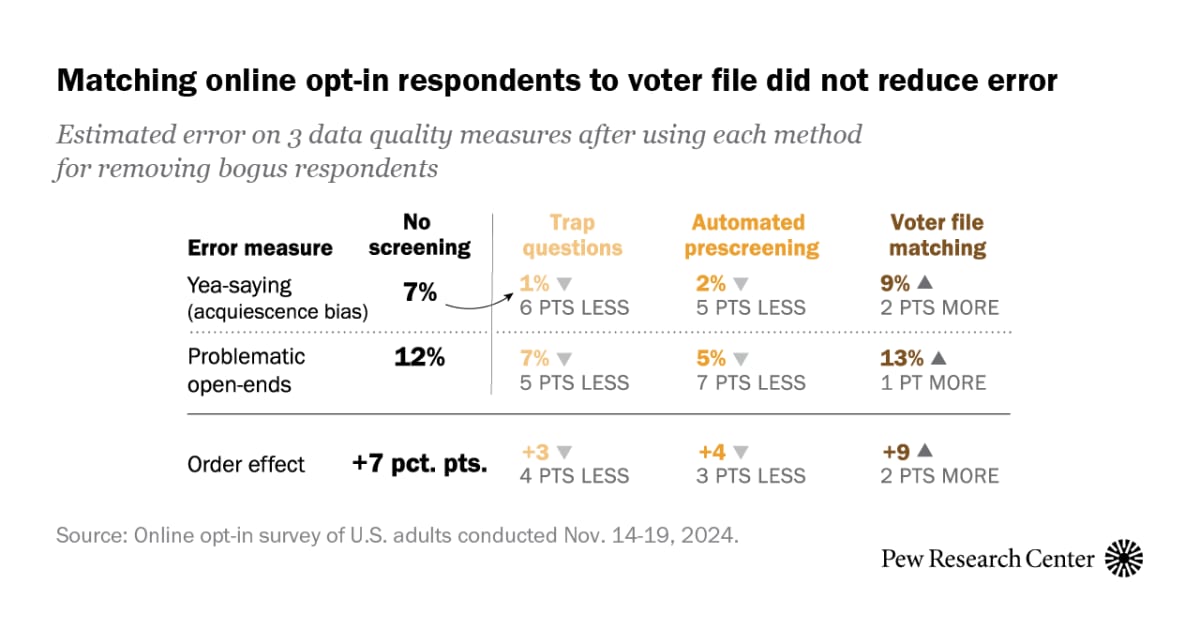
Pew Research Center has released a study evaluating methods to detect and remove bogus respondents from online opt-in polls. The research compares trap questions, proprietary prescreening systems, and voter file matching to improve data integrity.
The Crisis of Data Integrity in Modern Polling
The digital age has revolutionized how public opinion is gathered, but it has simultaneously introduced significant vulnerabilities to the polling industry. The recent study by the Pew Research Center highlights a critical challenge: the proliferation of 'bogus respondents' in online opt-in surveys. These individuals, often bots or bad actors, pose a severe threat to the validity of sociological and political data, potentially skewing results that influence decision-makers, media narratives, and public discourse. Understanding the mechanics of this interference is essential for maintaining the credibility of survey-based research.
Evaluating Detection Methodologies
To combat this, the research investigates three distinct strategies for data cleansing. The first method involves the use of 'trap questions' or 'attention checks,' which are designed to catch respondents who are not reading questions carefully. The second approach utilizes the Sentry prescreening system, a proprietary tool developed by CloudResearch that aims to filter out inauthentic participants before they enter the survey environment. The third method, which offers a high degree of verification, involves cross-referencing respondents against a national voter file to ensure they are real, eligible, and unique individuals.
The Necessity of Methodological Rigor
Why does this matter? Pew Research Center’s commitment to high-quality research is predicated on the idea that accurate data is a public good. When the polling industry faces technical threats, the public’s ability to understand complex societal topics is diminished. By testing these specific methodologies, researchers are not just optimizing their own workflows; they are establishing a baseline for best practices across the entire industry. This is a vital step in ensuring that opt-in surveys remain a viable tool for understanding public sentiment in an era of digital manipulation.
Broader Implications for Research Standards
The findings from this study are likely to influence how future surveys are constructed and analyzed. As the gap between legitimate and bogus respondents narrows due to more sophisticated automation, the reliance on single-method detection is becoming obsolete. The study suggests a transition toward multi-layered security protocols. By integrating behavioral checks like Sentry with identity-based verification like voter file matching, polling organizations can significantly reduce the 'noise' in their datasets, leading to more reliable and actionable insights.
Future Trends in Survey Methodology
Looking ahead, the industry will likely see a move toward more stringent identity verification requirements for online participants. As AI-driven bots become more adept at passing basic trap questions, the value of 'ground truth' data—such as voter registration records—will likely increase. This research serves as a bellwether for the future of the industry, signaling that the 'easy fix' is a myth. Instead, the path forward requires a persistent, evolving, and technologically robust approach to ensuring that every respondent in an opt-in poll is a genuine participant.