Image of Our Satellite-Choked Night Skies
Source Entity
Hacker News
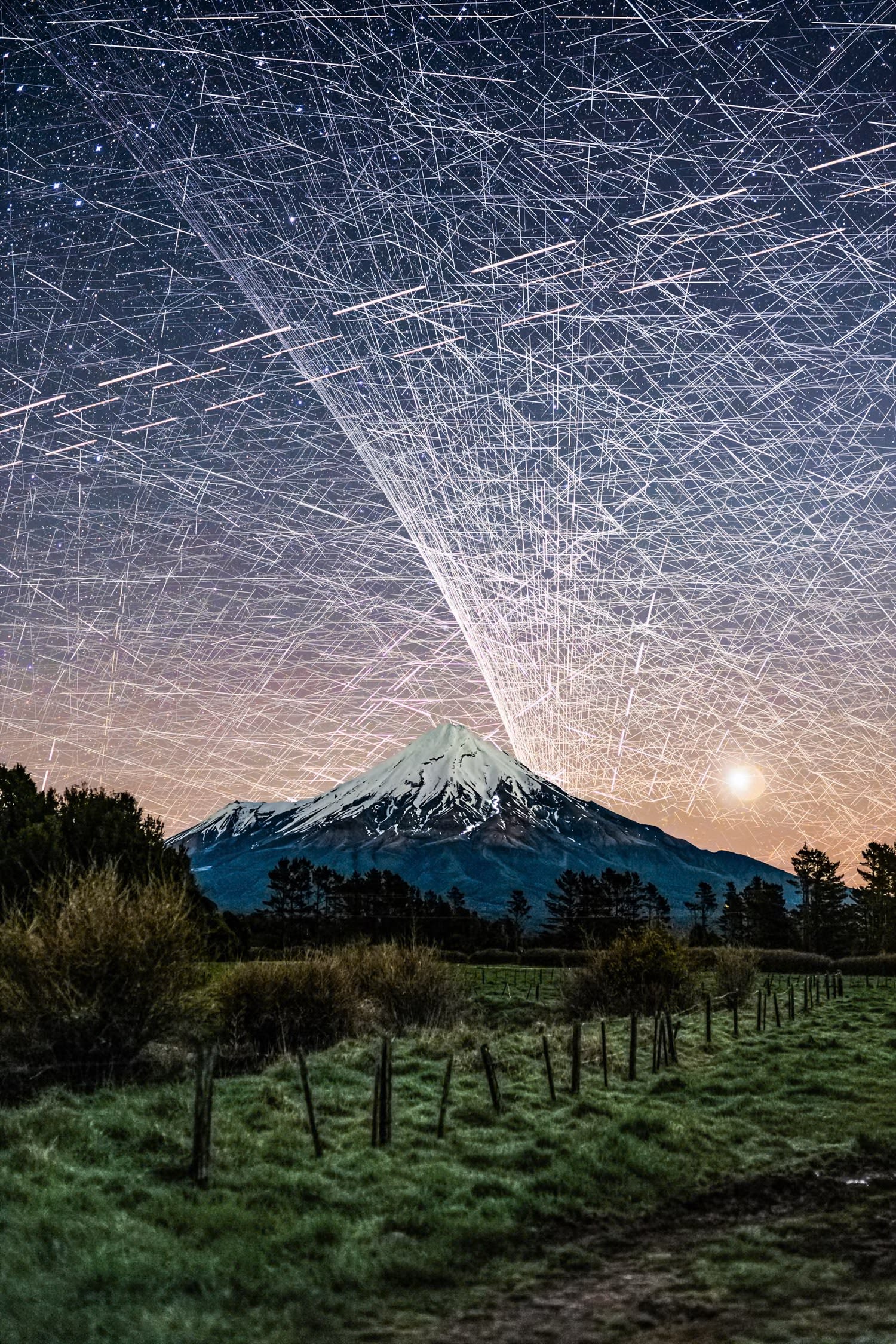
Photographer Brendan Larsen created a viral composite image of the night sky over Mt. Taranaki, revealing thousands of satellite trails. The project required over 45 hours of manual editing to process nearly 600 individual photographs.
The Visual Evidence of Orbital Congestion
Photographer Brendan Larsen’s recent project has provided a striking visual representation of the rapidly changing nature of our night sky. By capturing 578 individual photographs over a two-hour window above Mt. Taranaki, Larsen created a composite image that highlights an often-invisible consequence of the modern space age: the proliferation of low Earth orbit (LEO) satellites. The sheer volume of streaks captured in this image—representing an estimated 14,450 satellite trail appearances—serves as a tangible record of the increasing density of objects orbiting our planet.
A Labor-Intensive Process
Contrary to speculation from online observers who often dismiss complex modern imagery as the product of generative artificial intelligence, Larsen’s work is a testament to traditional manual labor. The process involved capturing eight-second exposures with a two-second interval between shots, followed by a staggering 45 hours of manual masking. By painstakingly stitching these 578 images together, Larsen ensured that the final output was an accurate, observational record rather than a synthetic hallucination, grounding the image firmly in the reality of current space debris and active satellite constellations.
The Proliferation of LEO Constellations
This photographic evidence underscores the broader shift in space utilization. Over the past decade, the deployment of massive satellite constellations has revolutionized global communications, yet it has simultaneously transformed the astronomical landscape. These satellites, which are essential for high-speed internet and global connectivity, reflect sunlight back toward Earth, creating persistent streaks that interfere with long-exposure astrophotography and professional ground-based observatories. Larsen’s image provides a rare, high-resolution look at the cumulative effect of these thousands of individual satellites on a single frame.
Scientific and Cultural Implications
Beyond the aesthetic impact, the image raises significant questions regarding the long-term sustainability of the night sky. Astronomers have long voiced concerns about the "crowding" of orbit, which complicates the study of distant galaxies and deep-space phenomena. As more companies and nations launch satellite arrays to expand digital infrastructure, the baseline of "dark skies" is being fundamentally altered. Larsen’s work acts as a cultural bridge, moving the conversation about space traffic management from technical white papers into the public consciousness.
The Future of Night Sky Observation
Looking forward, this project highlights a growing tension between technological advancement and the preservation of the natural environment. As the number of satellites in LEO continues to climb, photographers and researchers alike will face increasing challenges in filtering out artificial interference. Larsen’s success in documenting this phenomenon suggests that while the night sky is becoming more "cluttered," it also provides a unique opportunity for citizen scientists and artists to monitor the health of our orbital environment through systematic, long-term observational photography.