What happens when quantum mechanics and relativity meet?
Source Entity
Jacek Krywko
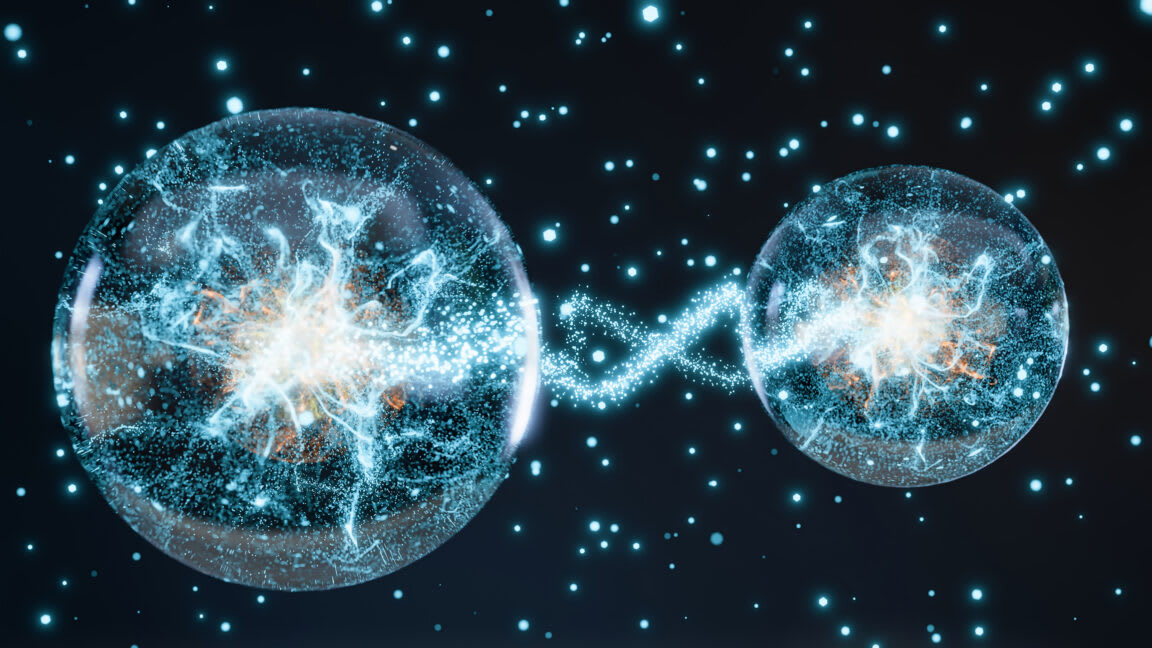
Researchers have developed a novel interferometer to test the intersection of quantum mechanics and general relativity. By placing atoms in a superposition of free-fall and stationary states, the team aims to resolve long-standing theoretical contradictions regarding gravity.
Bridging the Quantum-Relativity Divide
For nearly a century, the fundamental incompatibility between quantum mechanics—the physics of the very small—and Albert Einstein’s general relativity—the physics of gravity and the cosmos—has remained the most significant hurdle in modern theoretical physics. While quantum mechanics describes the behavior of subatomic particles through probability waves, general relativity defines gravity as the curvature of spacetime. When these two frameworks are applied to the same phenomenon, such as an object in free fall, the mathematical results often diverge, leading to a long-standing impasse in our understanding of the universe.
The Challenge of Experimental Verification
The difficulty in resolving this conflict has historically been technological rather than theoretical. Physicists have long posited that a quantum wave in free fall should behave in a specific, predictable manner; however, measuring this behavior requires extreme precision. Until now, no interferometer possessed the sensitivity or architectural capability to observe these quantum effects at a macroscopic or semi-macroscopic scale without introducing environmental interference that would collapse the fragile quantum state.
A Breakthrough in Interferometry
A collaborative team led by Ron Folman of Ben-Gurion University of the Negev, including Nobel laureate Roger Penrose, has achieved a milestone by constructing an interferometer capable of putting a single atom into a superposition of two distinct trajectories. By forcing the atom to exist simultaneously in a state of free fall and a state of being held perfectly still, the researchers have created a controlled environment to test how gravity interacts with quantum wave functions. This dual-path experiment is designed to isolate the gravitational effect on the atom's phase, providing a direct metric to compare against century-old predictions.
Implications for Fundamental Physics
If the experimental data aligns with traditional quantum theory, it reinforces our current understanding of how gravity influences quantum systems. Conversely, if the results deviate from these predictions, it could provide the first empirical evidence that Einstein’s theory of gravity and quantum mechanics require a radical reconciliation. Such a finding would be transformative, potentially acting as the "smoking gun" for a unified theory of quantum gravity, a goal that has eluded physicists for generations.
Future Trajectories in Quantum Research
The success of this experimental design marks a significant shift in how we approach the study of gravity at the atomic level. By moving away from theoretical speculation and toward high-precision measurement, the team has opened a new frontier in experimental physics. Future iterations of this interferometer could be scaled to test larger particles, potentially unveiling the threshold where quantum effects give way to classical gravitational behavior, thereby mapping the transition between the two regimes.
Conclusive Summary
This experiment represents a monumental effort to bridge the gap between two pillars of modern science. By utilizing superposition to force a confrontation between quantum mechanics and general relativity, the team led by Folman and Penrose has provided a vital tool for testing the limits of our physical laws. Whether the results confirm established theories or necessitate a new paradigm, the ability to measure these interactions marks a definitive step toward a more cohesive understanding of the universe.