40 years ago September 3, 1986: PM for immediate sanctions
Source Entity
The Indian Express
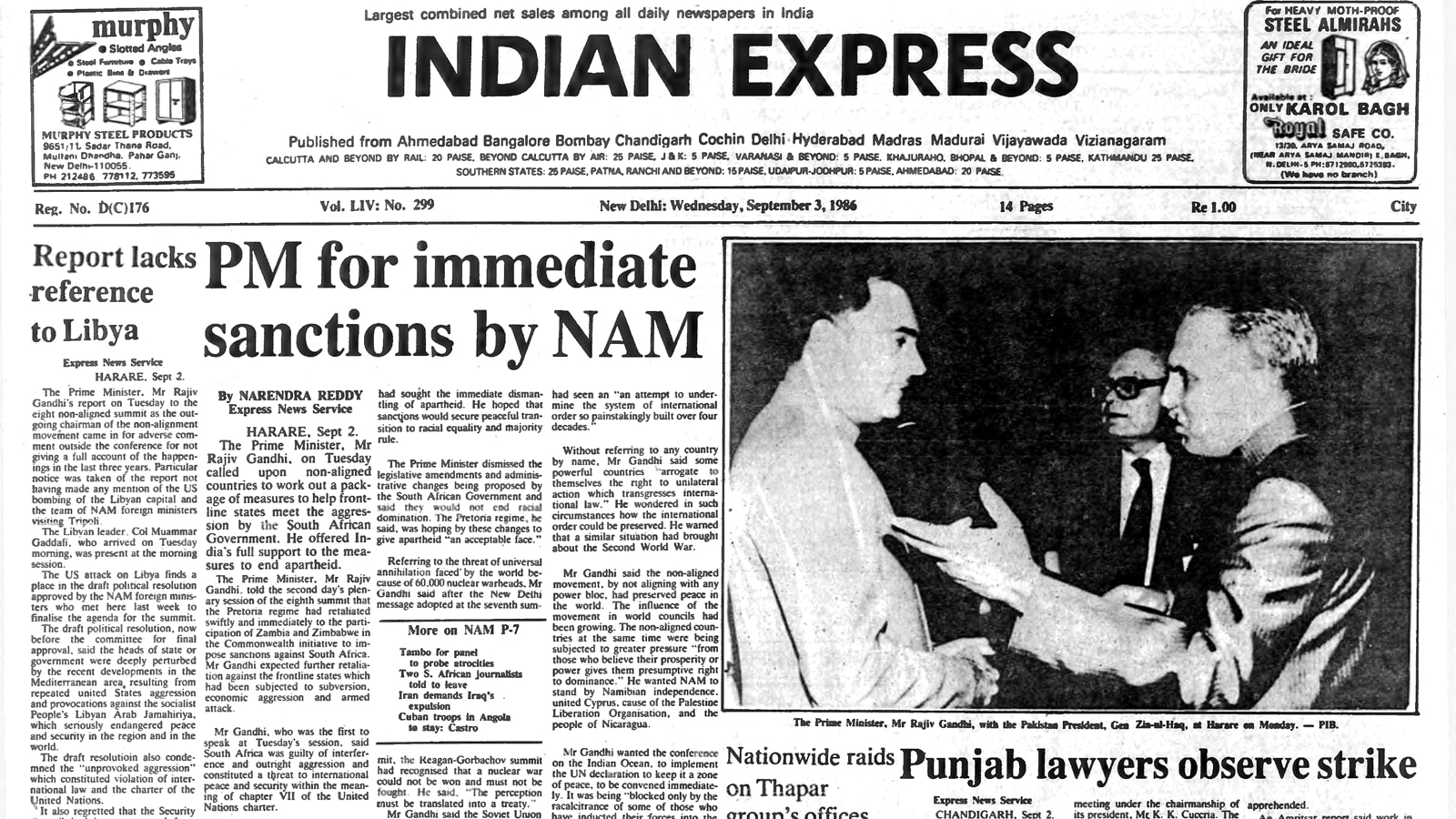
In 1986, Prime Minister Rajiv Gandhi urged non-aligned nations to impose sanctions against South Africa's apartheid regime. His tenure as NAM chairman faced criticism for omitting key geopolitical events, while Delhi saw local unrest leading to the cancellation of a transport scheme.
The 1986 Non-Aligned Movement and Global Geopolitics
On September 3, 1986, Prime Minister Rajiv Gandhi, serving as the outgoing chairman of the Non-Aligned Movement (NAM), issued a definitive call for collective action against the South African apartheid regime. Gandhi urged fellow non-aligned nations to construct a robust package of sanctions, explicitly aiming to bolster 'frontline states'—the nations bordering South Africa that were bearing the brunt of the apartheid government's regional military aggression. This stance reinforced India’s long-standing moral and diplomatic commitment to the anti-apartheid movement, a cornerstone of Indian foreign policy since independence.
Challenges to NAM Leadership
Despite the moral clarity regarding South Africa, Gandhi’s leadership of the movement faced intense scrutiny. Critics outside the 1986 summit argued that his official report failed to provide a comprehensive account of global developments during his three-year tenure. The omission of the 1986 United States bombing of Tripoli—and the subsequent diplomatic mission by NAM foreign ministers to Libya—was highlighted as a significant oversight. This criticism underscored the difficulty of maintaining a unified, coherent narrative within a diverse coalition of nations often pulled in opposing geopolitical directions.
The Complexity of Non-Alignment
Historically, the Non-Aligned Movement sought to provide a 'third way' for developing nations, avoiding the binary traps of the Cold War. However, as evidenced by the 1986 summit, the movement struggled to address specific acts of aggression by superpowers. The tension between the need for neutrality and the desire to condemn specific acts of violence, such as the bombing of Libya, created internal friction that tested the efficacy of the organization’s leadership.
Domestic Unrest in Delhi
While the Prime Minister navigated complex international waters, his administration faced localized challenges at home. The Delhi Transport Corporation (DTC) was forced to scrap a proposed scheme following fierce, violent resistance from residents in trans-Jamuna colonies. This incident serves as a historical reminder of the disconnect that can occur between urban planning policies and the immediate, practical needs—or perceptions—of local communities.
Legacy and Future Implications
Reflecting on these events 40 years later, we see the dual pressures that defined the mid-1980s: the global push for human rights, exemplified by the fight against apartheid, and the domestic challenges of urban governance. Rajiv Gandhi's dual focus on international solidarity and domestic policy illustrates the perpetual balancing act required of a leader in a developing democracy. While the NAM eventually saw the end of apartheid, the criticisms leveled against the 1986 report highlight the evolving requirements for transparency and accountability in international diplomacy.