Allan Little: I met dangerously fanatical Mladić early in Bosnian war
Source Entity
BBC News
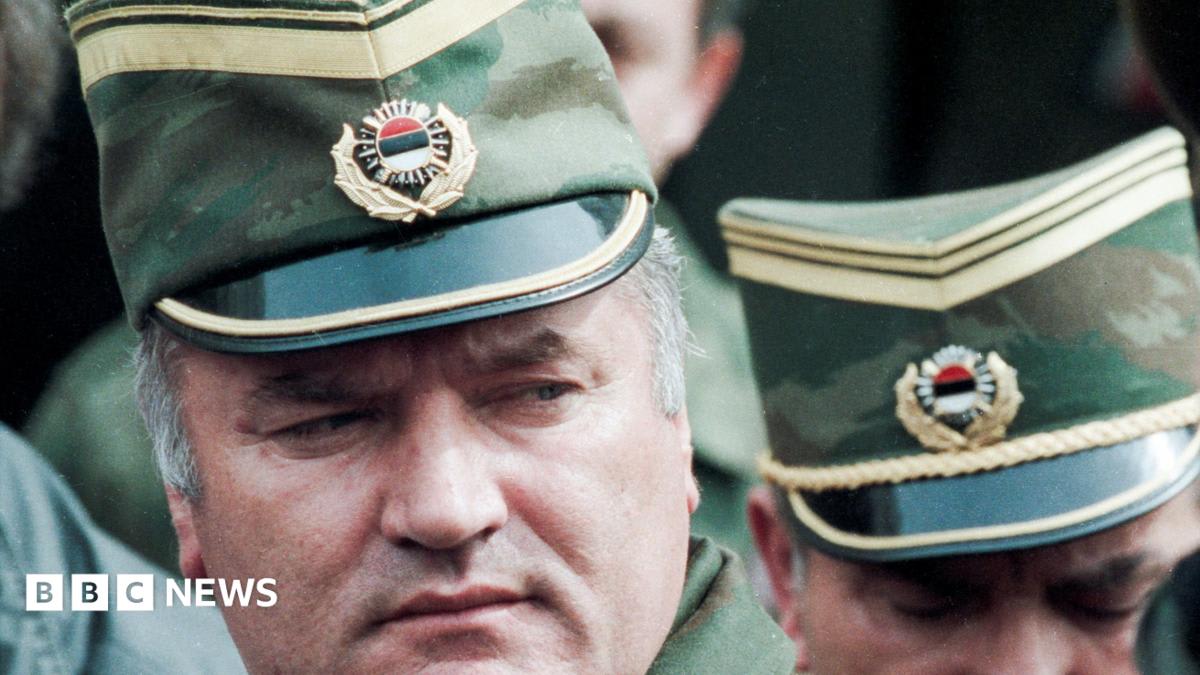
Ratko Mladić, the former Bosnian Serb commander convicted of genocide and war crimes, has died in a UN prison at age 84. His death marks the end of a controversial chapter in international justice following his role in the 1990s Bosnian conflict.
The Death of Ratko Mladić: Closing a Dark Chapter
Ratko Mladić, the former Bosnian Serb commander infamously known as the "Butcher of Bosnia," has died at the age of 84 while serving a life sentence in a UN prison facility at The Hague. His death, confirmed by UN officials, marks the finality of a legal process that spanned decades and addressed some of the most harrowing atrocities witnessed in post-World War II Europe. Mladić had been receiving palliative care within the prison hospital, and his passing follows a rejected bid for early release in May, where the court acknowledged his "dire" health but maintained the integrity of his life sentence.
A Legacy of Conflict and Atrocity
As the Commander of the Bosnian Serb army during the splintering of Yugoslavia in the early 1990s, Mladić orchestrated a brutal campaign of "ethnic cleansing." This term served as a euphemism for the systematic massacre of tens of thousands of civilians. His pursuit of a "Greater Serbia" led to the bloodiest period in European history since the Third Reich, characterized by a single-minded determination that resulted in widespread devastation. Mladić’s rhetoric—which often painted Muslim neighbors as existential threats—fueled the fanaticism that sustained his military campaigns.
The Siege of Srebrenica and International Justice
Central to his conviction was his role in the 1995 massacre in Srebrenica, where at least 8,000 Muslims were killed in a designated UN "safe area." This event remains the worst atrocity on European soil since World War II. Following the conclusion of the Bosnian war, Mladić evaded capture for 16 years, eventually being apprehended in rural Serbia in 2011. His subsequent trial at The Hague resulted in a life sentence in 2017 for genocide, war crimes, and crimes against humanity, a verdict that was definitively upheld on appeal in 2021.
Challenges of Memory and Accountability
Reactions to his death underscore the deep divisions that persist in the Balkans. For survivors and families of victims, such as those represented by the Srebrenica Memorial, Mladić’s death does not equate to reconciliation. As noted by Emir Suljagic, the head of the Srebrenica Memorial, the death of the perpetrator does not clear mass graves nor does it alter the historical judgment of his actions. The focus now shifts toward the ongoing struggle to ensure that the truth and the memory of the victims are not lost with the passing of the man who orchestrated their suffering.
The Broader Implications for Global Tribunals
The life and death of Ratko Mladić serve as a definitive case study for the efficacy and limitations of international criminal law. By holding high-ranking military officials accountable for genocide, the UN tribunal at The Hague established a significant legal precedent. However, the lengthy duration between the crimes, the 16-year manhunt, and the decades-long legal proceedings highlight the procedural difficulties in achieving justice for mass atrocities.
Conclusion
Ultimately, the death of Ratko Mladić brings a formal end to the legal proceedings against one of the key architects of the Bosnian war. While the judicial process has concluded with his death in custody, the historical burden of his actions remains. The legacy of the 1992-1995 conflict continues to shape the geopolitical landscape of the Balkans, and the international community remains tasked with the heavy responsibility of ensuring that the historical record of these atrocities remains intact for future generations.