Rising non-accruals signal growing risk in private credit
Source Entity
Yahoo Finance
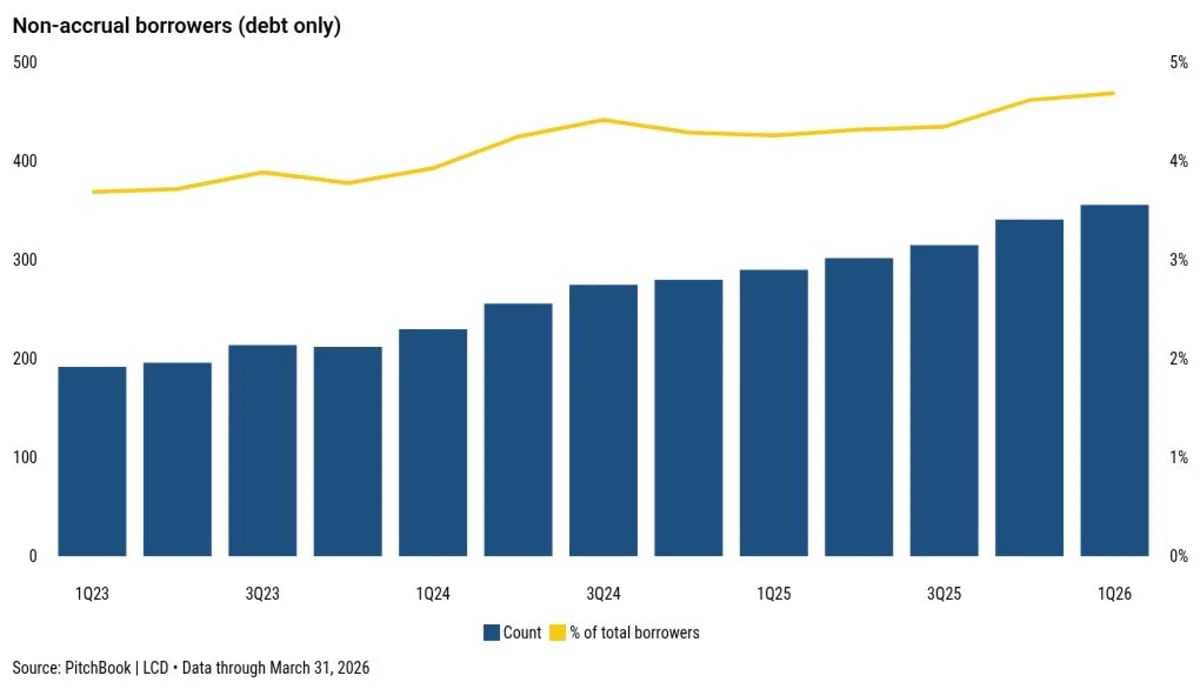
Non-accrual rates in private credit are rising, with the number of defaulting borrowers increasing to 101. Data from top BDCs shows a concerning trend of higher exposure to non-performing debt despite overall portfolio contraction.
The Growing Shadow in Private Credit
Recent data highlights a concerning upward trend in non-accrual status among private credit borrowers, signaling potential systemic stress within the sector. As of the second quarter, the number of distinct borrowers holding at least one tranche in non-accrual status has climbed to 101, marking a quarterly increase of 11. This shift is not merely statistical noise; it represents an underlying degradation in credit quality that warrants close observation by market participants and regulators alike.
Quantifying the Exposure Risk
The financial implications of these non-accruals are significant when viewed through the lens of total debt exposure. For borrowers with at least one non-accrual tranche, the total exposure at cost reached $5.0 billion. This accounts for 5.95% of total debt, a notable rise of 54 basis points from the preceding quarter. This increase suggests that lenders are facing greater difficulty in recovering interest payments, a trend that often precedes more severe default scenarios and asset write-downs.
Trends Among Leading BDCs
The top ten Business Development Companies (BDCs) are not immune to these pressures. Debt tranches in non-accrual status at these institutions rose to 3.95% of total debt at cost, reflecting a 20 basis point increase quarter-over-quarter. Interestingly, this rise in non-accrual balances occurred in tandem with a 2.3% contraction in the overall debt portfolio, which now sits at $83.6 billion. The fact that non-accruals increased even as the total portfolio shrank—by $89 million to $3.3 billion—indicates a tightening of credit conditions and a potential "flight to quality" that is failing to mask the deterioration of existing loan books.
Broader Market Implications
Historically, private credit has been touted for its resilience and ability to provide yield in a low-interest-rate environment. However, the current data suggests that the sector is hitting a pressure point. As borrowers face higher costs of capital and slowing economic growth, the ability to service debt becomes strained. The rise in non-accruals among BDCs is a leading indicator of broader corporate credit health, potentially signaling that the "easy money" era of private lending is experiencing a necessary, albeit painful, correction.
Future Outlook and Strategic Considerations
Looking ahead, the trajectory of these non-accrual rates will likely depend on macroeconomic factors, including interest rate stability and the ability of borrowers to refinance their debt. Investors in BDCs should prepare for a period of increased volatility and potentially lower dividend yields as credit losses are recognized. The contraction in the overall debt portfolio suggests that lenders are becoming more selective, which may help stabilize the sector in the long term but will likely lead to restricted credit availability for mid-market firms in the short term. The coming quarters will be critical in determining whether this is a temporary blip or the start of a sustained period of credit distress.