Continuation funds drive record H1 for secondary market
Source Entity
Yahoo Finance
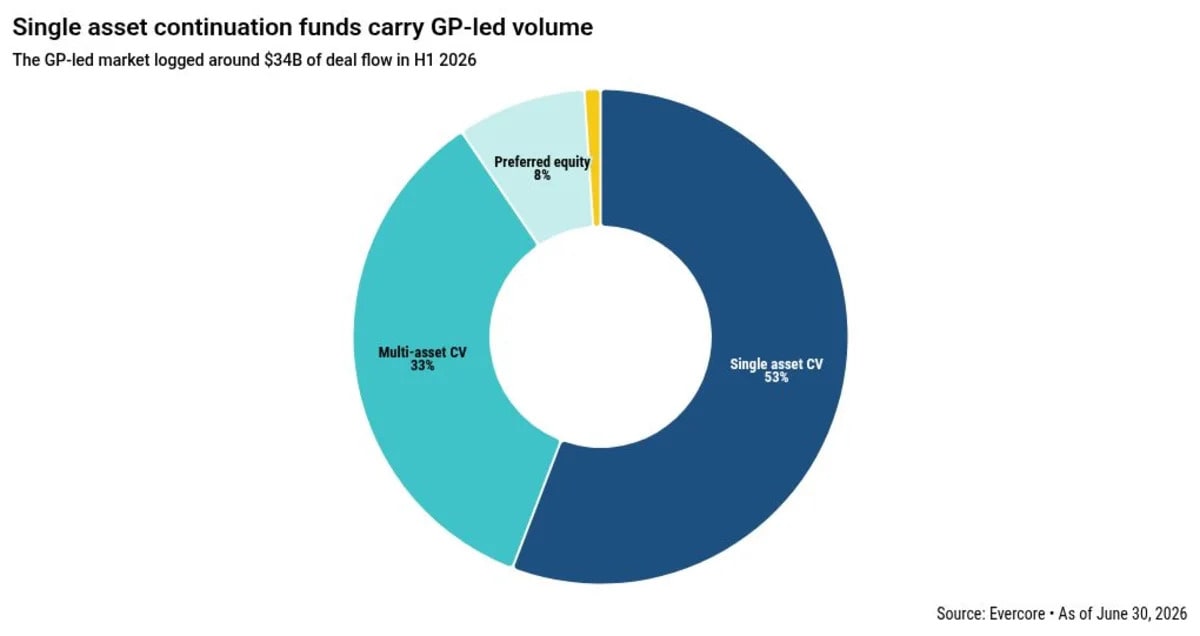
The secondary private equity market hit a record $120 billion in H1 2026, driven by a surge in GP-led single-asset continuation funds. This shift marks a strategic pivot for sponsors seeking to extend holding periods for high-performing assets while providing liquidity to investors.
The Rise of Secondary Market Dominance in 2026
The private equity landscape witnessed a historic milestone in the first half of 2026, as secondary market deal volume shattered previous benchmarks by surpassing $120 billion. According to data provided by Evercore, this represents a significant 20% increase over the record-breaking figures observed in H1 2025. This surge underscores a maturing secondary market that is increasingly vital to the liquidity and operational strategy of global private equity sponsors.
The Shift Toward GP-Led Transactions
At the core of this growth is a structural shift in how transactions are executed. GP-led transactions now account for 53.7% of the total deal volume, marking a definitive departure from the historical dominance of LP-led secondary deals. In the past, the secondary market was primarily a tool for Limited Partners (LPs) to exit positions in private funds, often due to liquidity needs or portfolio rebalancing. The current trend highlights that General Partners (GPs) are now the primary drivers of market activity.
Why Continuation Funds are Thriving
Sponsors are increasingly utilizing single-asset continuation funds to solve two distinct challenges: the need to generate distributions for existing investors and the desire to retain high-quality, or 'trophy,' assets. By moving a specific asset into a new vehicle, GPs can reset the clock on their investment horizon, allowing more time to maximize the value of a company that may still have significant growth potential. This mechanism serves as a bridge for investors who want liquidity while offering others the chance to maintain exposure to high-performing businesses.
Strategic Implications for Private Equity
This trend toward continuation funds reflects a broader adaptation to the current macroeconomic environment. As traditional exit avenues like IPOs or strategic M&A may face timing constraints, sponsors are looking inward to manage their portfolios. By offloading assets into secondary vehicles, GPs provide a controlled environment for value creation, effectively bypassing the volatility associated with public market exits. This evolution suggests that secondary vehicles have transitioned from a niche liquidity tool to a core component of the modern PE toolkit.
Future Trends and Market Outlook
Looking forward, the reliance on GP-led secondary deals is likely to persist as sponsors become more comfortable with the structure. The ability to hold onto 'trophy' assets for longer durations while keeping investors satisfied is a powerful incentive that will likely keep deal volumes elevated. As intermediaries like Evercore continue to facilitate these complex transactions, the secondary market will likely become even more sophisticated, potentially drawing in a wider array of institutional capital looking for exposure to proven, mature assets.
Conclusion
The 2026 record of $120 billion in secondary deal volume is more than just a statistical high; it is a signal of the maturation of the private equity asset class. By prioritizing GP-led continuation funds, the industry is demonstrating a refined approach to asset management that balances the need for investor liquidity with the strategic imperative of long-term value realization.