Spain sees widespread disruption in first general strike for 14 years
Source Entity
BBC News
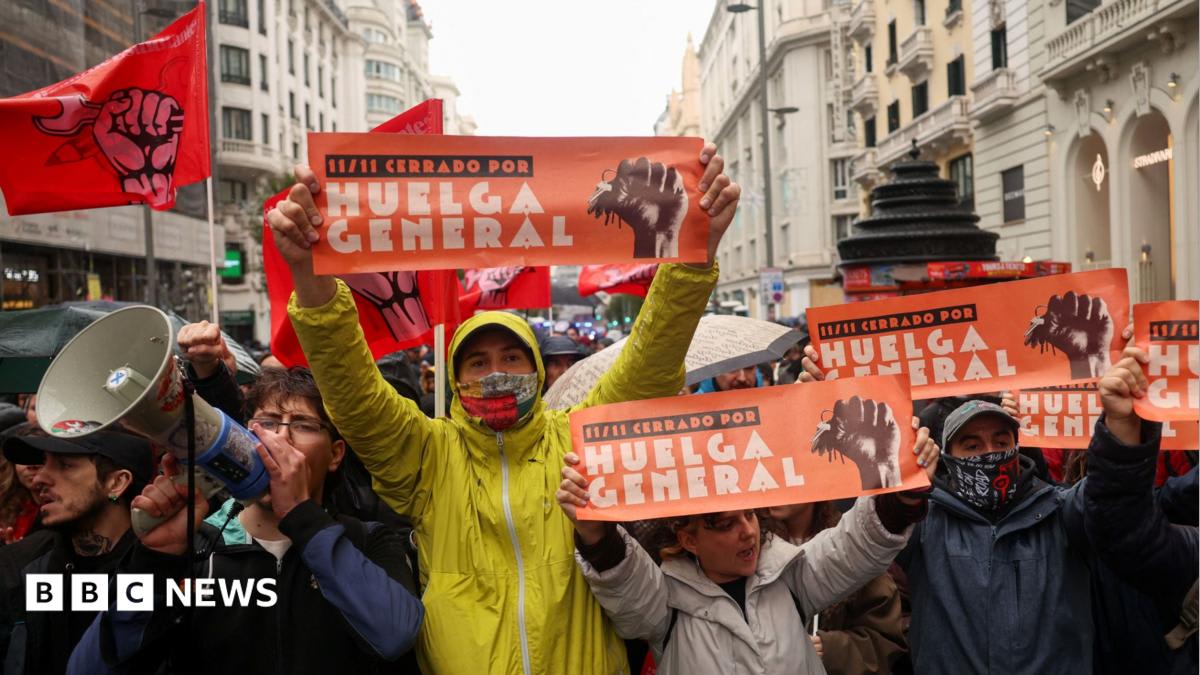
Spain is experiencing its first general strike in 14 years, led by major trade unions protesting the housing and cost-of-living crises. The unrest follows a failed legislative attempt by Prime Minister Pedro Sánchez, who has since called for snap elections on November 29.
Spain Faces Historic General Strike Over Housing Crisis
Spain is currently gripped by its first general strike in 14 years, a significant labor action that has paralyzed public services and industrial hubs across the nation. Organized by the country’s two primary trade unions, the Unión General de Trabajadores (UGT) and Comisiones Obreras (CCOO), the 24-hour national strike serves as a visceral response to a deepening socioeconomic crisis defined by surging housing costs and a broader cost-of-living struggle.
The Catalyst: Eviction and Legislative Failure
The roots of this widespread unrest can be traced back to September, when the eviction of 87-year-old Maricarmen Abascal—a resident of Madrid for seven decades—ignited public fury. This event acted as a tipping point, crystallizing public anger over housing insecurity. The situation was further exacerbated when Prime Minister Pedro Sánchez’s left-wing minority coalition failed to secure the necessary support to pass emergency housing legislation, forcing a political stalemate that ultimately led to the announcement of a snap general election scheduled for November 29.
Escalation and Public Disorder
The strike has manifested in both organized labor demonstrations and pockets of intense civil unrest. In major urban centers, particularly Madrid and Barcelona, tens of thousands of citizens have taken to the streets. While union leaders like Pepe Álvarez and Unai Sordo have lauded the participation as "massive" and "very significant," the Spanish Confederation of Business Organisations has offered a conflicting assessment, characterizing the impact as "low and uneven." Regardless of the internal dispute over scale, the physical reality in cities like Barcelona has been volatile, with reports of smashed shop windows, burning debris, and police utilizing tear gas to disperse crowds.
Political Implications Ahead of the Election
With the national vote only weeks away, the strike serves as a powerful political barometer. The timing of the labor action suggests that the electorate is demanding immediate, systemic changes to the housing market that neither the incumbent administration nor the opposition has successfully addressed. The clash between protesters and riot police in areas like the Chamartin EMT bus garage underscores the high-stakes environment in which the upcoming parliamentary election will be contested.
Future Trends and Economic Outlook
Looking forward, the success or failure of this strike will likely dictate the tone of the upcoming campaign trail. If the government cannot stabilize the housing market or address the inflationary pressures impacting the average Spaniard, the political landscape may shift toward more radical policy alternatives. The current disruption to transport and public services is a warning sign of deeper systemic instability that will require more than temporary measures to resolve. As the nation approaches the November 29 polls, the intersection of labor power and voter frustration will be the definitive factor in the future of Spanish governance.
Multiple Citing Sources