The Stock Market Is Repeating a Pattern Not Seen in Decades. Here's What History Says Comes Next.
Source Entity
Yahoo Finance
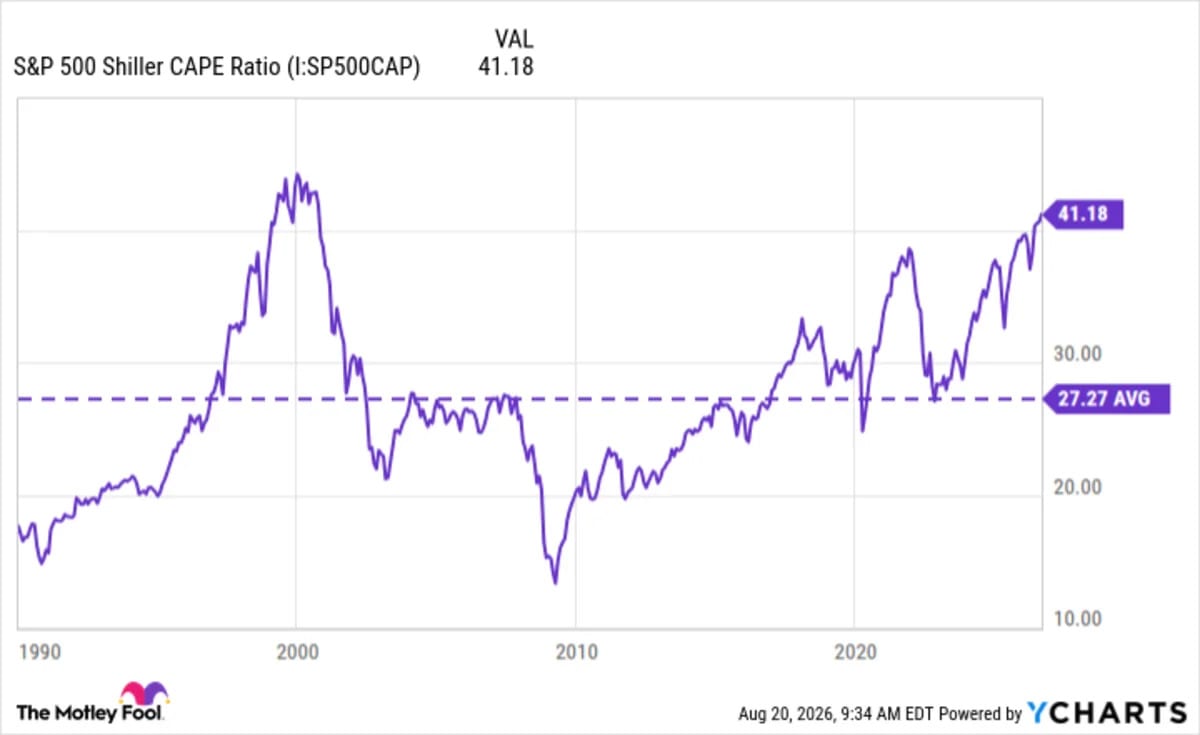
Current stock market valuations, measured by the CAPE ratio, have reached levels not seen since the 1999 dot-com bubble. Analysts warn that these stretched valuations indicate a period of significant risk for investors.
The Return of Historic Market Valuations
The financial markets are currently navigating an era of valuation expansion that has not been witnessed in over two and a half decades. As historical patterns suggest, the stock market often moves in cycles, and the current environment is characterized by a rarity not seen since the peak of the late 1990s. This development has sparked intense debate among analysts regarding the sustainability of equity prices relative to corporate earnings.
Understanding the CAPE Ratio
To quantify this phenomenon, market experts frequently utilize the Shiller price-to-earnings (P/E) ratio, also referred to as the cyclically adjusted P/E ratio (CAPE ratio). This metric provides a smoothed perspective on valuations by accounting for inflation and long-term earnings cycles. Currently, the CAPE ratio has climbed to 42.2, a figure that serves as a stark reminder of the market's current intensity, trailing only the historic peak of 44.2 recorded during the dot-com bubble in November 1999.
Historical Parallels and Potential Risks
Comparing the current market landscape to the 1999 bubble provides critical context for modern investors. The dot-com era was defined by rapid speculation and high-growth expectations that eventually faced a severe correction. By reaching a CAPE ratio of 42.2, the S&P 500 is signaling that investors are paying a premium for future earnings that is historically unprecedented outside of that specific period of market exuberance.
The 'Straw That Breaks the Camel's Back'
Beyond the mathematical metrics, there is a growing sentiment among market observers that valuations have become increasingly stretched. The metaphor of the 'straw that breaks the camel’s back' suggests that the market is in a fragile state where even minor macroeconomic shifts or unforeseen negative catalysts could trigger a significant repricing. When valuations are this elevated, the margin for error for corporations and the broader economy narrows significantly.
Future Trends and Investor Outlook
Looking ahead, the combination of high CAPE ratios and stretched valuations suggests that market participants should exercise heightened caution. While historical signals—such as those observed in 2009—can sometimes lead to 'double down' opportunities, the current environment is fundamentally different due to the sheer scale of the valuation premium. The market is currently testing the limits of investor sentiment, and history cautions that such periods of extreme pricing are rarely sustained indefinitely without a period of adjustment.