'Terrorist' or 'victims of terrorism'? Iran's Pezeshkian takes Trump head-on at UNGA
Source Entity
ABHISHEK MISHRA
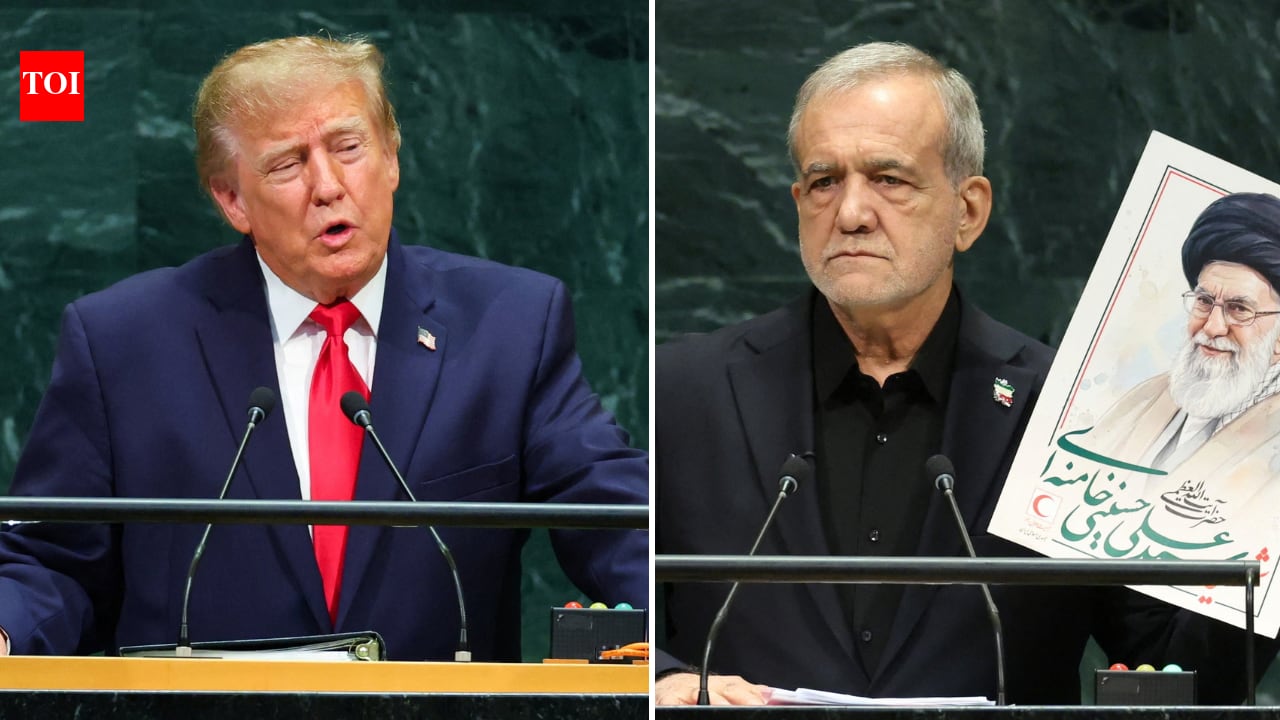
At the UNGA, President Trump presented a binary choice for Iran: a diplomatic deal or total annihilation. This rhetoric highlights his administration's dual-track strategy of military posturing and negotiated settlement.
The Binary of Diplomacy and Destruction: Trump’s Iran Strategy at UNGA
During his address to the United Nations General Assembly, President Donald Trump framed the United States' relationship with Iran through a stark, binary lens: either a comprehensive diplomatic agreement or the prospect of total annihilation. This rhetorical framing underscores the core tension of his foreign policy approach, which oscillates between aggressive military posturing and a stated willingness to pursue deal-making. By explicitly posing the question of whether he will seek a path to prosperity for the Islamic Republic or drive them into 'hell,' the President has signaled that the window for negotiation is simultaneously open and perilously narrow.
The Strategic Paradox of 'Deal or Annihilation'
The President’s rhetoric highlights a complex strategic paradox. On one hand, he explicitly threatened to 'annihilate' Iran should the nation refuse to abandon its nuclear ambitions or fail to reach an acceptable accord. On the other, he painted an optimistic vision of a post-deal Iran, suggesting that a successful agreement could allow the country to rebuild into one of the most prosperous nations in the Middle East or even the world. This approach is consistent with his broader philosophy of using maximum pressure—both economic and military—as a precursor to leverage in high-stakes negotiations.
Diplomatic Fallout and International Tensions
The impact of this rhetoric was immediate, evidenced by the Iranian delegation’s decision to walk out during the President’s address. This physical act of protest serves as a poignant indicator of the current state of diplomatic relations between Washington and Tehran. While the President suggested that a deal could potentially be reached following the November midterm elections, the current atmosphere is characterized by significant friction, with Iran signaling a limited openness to negotiations even as it remains the target of intense US rhetoric.
Global Context: Linking Iran and Ukraine
Interestingly, the President utilized the global platform of the UNGA to draw parallels between his Iran policy and his approach to the Russia-Ukraine conflict. By positioning himself as a mediator in two of the world's most significant ongoing conflicts, he aimed to project an image of an American leader who is both capable of decisive military action and skilled in the art of the deal. While he claimed that a resolution in Ukraine would happen 'very quickly' due to close cooperation, his framing of the Iran situation remained significantly more combative.
Historical Precedent and Future Implications
Trump’s reliance on 'deal-making' as a central tenet of his foreign policy is not new, yet the stakes in the Middle East remain uniquely precarious. The threat of annihilation represents a significant escalation in tone that complicates the work of international mediators. Should this strategy fail, the implications for regional stability in the Middle East would be profound, potentially triggering a broader conflict. Conversely, if his prediction of a post-midterm deal holds true, it would represent a dramatic shift in the current geopolitical architecture of the region.
Conclusion: A High-Stakes Balancing Act
Ultimately, the President’s UNGA address was a deliberate exercise in managing perceptions. By balancing threats of war with the promise of economic revitalization, he is attempting to force Iran into a corner where diplomacy becomes the only logical exit. Whether this strategy serves to de-escalate tensions or pushes the region closer to an unintended collision remains the defining question of his administration's approach to foreign policy.
Multiple Citing Sources