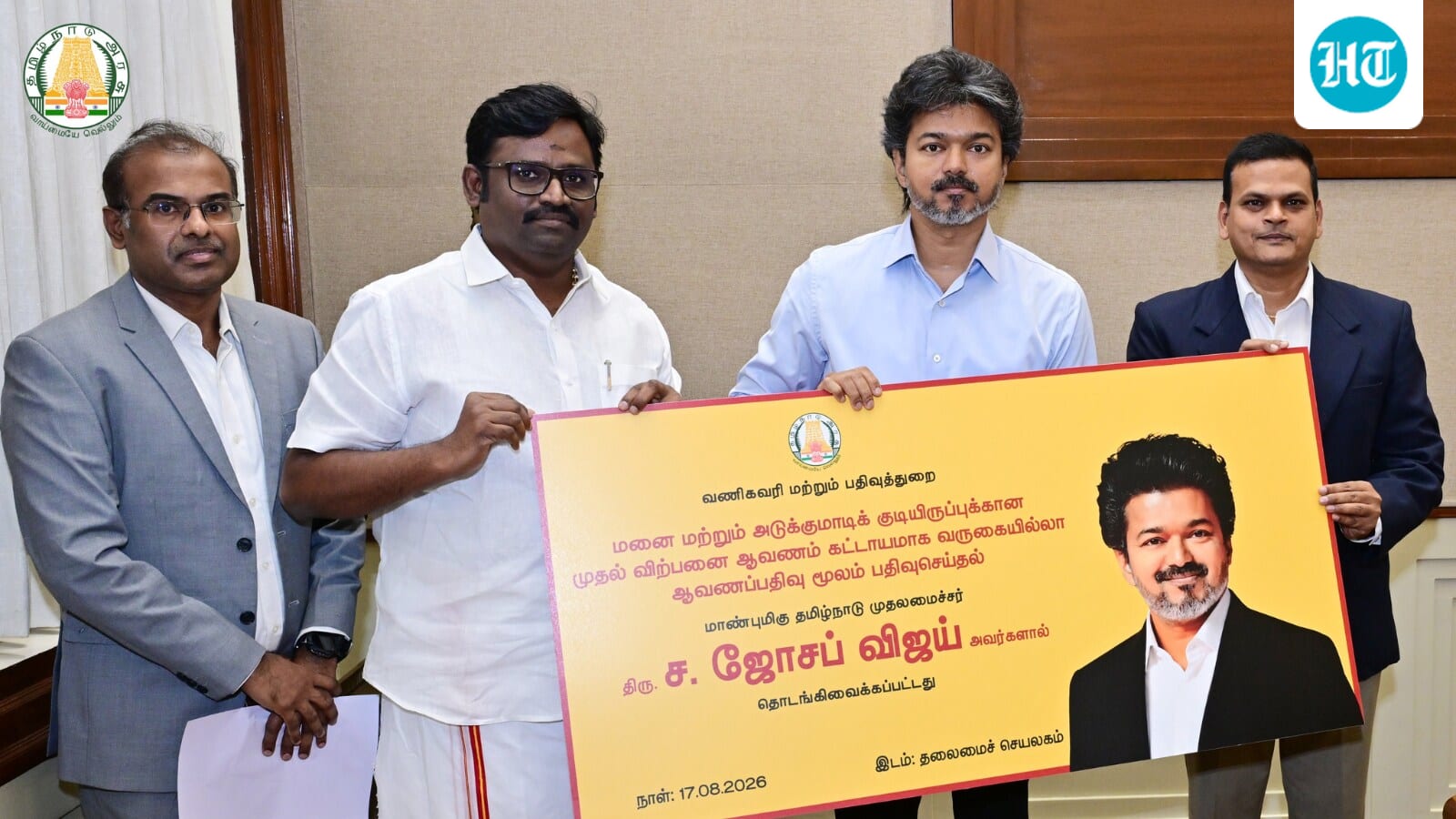
Tamil Nadu CM Vijay makes online registration mandatory for first sale of plots, flats: What it means
Source Entity
Latest News: Todays Latest News Headlines from India & World | Hindustan Times | Hindustan Times
Chief Minister C. Joseph Vijay’s TVK-led coalition government has completed its first 100 days, focusing on welfare expansion and fiscal reforms. Key policy shifts include increased milk procurement prices and a major boost in health insurance coverage to ₹25 lakh.
The First 100 Days of the TVK Government
The Tamilaga Vettri Kazhagam (TVK)-led coalition government, under the leadership of Chief Minister C. Joseph Vijay, has marked its first 100 days in office with a strategic pivot toward balancing administrative reform with robust welfare initiatives. Since assuming power following the May 2026 assembly elections—where the TVK secured 108 of the 234 seats—the administration has been navigating the complexities of coalition governance alongside partners such as Congress, the IUML, and the VCK, with additional support from Left parties.
Navigating Coalition Dynamics and Political Opposition
The current government represents a significant political shift in Tamil Nadu, given that its coalition partners were previously aligned with the DMK, which Chief Minister Vijay has explicitly identified as his primary political antagonist. This inherent tension has set the stage for a period of intense scrutiny. The administration has not been without its challenges, grappling with internal controversies regarding ministerial conduct, transparency concerns, and the behavior of party cadres, all while attempting to solidify its governance mandate despite not holding an absolute majority.
Prioritizing the Agricultural Sector
In a move reflecting a blend of traditional values and economic support for rural livelihoods, Chief Minister Vijay announced a significant increase in milk procurement prices on August 19, 2026. By raising the price from ₹38 to ₹41 per litre—achieved through a combination of increased cooperative society payouts and a hike in government incentives—the administration aims to stabilize the income of dairy farmers. The CM underscored the cultural and biological significance of bovine health, framing the policy as a recognition of the contribution made by the state's 8,800 milk cooperative societies.
Revolutionizing Public Health Infrastructure
Perhaps the most ambitious aspect of the government's early tenure is its aggressive expansion of the public health safety net. The Chief Minister announced a five-fold increase in the Chief Minister’s Comprehensive Health Insurance Scheme coverage, moving from ₹5 lakh to ₹25 lakh. This policy is grounded in the ideological stance that medical care is a fundamental human right rather than an income-contingent privilege.
Infrastructure and Specialized Care
Complementing the insurance expansion is a significant capital investment in health infrastructure. The government has committed to constructing a 400-bed multi-super-speciality hospital in Perambur, the Chief Minister’s own constituency, at a cost of ₹300 crore. Furthermore, the state has allocated ₹673.44 crore toward a comprehensive Cancer Care Mission. These investments signal a desire to decentralize high-quality medical care and address the growing financial burden of chronic illnesses on the state's population.
Looking Ahead: Challenges and Trends
As the TVK government moves beyond its first 100 days, it faces the dual challenge of maintaining fiscal consolidation while continuing to fund ambitious welfare schemes. The success of these initiatives will likely depend on the government's ability to manage its coalition partners and mitigate the ongoing controversies regarding administrative transparency. If the current trajectory continues, the TVK administration is set to define its legacy through the lens of social equity and institutional reform, though its long-term stability remains a focal point for political analysts.
Multiple Citing Sources
Verification Required?