Robot week in China: A record IPO, a US ban & an industry admitting machines aren’t ready – yet
Source Entity
Latest News: Todays Latest News Headlines from India & World | Hindustan Times | Hindustan Times
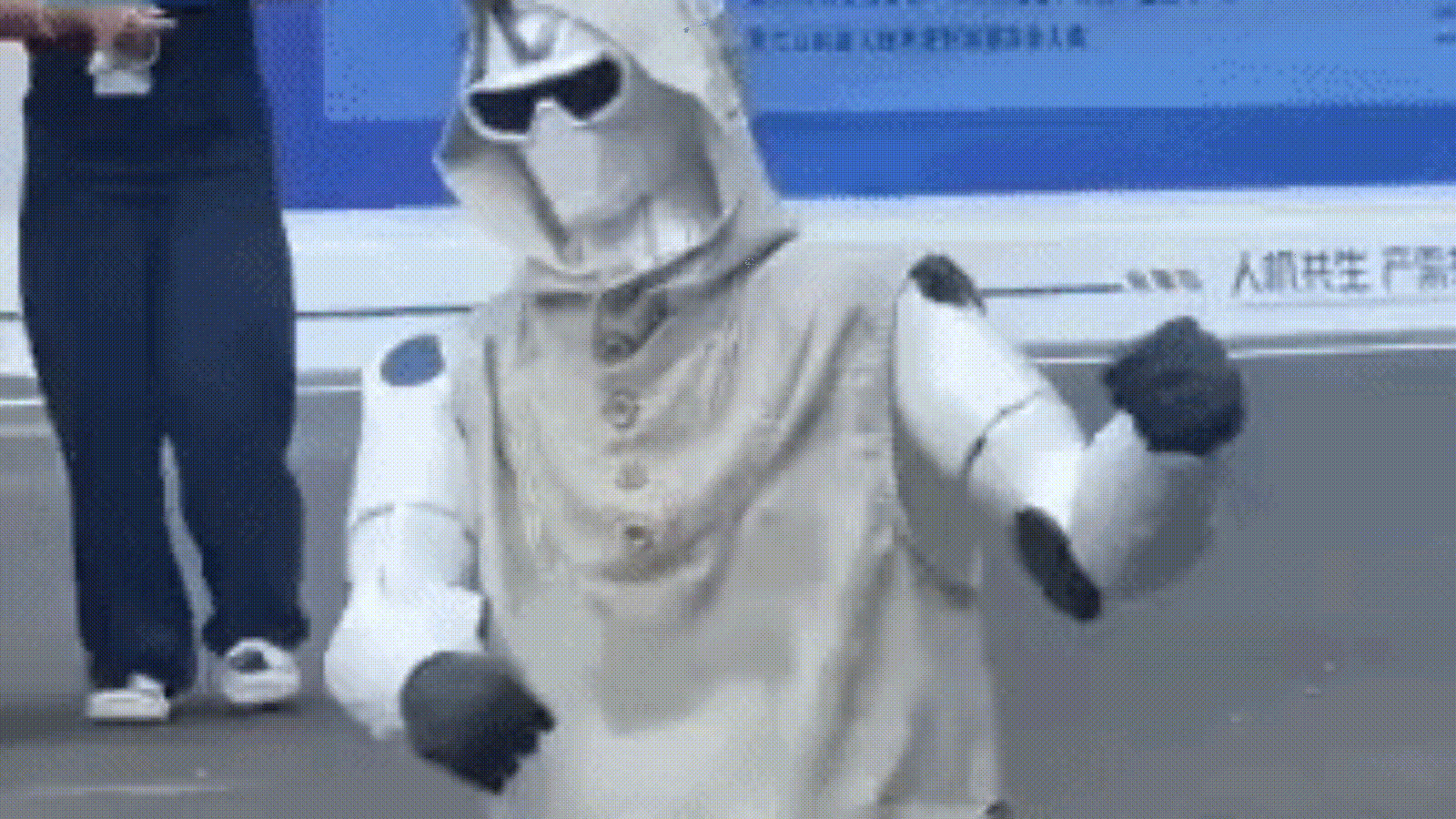
Unitree Robotics founder Wang Xingxing estimates a 'ChatGPT moment' for humanoid robots is still a decade away. Despite a massive market debut and public demonstrations, the industry is transitioning from novelty displays to practical commercial applications.
The Future of Robotics: Between Hype and Reality
At the 2026 World Internet Conference and the concurrent World Robot Conference in Beijing, the robotics industry has found itself at a pivotal crossroads. While recent events have showcased impressive feats—such as humanoid robots engaging in sparring matches—industry leaders are tempering expectations regarding the speed of widespread adoption. Wang Xingxing, the founder of Unitree Robotics, has explicitly stated that the "ChatGPT moment" for humanoid robotics, representing a paradigm shift in capability and ubiquity, likely remains a decade away.
Market Enthusiasm vs. Technical Maturity
The current fervor surrounding robotics is reflected in the financial markets, where Unitree Robotics saw its shares soar 460% above its IPO price during its recent Shanghai debut. This $905 million initial public offering underscores a massive investor appetite for the sector. However, there is a clear disconnect between this market valuation and the current functional reality of the technology. As noted during various demonstrations, while robots are currently being used for tasks like sorting parcels or packing mobile phones, their broader utility remains limited.
The Chinese Strategic Bet
China is positioning robotics as a cornerstone of its future economic growth, viewing the sector as a vital arena for global technological competition. The World Robot Conference in Beijing, featuring over 300 companies and 2,000 exhibits, serves as a testament to the scale of this ambition. The government’s focus is to transition these machines from crowd-pleasing gimmicks—like boxing demonstrations—into essential tools for industrial productivity.
Defining the 'ChatGPT Moment'
In the context of artificial intelligence, the 'ChatGPT moment' refers to the point where a technology moves from experimental curiosity to an indispensable, high-utility tool that is accessible and transformative. For humanoid robots, this implies the ability to navigate complex, unstructured environments and perform diverse tasks with high reliability. Wang Xingxing’s conservative ten-year estimate suggests that while the hardware is maturing, the integration of advanced, adaptable software that allows for true autonomous utility is still a significant hurdle.
The Path Toward Commercialization
As the industry gathers to launch over 150 new products, the focus is shifting toward commercial viability. The challenge for companies like Unitree is to prove that these humanoids can provide a return on investment beyond the showroom floor. The next decade will likely be defined by a grueling process of refinement, where the focus moves away from physical spectacle and toward solving the logistical and algorithmic problems that currently prevent robots from being truly useful in household or complex industrial settings.
Conclusion
While the robotics sector is currently fueled by intense hype and significant capital investment, the industry appears to be entering a phase of pragmatic development. The next ten years will be critical in determining whether humanoid robots can evolve from the current state of exhibition-led innovation into the foundational economic drivers that governments and investors currently anticipate.
Multiple Citing Sources
Verification Required?