It left Earth in 1977. It’s still calling home: Voyager 1’s extraordinary journey
Source Entity
CHETHAN KUMAR
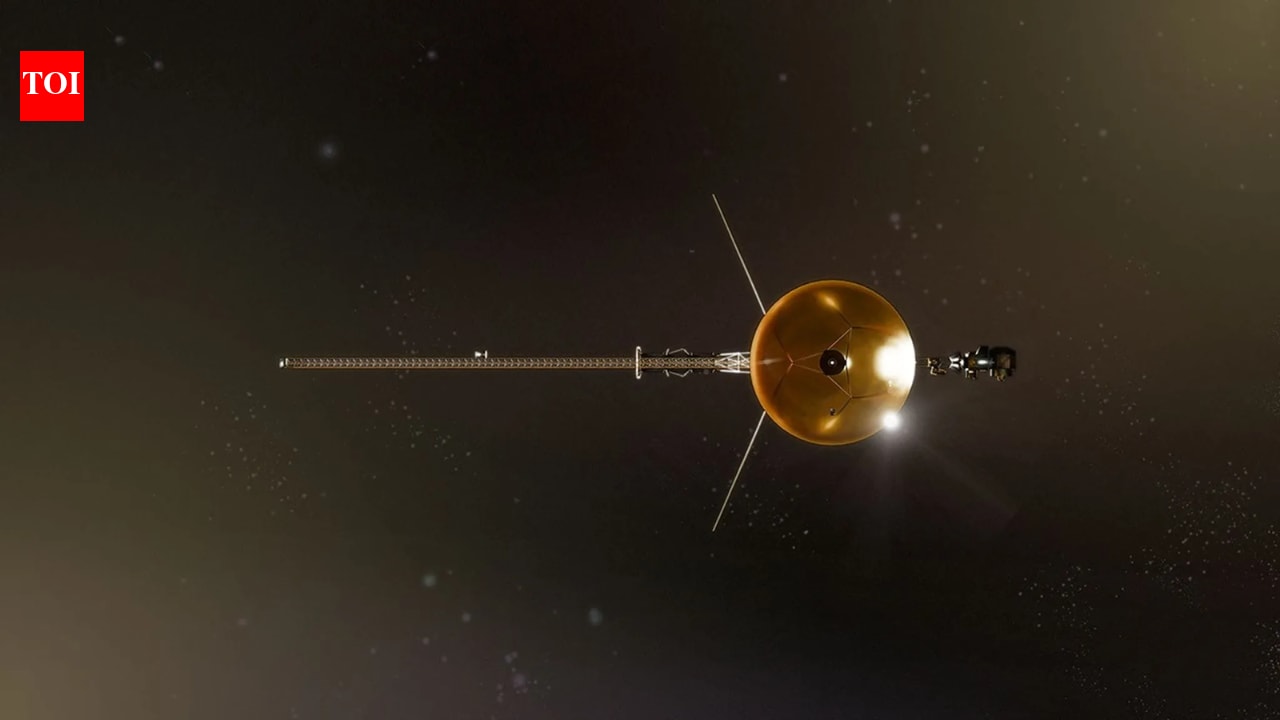
NASA's Voyager 1 spacecraft is reaching the historic milestone of one light-day from Earth, approximately 26 billion kilometers away. Launched in 1977, this enduring mission continues to provide critical data from interstellar space after nearly five decades.
A Historic Voyage: Voyager 1 Reaches One Light-Day
NASA’s Voyager 1 spacecraft is on the cusp of a monumental achievement in human history, set to reach the distance of one light-day from Earth. This milestone, representing the distance light travels in a 24-hour period—approximately 26 billion kilometers—underscores the unprecedented longevity and reach of human engineering. Launched on September 5, 1977, the probe has spent nearly half a century traversing the cosmos, marking it as the most distant human-made object ever created.
Origins and Original Objectives
To understand the significance of this milestone, one must revisit the mission's inception. Voyager 1 and its twin, Voyager 2, were launched in 1977 as part of a grand design to perform fly-by interplanetary missions. Their initial charter was to explore the giant planets of our solar system, specifically Jupiter and Saturn. These missions provided humanity with its first detailed look at these massive worlds, including the discovery of intricate moon surfaces, such as the cratered terrain of Rhea and the geologically inactive Callisto.
The Shift to Interstellar Exploration
While the original mission focused on planetary reconnaissance, the longevity of the spacecraft allowed NASA to extend their utility far beyond the outer planets. A pivotal objective became the characterization of the outer solar system environment and the search for the heliopause—the boundary where the influence of our sun’s solar wind meets the interstellar medium. Voyager 1’s continued operation has fundamentally enriched our scientific understanding of the space between stars, proving that the mission’s value grew exponentially as it ventured into the unknown.
Iconic Moments and the Golden Record
Beyond technical data, Voyager 1 has captured the human imagination through its unique perspective. One of its most enduring legacies is the "Pale Blue Dot" image, a photograph of Earth taken from the outer reaches of the solar system. This "family portrait" of our solar system serves as a humbling reminder of our place in the universe. Furthermore, the spacecraft carries the Golden Record, a symbolic message from Earth intended for any extraterrestrial intelligence it might encounter, encapsulating the history and culture of humanity.
Implications of the Light-Day Milestone
Reaching a distance of one light-day means that radio signals sent from Earth now take a full 24 hours to reach the spacecraft, and another 24 hours for a response to return. This extreme communication latency highlights the immense scale of the journey. Managing a spacecraft under such conditions is a testament to the ingenuity of the flight controllers and engineers who continue to maintain communication with a probe built with 1970s-era technology.
Future Trends and Legacy
The trajectory of Voyager 1 serves as a blueprint for future deep-space exploration. As it continues its silent drift through the interstellar medium, it remains a beacon of human curiosity. While the power sources on board will eventually deplete, the data gathered by Voyager 1 will remain a cornerstone of astrophysics for generations. It represents the first step in our transition from a solar-system-bound species to one capable of reaching into the vast, uncharted territory of the galaxy.