40 years ago, November 9, 1986: Swoop on Tamil militants
Source Entity
The Indian Express
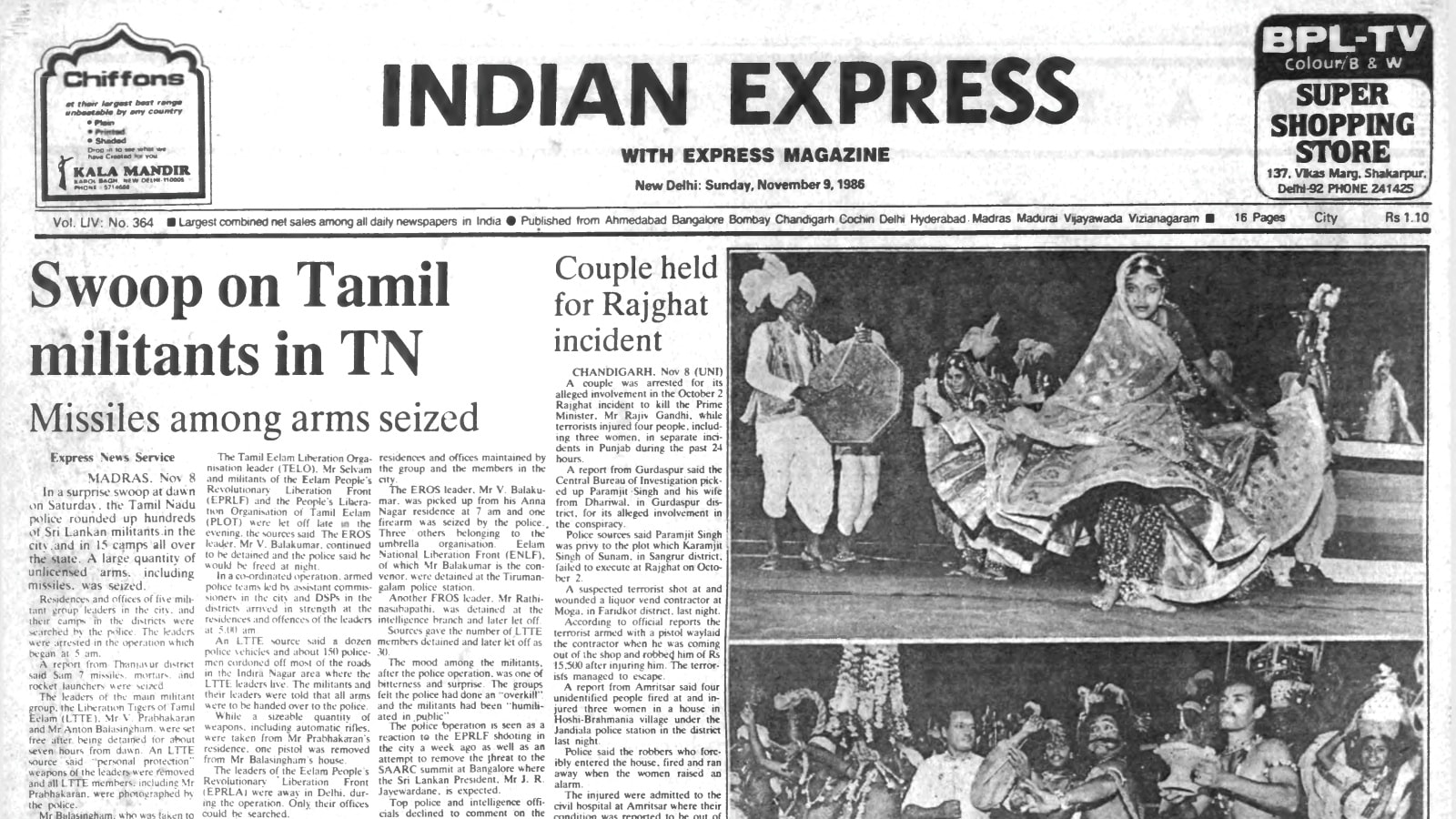
On November 9, 1986, Tamil Nadu authorities conducted a massive crackdown on Sri Lankan militant groups, seizing unlicensed arms and arresting key leaders. Simultaneously, investigations into a plot against Prime Minister Rajiv Gandhi and ongoing violence in Punjab highlighted a period of intense internal security challenges for India.
The 1986 Security Crackdown: A Historical Analysis
The Tamil Nadu Operation
On November 9, 1986, the Tamil Nadu police executed a significant coordinated operation, targeting Sri Lankan militant factions operating within the state. This dawn raid spanned the capital and 15 distinct camps across the region, resulting in the detention of hundreds of militants and the seizure of a substantial cache of unlicensed weaponry. By searching the residences and offices of five key militant leaders, the state effectively disrupted the logistical networks that had utilized Tamil Nadu as a strategic base for operations related to the ongoing Sri Lankan civil war.
Contextualizing the Militant Presence
During the mid-1980s, the ethnic conflict in Sri Lanka had led to a significant influx of refugees and militant groups into India. The presence of these groups in Tamil Nadu created a complex security environment for the Indian government. The 1986 crackdown marked a decisive pivot in how local authorities managed these groups, signaling that the state would no longer tolerate the unchecked proliferation of arms or the operation of unofficial paramilitary camps on its soil, thereby balancing humanitarian support with national security imperatives.
The Rajghat Conspiracy
Parallel to the events in the south, the national security apparatus was focused on the investigation of the October 2, 1986, attempt on the life of Prime Minister Rajiv Gandhi at Rajghat. The arrest of Paramjit Singh and his wife in Gurdaspur by the Central Bureau of Investigation (CBI) underscored the gravity of the threat against the Prime Minister. This incident was a stark reminder of the volatile political climate of the era, where high-profile assassination plots were becoming an increasing concern for intelligence agencies.
Domestic Unrest in Punjab
The broader security landscape was further complicated by the situation in Punjab, where terrorist activities continued to destabilize the region. The reported injuries of four people, including three women, in separate incidents within a 24-hour window, illustrate the persistent nature of the insurgency during this period. The proximity of the suspects arrested for the Rajghat plot to the Gurdaspur district suggests a potential link or at least a geographic overlap between the perpetrators of national-level political violence and local insurgent cells.
Strategic Implications and Future Trends
These events collectively represent a critical juncture in India’s internal security history. The 1986 crackdown served as a precursor to more stringent monitoring of foreign militant groups and reinforced the necessity of inter-agency cooperation—involving state police and the CBI—to combat both international spillover and domestic terrorism. The proactive stance adopted by the government in late 1986 set a precedent for future intelligence-led operations aimed at neutralizing threats before they could escalate into broader national crises.