AutoSynthData: Generating Training Data for Enterprise Agents
Source Entity
Hugging Face - Blog
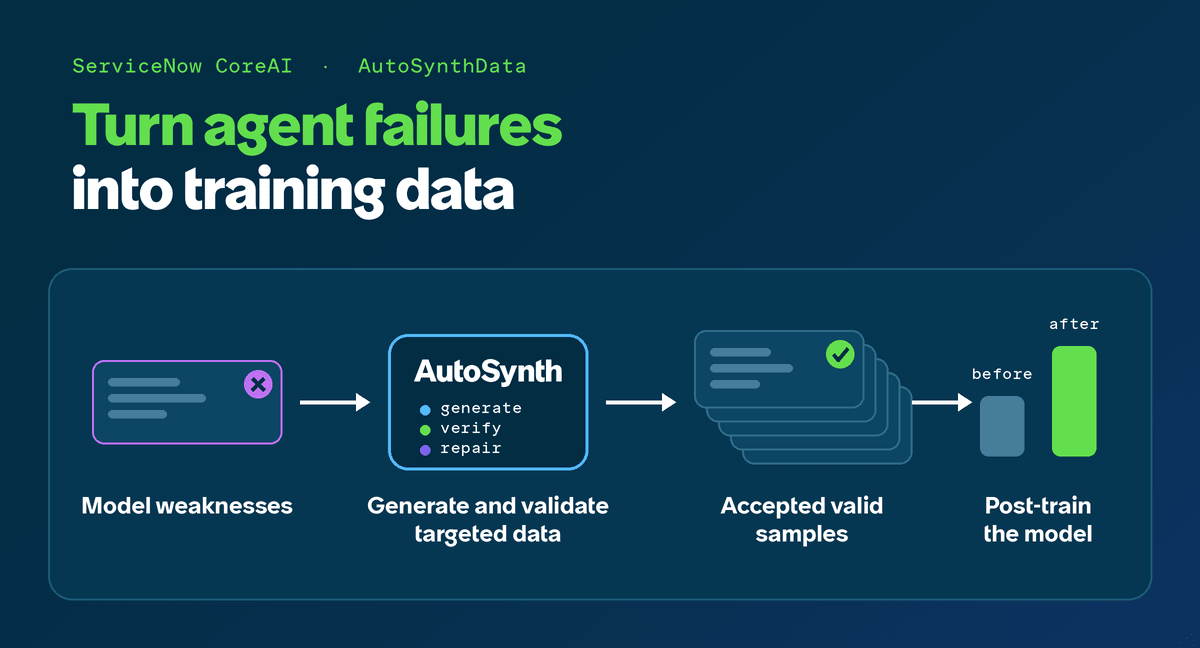
AutoSynthData addresses the challenge of tailoring AI agents to specific enterprise environments by generating synthetic training data. This approach helps overcome model weaknesses by creating diverse, environment-specific tasks to improve agent performance.
Bridging the Gap: The Rise of AutoSynthData in Enterprise AI
In the rapidly evolving landscape of artificial intelligence, the deployment of large language models (LLMs) within corporate environments has hit a significant bottleneck. While general-purpose models demonstrate impressive capabilities across a wide array of tasks, they frequently falter when integrated into the specialized ecosystems of specific enterprises. AutoSynthData emerges as a critical solution to this problem, focusing on the generation of synthetic training data designed to align AI agents with the unique workflows, software stacks, and regulatory constraints of individual businesses.
The Challenge of Contextual Limitations
Enterprise agents operate in high-stakes environments where accuracy, policy adherence, and tool interoperability are paramount. A model that is broadly capable may still struggle with the nuances of a proprietary workflow or the specific way a company manages its internal data. These failures often stem from a lack of exposure to the specific 'rules of the road' that govern a business. When an agent misuses a tool or fails to respect a constraint, it indicates a gap in the model's training data, necessitating a move away from generalized learning toward highly targeted, environment-aware instruction.
Converting Failure into Training Assets
The core innovation of AutoSynthData lies in its methodology for addressing these specific weaknesses. Recognizing that a single failure is merely a data point, the system seeks to transform these isolated incidents into robust, comprehensive training datasets. By analyzing where an agent struggles, AutoSynthData generates a multitude of variations for the same task, ensuring the model encounters the challenge across diverse scenarios. This process is essential for hardening an agent against the unpredictable nature of real-world corporate operations.
Ensuring Realism and Reliability
A common pitfall in synthetic data generation is the risk of creating 'hallucinated' or impossible tasks that do not reflect actual business requirements. AutoSynthData mitigates this by ensuring that the generated tasks are not only executable within the existing environment but also mimic the intent of actual human users. Furthermore, the system incorporates rigorous validation mechanisms to verify whether the agent successfully completes the task, creating a closed-loop feedback system that continuously refines the model's reasoning capabilities.
Future Trends and Strategic Implications
As organizations continue to pivot toward agentic workflows, the demand for AutoSynthData-like solutions will likely skyrocket. Moving forward, the ability to rapidly synthesize data will differentiate successful AI deployments from those that remain stuck in the pilot phase. By automating the data creation process, enterprises can significantly reduce the time-to-market for specialized agents, ensuring that AI systems evolve at the same pace as the business tools they are meant to support. This shift marks a transition from 'model-centric' AI development to 'environment-centric' development, where the context of the work is just as important as the intelligence of the model itself.