AWS rates PHP RCE as Important so Amazon Linux 2023 patch may take 20 days
Source Entity
Hacker News
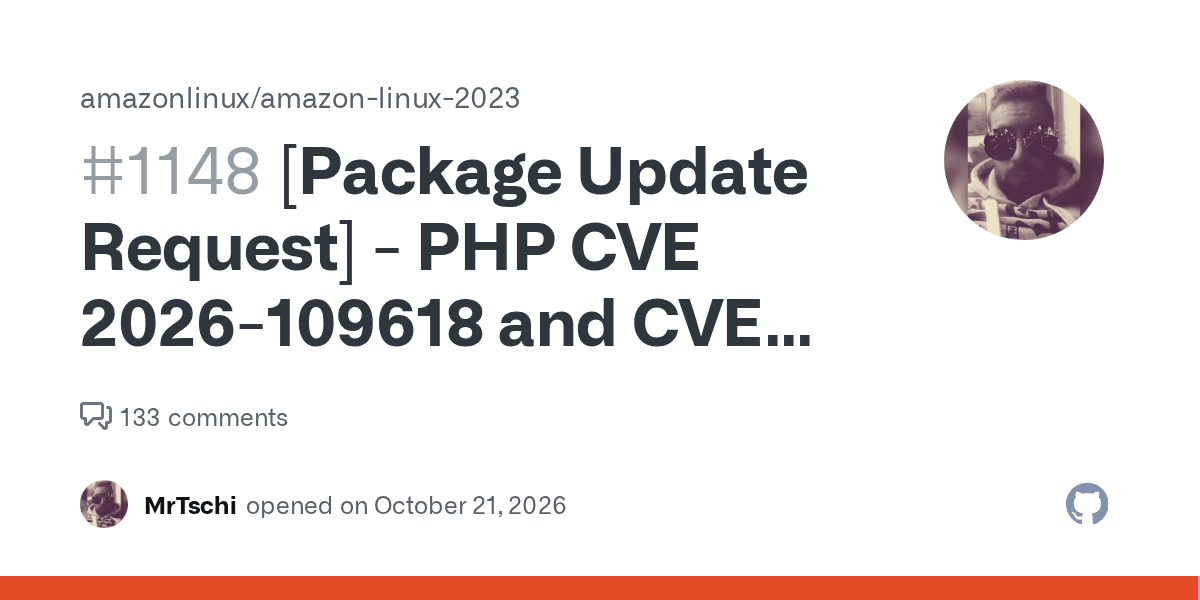
AWS has classified a new PHP Remote Code Execution (RCE) vulnerability as 'Important,' leading to a delayed patch cycle for Amazon Linux 2023. Security experts caution that while the flaw is significant, it is not easily exploitable, despite the proliferation of non-functional proof-of-concept scripts.
Understanding the PHP RCE Vulnerability Landscape
Recent reports have identified critical vulnerabilities in PHP web runtimes, specifically tracked as CVE-2026-109618 and CVE-2026-109619. These flaws have garnered significant attention due to their potential for Remote Code Execution (RCE), a class of vulnerability that allows attackers to execute arbitrary commands on a target server. The situation has prompted an immediate response from major infrastructure providers, including Amazon Web Services (AWS), which has officially classified the threat level as 'Important' for its Amazon Linux 2023 distribution.
The AWS Patching Timeline and Operational Risk
Despite the severity often associated with RCE vulnerabilities, AWS has indicated that the patch deployment for Amazon Linux 2023 may take up to 20 days. This extended timeline reflects the complex nature of maintaining enterprise-grade operating systems, where stability and compatibility testing are paramount. Organizations relying on Amazon Linux 2023 must now balance the need for security updates with the operational risk of waiting nearly three weeks for an official vendor-supplied fix, potentially leaving systems exposed to sophisticated threat actors during this window.
Dissecting the Exploitability Gap
Contrary to the alarmist sentiment currently circulating within certain online security communities, expert analysis suggests that this vulnerability is not easily exploitable. Unlike historical disasters such as Log4Shell or Heartbleed, which allowed for trivial, wide-scale exploitation, these PHP vulnerabilities appear to require highly specific environmental configurations. There is a notable disconnect between the perceived threat and the practical reality of executing an attack against a vanilla PHP instance.
The 'LLM Effect' and Misinformation
A concerning trend in the current cybersecurity landscape is the proliferation of misleading 'Proof-of-Concept' (PoC) scripts generated by Large Language Models (LLMs). Thousands of these scripts have appeared on platforms like GitHub, yet researchers have confirmed that they do not function against standard, unhardened PHP installations. This phenomenon creates a 'noise-to-signal' problem, where security teams are overwhelmed by fake exploits, potentially distracting them from genuine threats or leading to unnecessary panic.
Defensive Mitigation Strategies
For organizations currently evaluating their exposure, the focus should remain on verified, defense-in-depth strategies rather than relying on unvetted patches. Security teams should look toward Web Application Firewall (WAF) configurations, such as the 'PHP2Shell' rule set, which targets specific patterns like POST requests and PHPSESSID cookie manipulation. By implementing these granular inspection rules, administrators can block malicious traffic patterns at the network edge, providing a necessary buffer while awaiting official vendor patches.
Conclusion and Future Outlook
As this event unfolds, it serves as a stark reminder of the importance of rigorous vulnerability verification. While the PHP runtime flaws are undeniably serious, they do not currently represent the 'easy' exploit that many fear. Moving forward, the industry must prioritize critical thinking and manual verification over automated, AI-generated threat assessments to ensure that defensive resources are allocated effectively in the face of evolving web vulnerabilities.
Multiple Citing Sources