Chemistry is Actually Geometry
Source Entity
Hacker News
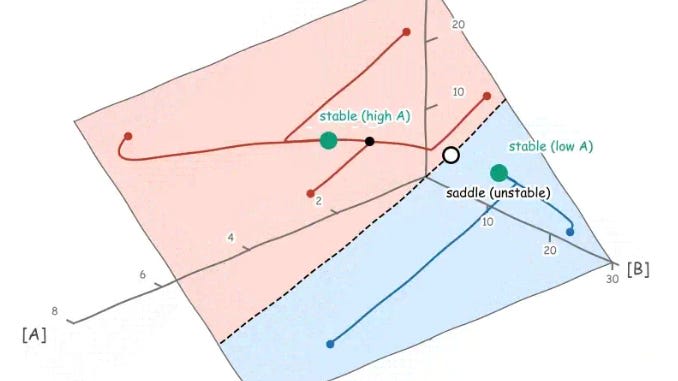
Chemical reactions are being re-conceptualized through the lens of geometry to better model complex biochemical systems. This shift seeks to simplify the massive differential equations currently required to understand life-like synthetic processes.
The Geometric Paradigm Shift in Chemistry
Recent scientific discourse suggests a fundamental pivot in how we perceive chemical reactions, moving from traditional kinetic modeling toward a framework rooted in geometry. While chemical reactions—the process by which molecules transform, release energy, or shift in color—are usually described through changing concentrations over time, the inherent complexity of these systems often makes them difficult to predict. By framing chemistry as geometry, researchers are attempting to bridge the gap between simple molecular interactions and the robust, life-like behaviors observed in biochemical processes.
The Limitations of Traditional Modeling
Currently, the standard approach to modeling biochemical processes relies on vast systems of differential equations. As these systems grow in complexity, the computational cost and mathematical density become prohibitive. Because life itself is a highly robust chemical process capable of functioning across diverse environments, capturing its essence requires more than just tracking individual molecular counts. The reliance on these massive, cumbersome equations is exactly what researchers are aiming to overcome by seeking a more elegant, geometric abstraction.
Engineering Life-Like Systems
To manufacture synthetic forms that mimic the behavior of living organisms, we must first master the ability to engineer chemical properties at will and at a low cost. This requires a theoretical framework that can translate the 'quirks' of chemical reactions into predictable outcomes. If chemistry can be mapped through geometric principles, it may allow scientists to simplify the design process for synthetic life, moving away from brute-force computation toward a more intuitive, structural understanding of molecular evolution.
The Promise of Geometric Theory
By treating chemical concentrations as geometric variables rather than just numeric values, scientists hope to visualize the evolution of reactions in ways that differential equations cannot easily capture. This geometric approach could reveal the underlying 'shape' of chemical stability, explaining why biochemical processes are so surprisingly robust. Understanding these shapes would provide the blueprint needed to create synthetic materials that possess biological characteristics, such as self-organization and complex pattern formation.
Future Implications and Conclusion
If successful, this transition toward a geometric understanding of chemistry could usher in a new era of synthetic biology and materials science. By reducing the reliance on high-dimensional differential equations, we can democratize the engineering of complex chemical systems, making the creation of life-like synthetic entities more accessible. Ultimately, this paradigm shift represents a necessary maturation of the field, moving from observation of chemical quirks to the intentional, geometric design of life-sustaining processes.