Code mode yields a 99.2% cost reduction in our systems
Source Entity
Hacker News
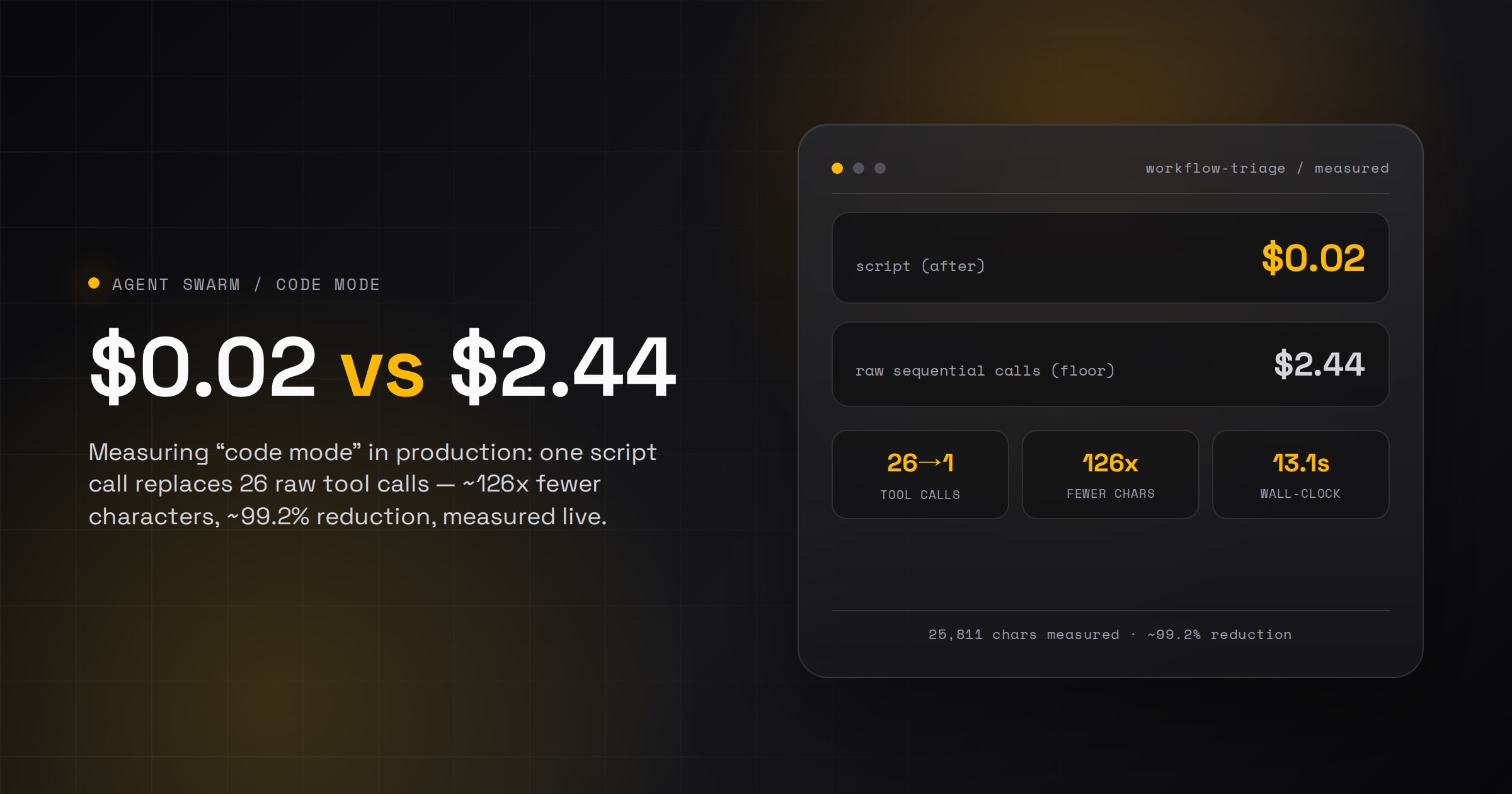
Developers are achieving massive cost reductions in AI systems by offloading data processing from LLMs to sandboxed code execution. By using scripts instead of individual token-heavy tool calls, companies like Cloudflare and Anthropic have demonstrated efficiency gains exceeding 98%.
The Shift Toward Efficient AI Orchestration
Recent developments in the AI industry have highlighted a fundamental shift in how developers handle data-intensive tasks. By moving away from relying on Large Language Models (LLMs) to process every piece of raw data, engineers are discovering that sandboxed code execution—often termed "Code Mode" or MCP-based orchestration—can reduce computational costs by over 99%. This approach fundamentally changes the relationship between the model's context window and external data sources.
The Mechanics of Cost Reduction
The core principle behind this efficiency gain is the avoidance of "raw data saturation" within the model's context window. Traditionally, developers would feed large datasets directly into an LLM to perform analysis. However, as noted in recent reports from Anthropic and Cloudflare, this is highly inefficient. When an agent is given a sandbox environment and a generated API instead of direct tool calls, it can perform complex operations without the raw data ever hitting the model’s limited and costly context space. This transition reduces a task that might require 150,000 tokens down to a mere 2,000.
Industry Adoption: From Cloudflare to Custom Swarms
Cloudflare’s implementation of "Code Mode" serves as a primary benchmark for this architectural shift. By effectively managing over 2,500 API endpoints, they managed to shrink a 1.17-million-token workload to just 1,000 tokens. This is not merely an incremental improvement; it is a structural optimization that makes large-scale automation economically viable. Similar methodologies are being integrated into custom development environments, where system templates now explicitly instruct agents to prefer script-based execution over individual, high-frequency tool calls.
Strategic Implications for AI Development
This trend signals a move toward "Agentic Workflows" where the LLM acts as an architect rather than a laborer. By instructing agents via specific rubrics—such as system.agent.context_mode—developers are creating systems that recognize when a task requires a bulk fan-out operation. By forcing the agent to reach for a script when handling 10 or more items, the system preserves its intelligence for high-level reasoning rather than simple data parsing.
Future Trends in LLM Utilization
Looking forward, we can expect this pattern of "offloading to sandboxes" to become the industry standard. As LLMs become more expensive to run at scale, the ability to write reliable, self-executing code to handle data preprocessing will become a key competitive advantage for software companies. Future AI systems will likely prioritize the development of robust, secure sandboxed environments that allow the model to maintain oversight without direct, token-heavy involvement in every sub-process.
Conclusion
In summary, the transition toward code-first execution architectures is a critical milestone in making artificial intelligence commercially sustainable. By minimizing the reliance on raw data processing within the model's context, developers are achieving unprecedented efficiency. This strategy not only lowers operational costs but also improves the reliability and precision of AI-driven systems by leveraging the strengths of traditional computing alongside the reasoning capabilities of modern LLMs.