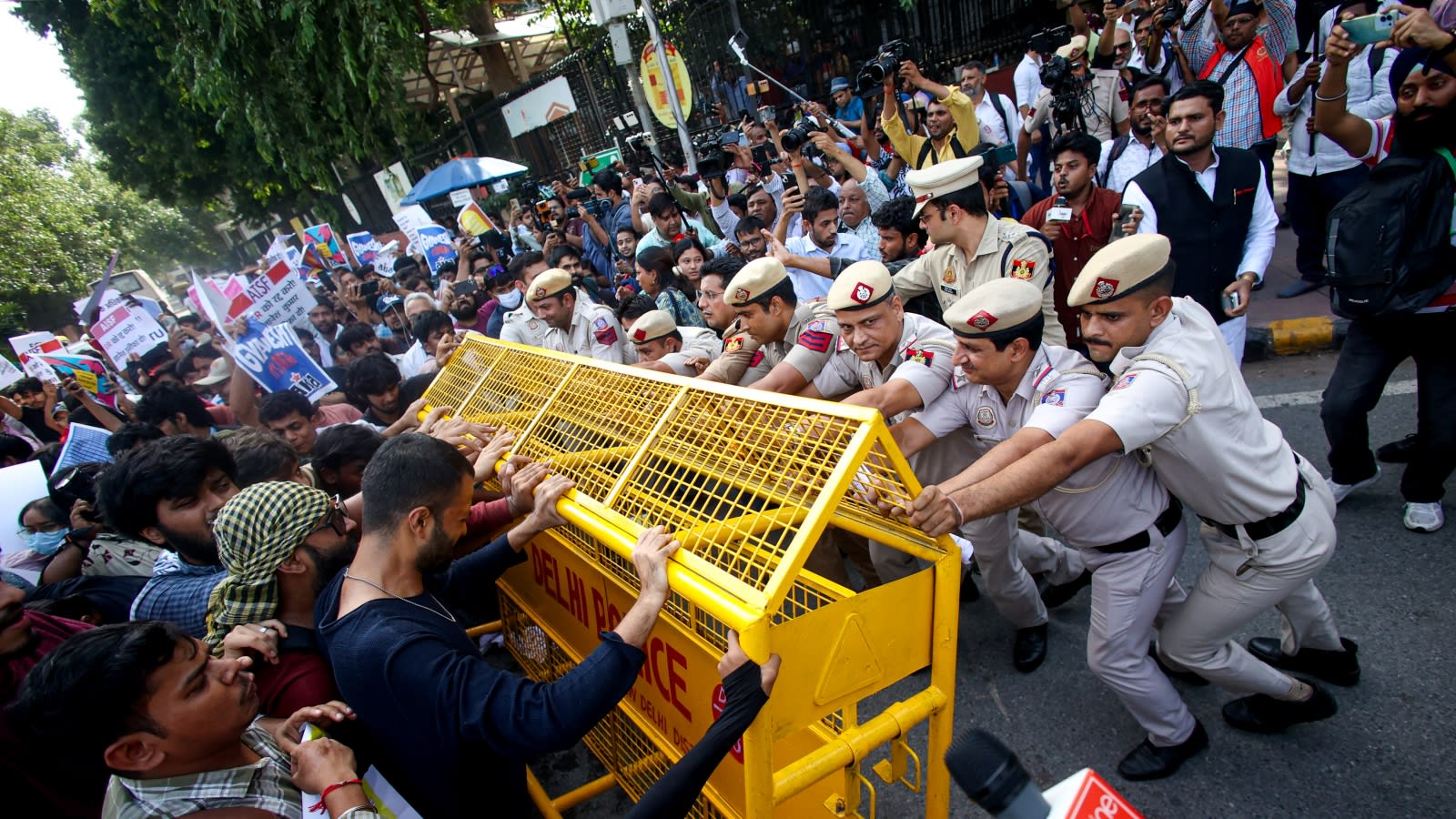
Anti-CEC Protest Supreme Court Hearing LIVE: Pleas against detentions, metro curbs
Source Entity
Ashish Shaji
Congress leaders Mallikarjun Kharge and Rahul Gandhi's attempt to meet the Chief Justice of India regarding electoral integrity allegations was officially declined. The CJI cited the separation of powers and the sub judice nature of the issues as primary reasons for the refusal.
The Constitutional Standoff: Congress Leaders and the CJI
The recent political friction in India reached a new height when Congress President Mallikarjun Kharge and Leader of the Opposition Rahul Gandhi formally requested a meeting with the Chief Justice of India (CJI), Surya Kant. The initiative was framed as an urgent intervention to address what the Congress party describes as 'vote chori' (vote theft) and the erosion of constitutional institutions. By terming the current climate an 'undeclared Emergency,' the Opposition sought to bring their grievances regarding the Election Commission’s functioning and recent legislative changes directly to the judiciary.
The Judiciary’s Stance on Political Engagement
Chief Justice Surya Kant’s decision to decline the meeting, conveyed via an official email, underscores the rigid boundaries of the Indian judiciary. The CJI’s office clarified that the request was rejected with specific reasons, primarily emphasizing the principle of the separation of powers. By choosing not to engage in a direct meeting with political leaders, the Supreme Court has signaled that it will not act as an arbiter for partisan political grievances, maintaining its role as an independent branch of government rather than a participant in political discourse.
The Sub Judice Barrier
Beyond the constitutional necessity of separating the judiciary from the executive and legislative spheres, the CJI’s refusal is rooted in legal pragmatism. Sources indicate that many of the concerns raised by the INDIA bloc, particularly those regarding electoral processes, are already matters that are sub judice—meaning they are currently under active consideration or litigation within the court system. For the CJI to hold a private meeting with political leaders to discuss these topics would risk compromising the impartiality of the judicial process.
Implications for Institutional Independence
This event highlights the growing tension between the Opposition and the government regarding the integrity of Indian constitutional bodies. The Congress party’s attempt to escalate their concerns to the Chief Justice represents a strategy of seeking external oversight for what they perceive as systemic electoral malpractice. Conversely, the rejection of this meeting serves as a reminder that the judiciary prefers to engage with such complex governance issues strictly through formal legal filings and courtroom proceedings rather than through informal channels.
Historical Context and Future Trends
Historically, the relationship between the judiciary and the political opposition has been a cornerstone of Indian democracy. While the judiciary has historically intervened in matters of fundamental rights, it has traditionally been cautious about entering the political fray. This incident suggests that we are entering a period where the Opposition will likely continue to test these institutional boundaries, while the judiciary will reinforce its commitment to procedural decorum. Moving forward, the focus will likely shift back to formal petitions, as the Supreme Court maintains its stance that it cannot intervene in the administrative functions of the state outside of established legal frameworks.
Conclusion
The rejection of the meeting between the INDIA bloc leaders and the Chief Justice of India marks a significant moment in the current political cycle. It reinforces the judiciary's commitment to maintaining a neutral distance from political controversies. As the Opposition continues to voice its concerns over 'vote chori' and institutional independence, the path forward remains defined by the courtroom rather than the meeting room, ensuring that any resolution on these matters will be dictated by judicial precedent and formal legal arguments.
Multiple Citing Sources