Introducing harness adapters: adapt your favorite model to your harness to improve performance and cost
Source Entity
Hugging Face - Blog
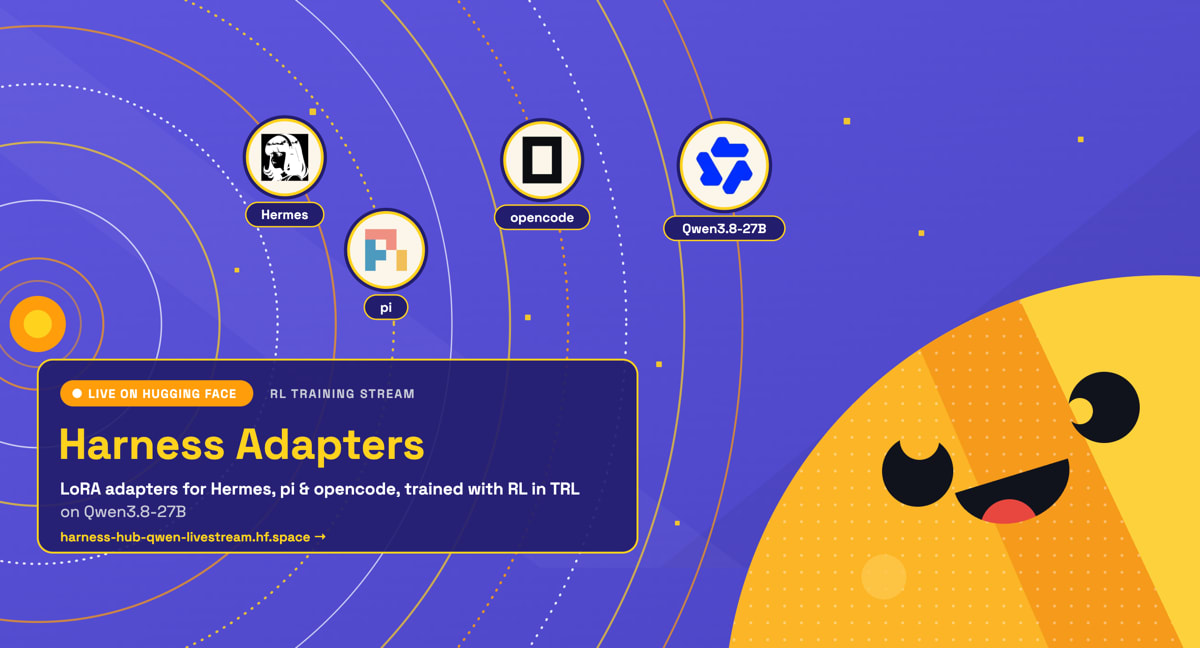
New research introduces harness adapters using Reinforcement Learning to optimize AI models for specific task distributions. This method significantly boosts accuracy while reducing token consumption compared to general-purpose baseline models.
The Evolution of Model Optimization: Harness Adapters
The current landscape of artificial intelligence is dominated by large, general-purpose models that are trained on broad datasets to perform a wide variety of tasks. While these models are impressive in their versatility, they often suffer from a 'jack-of-all-trades, master-of-none' limitation. The introduction of harness adapters marks a critical shift toward specialized performance, addressing the inherent inefficiencies that arise when a model is deployed in an environment or 'harness' for which it was not explicitly optimized.
Bridging the Gap Between Generalization and Specialization
At the core of this innovation is the recognition that base models are not fully optimized for specific harness-task combinations. When a model is deployed, it often carries unnecessary parameters or weight configurations that do not contribute to the specific workflow at hand. By utilizing Reinforcement Learning (RL) on a custom task distribution, developers can now create a 'harness adapter' that acts as a bridge, tailoring the model's behavior to the specific requirements of the target environment. This leads to a more streamlined and efficient computational footprint.
Quantitative Breakthroughs in Performance
To understand the significance of this development, one need only look at the performance gains demonstrated by the Qwen3.8-27B model. In its baseline configuration using the 'pi' harness on Terminal-Bench 2.1, the model achieved a 39% pass rate while consuming an average of 2.9K tokens per task. By freezing the base model weights and implementing a custom, RL-trained LoRA adapter, the performance surged to a 55% pass rate. Crucially, this was achieved while simultaneously reducing average token usage to 1.5K, representing a massive leap in both efficacy and cost-efficiency.
The Mechanics of RL-Driven Adaptation
Reinforcement Learning provides a powerful framework for this optimization because it allows the adapter to learn from the specific feedback loop of the task harness. Unlike static fine-tuning, which might overfit to a training set, RL-trained adapters iteratively adjust to the nuances of the task distribution. This ensures that the model remains responsive to the specific metrics of the harness, effectively 'squeezing' higher performance out of the existing base weights without the need for full retraining.
Broader Implications for AI Infrastructure
This approach has profound implications for the future of AI deployment, particularly in cost-sensitive environments. As token usage directly correlates with latency and operational expenditure, the ability to improve accuracy while slashing token consumption by nearly 50% is a game-changer. It allows enterprises to maintain smaller, more agile model architectures that outperform much larger, unoptimized counterparts. As this technology matures, we can expect a shift away from massive monolithic models toward modular architectures where base intelligence is augmented by highly specialized, lightweight adapters.
Conclusion: A More Efficient Future
The development of harness adapters represents a maturation of the AI field, moving from an era of 'bigger is better' to one of 'smarter and more efficient.' By leveraging RL to create targeted adapters, the industry is paving the way for faster, cheaper, and more accurate AI systems. This transition will likely define the next generation of AI development, where the focus shifts from raw parameter counts to the intelligent application of specialized adapters within custom task harnesses.