Engineers building Solar panels are using exact replicas of honeycombs made by Bees to ensure ...
Source Entity
TOI TECH DESK
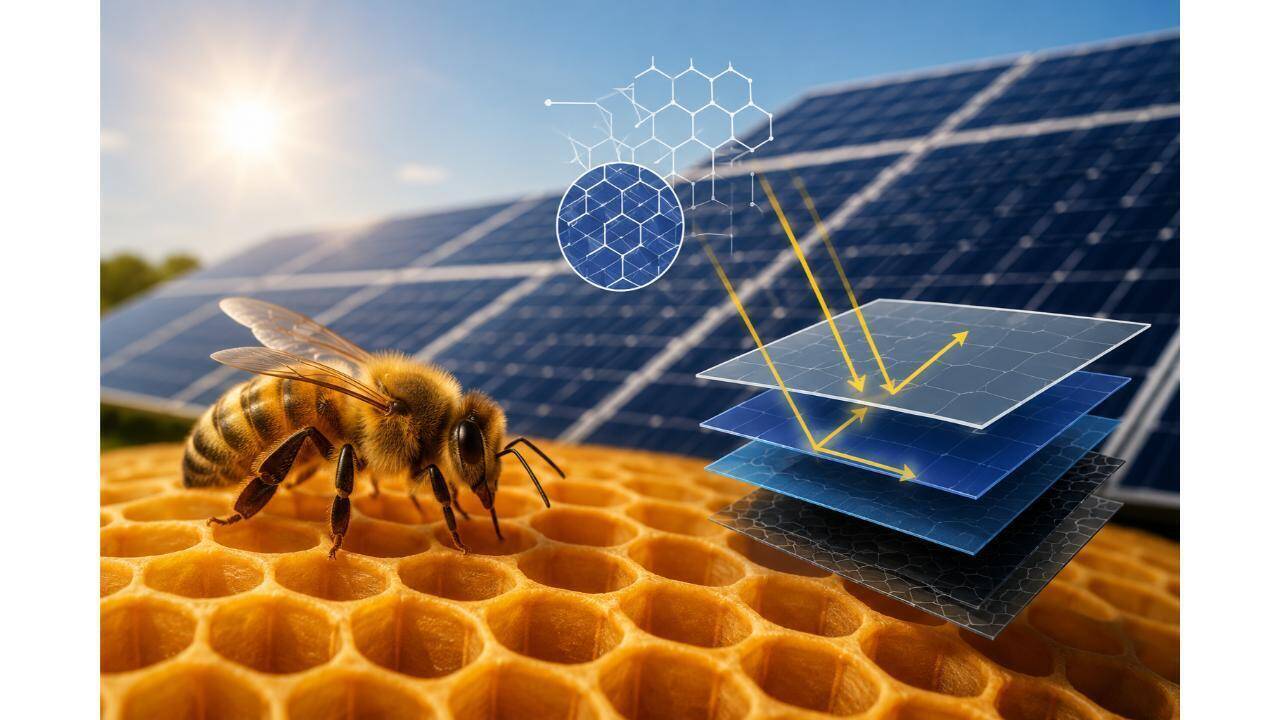
Engineers have developed innovative solar panels inspired by the geometric structure of honeycombs to maximize light capture. This biomimetic design reduces reflection and increases efficiency, potentially enabling solar integration on curved surfaces and vehicles.
Biomimicry in Energy: The Honeycomb Revolution
Nature has long served as an unparalleled blueprint for engineering innovation, and the latest advancement in solar technology is no exception. Engineers have recently turned to the hexagonal architecture of bee honeycombs to address a fundamental limitation in renewable energy: the inefficiency of traditional flat solar panels. By mimicking the exact structural geometry of a hive, researchers have developed a solar interface that fundamentally alters how light interacts with photovoltaic surfaces.
The Physics of Light Trapping
The primary challenge with conventional flat-panel solar technology is the loss of energy due to reflection. When sunlight strikes a flat surface at an angle—rather than directly overhead—a significant portion of that radiation bounces off the panel, rendering it unusable for electricity generation. The honeycomb-inspired design addresses this by creating a series of hexagonal traps. These structures act as light wells, capturing photons that would otherwise be lost to reflection and forcing them to interact with the photovoltaic material, thereby increasing total energy absorption.
Overcoming Efficiency Barriers
Early performance tests indicate that this biomimetic approach yields substantial gains in power output compared to standard flat-panel designs. By utilizing a geometry that has been perfected by bees over millions of years for structural integrity and space efficiency, engineers are effectively 'tuning' the solar surface to be more receptive to varying solar angles. This development signifies a major shift from merely improving the material properties of silicon cells to optimizing the physical macro-structure of the panels themselves.
Versatility and Future Applications
Beyond simple efficiency gains, the honeycomb structural design offers a unique advantage in physical adaptability. Because the honeycomb pattern can be engineered to be flexible, it opens the door for solar technology to be integrated into non-traditional environments. We are looking at a future where solar energy is no longer confined to rigid rooftops or vast solar farms, but can be applied to curved surfaces and even the bodies of vehicles, effectively turning everyday objects into power-generating assets.
Broader Implications for Renewables
This breakthrough underscores the growing importance of biomimicry in the global transition toward sustainable energy. By looking to biological models, engineers are finding ways to squeeze more utility out of existing materials. As this technology matures, it could drastically lower the 'levelized cost of energy' by requiring less surface area to generate the same amount of power, making solar energy more accessible in regions with limited space or less-than-ideal solar orientation.
Conclusion: A Greener Horizon
The integration of natural geometry into industrial energy production is a testament to the power of interdisciplinary research. By solving the issue of light reflection through the lens of a honeycomb, engineers have unlocked a path toward more versatile, efficient, and resilient solar infrastructure. As this design moves from testing environments to commercial application, it promises to redefine the role of solar energy in our daily lives.