Why do we think we understand the world more than we actually do?
Source Entity
Hacker News
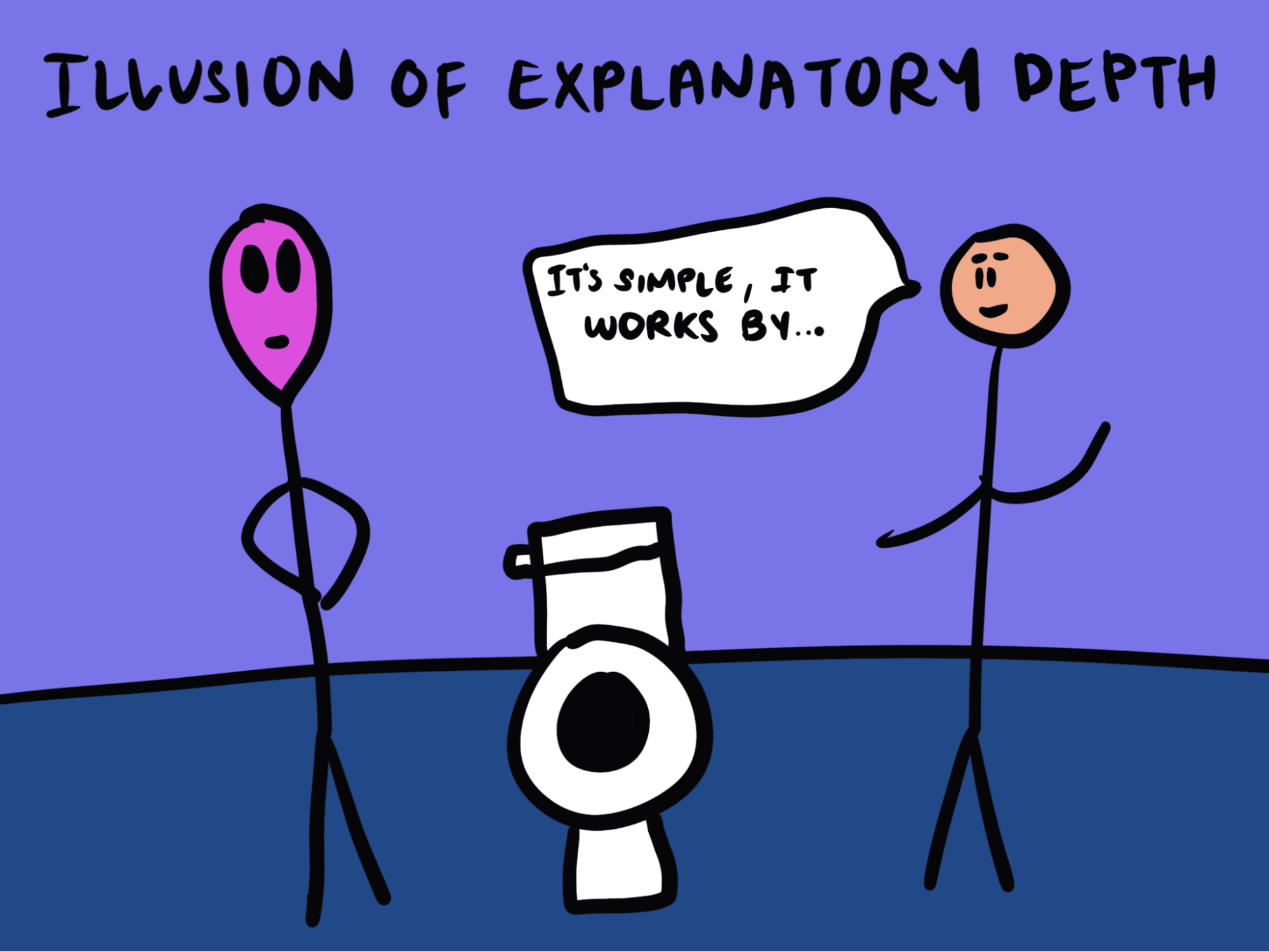
The 'Illusion of Explanatory Depth' reveals that humans often overestimate their understanding of everyday objects. This cognitive bias highlights the gap between our perceived knowledge and the actual complexity of the world around us.
The Illusion of Explanatory Depth: A Cognitive Mirage
Human cognition is often defined by a fascinating paradox: we navigate a world of complex mechanical and digital systems with ease, yet we possess a remarkably shallow understanding of how these systems function. This phenomenon, known as the 'Illusion of Explanatory Depth' (IoED), suggests that our confidence in our knowledge is often untethered from the technical reality of the objects we use daily. As the provided context illustrates, even the most mundane household fixture—the toilet—becomes a source of cognitive friction when one is forced to explain its internal mechanics.
The Mechanics of Ignorance
Why do we assume we understand the world more than we actually do? The answer lies in the way our brains function as cognitive misers. We prioritize functional knowledge—knowing that a lever flushes a toilet—over structural knowledge—knowing how the siphoning mechanism or water pressure regulation actually operates. By offloading the 'how' to the object itself or to the societal infrastructure that maintains it, we free up mental bandwidth for other tasks. This creates a false sense of expertise that remains unchallenged until we are forced to articulate the underlying principles.
Evolution and Social Survival
From an evolutionary perspective, this bias may have been adaptive. In ancestral environments, understanding the immediate utility of a tool was likely more critical for survival than mastering the physics of its creation. However, in our modern, highly technological society, this illusion can lead to significant blind spots. We rely on complex systems—from plumbing to global internet infrastructure—without truly grasping the dependencies that keep them running. This reliance on 'collective knowledge' means we often mistake the expertise of our civilization for our own personal mastery.
The Impact on Decision Making
This cognitive bias has profound implications for how we engage with complex societal issues. When individuals believe they understand the mechanics of a system (like economic policy or environmental science) better than they actually do, it can lead to overconfidence in personal opinions and a dismissal of expert analysis. The realization that one cannot explain the inner workings of a simple toilet is a humbling exercise that serves as a microcosm for broader intellectual humility. It forces us to confront the limits of our individual knowledge.
Bridging the Gap: Moving Toward Intellectual Humility
Recognizing the Illusion of Explanatory Depth is the first step toward more accurate self-assessment. By acknowledging that our understanding is often superficial, we become more open to learning and less prone to dogmatic thinking. Education systems and critical thinking frameworks should emphasize this gap, encouraging individuals to 'stress-test' their knowledge by attempting to explain complex topics in simple terms. This practice, often referred to as the Feynman Technique, is an effective antidote to the false sense of mastery that characterizes this common cognitive bias.
Conclusion
The gap between our perceived knowledge and objective reality is a fundamental aspect of the human condition. While the illusion of understanding allows us to function efficiently in a complex world, it also blinds us to the intricate dependencies that sustain our lives. By embracing the discomfort of not knowing, we can foster a more inquisitive, humble, and intellectually rigorous approach to understanding the world around us.