The Birth of the American 12-string Guitar
Source Entity
Hacker News
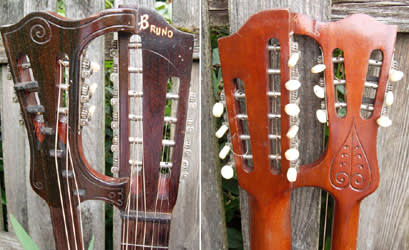
The American 12-string guitar lineage traces back to Carl E. Brown's 1896 patent for a unique 'Harp-Guitar'. This innovation introduced octave-strung courses and mechanical levers, setting the stage for modern multi-string instrument design.
The Origins of the American 12-String Guitar
The 1896 Patent Breakthrough
The evolution of the American 12-string guitar finds its foundational roots in the inventive spirit of the late 19th century. On February 8, 1896, musical instrument inventor Carl E. Brown submitted a formal patent for a specialized instrument he identified as the "Harp-Guitar." This device was not a standard six-string guitar; it featured a unique pear-shaped body and a complex configuration of 10 strings. Specifically, the four lower courses were strung in octaves, while the two higher strings remained single, creating a distinct auditory texture that would eventually influence the development of the modern 12-string instrument.
Mechanical Innovation and Design
What set Brown’s invention apart from contemporary instruments was his integration of mechanical utility into the luthier’s craft. The patent detailed a specific lever mechanism designed to shift the four high extra strings out of the primary playing position. This level of mechanical complexity suggests that Brown was attempting to bridge the gap between traditional guitar playing and the versatility of a harp, offering musicians a broader range of tonal options. The fact that a prototype was already hanging in a local music store at the time of his filing underscores the immediate commercial intent behind his design.
Commercialization and Manufacturing Partnerships
Following the successful granting of the patent on September 22, 1896, Brown moved quickly to bring his vision to the mass market. In the fall of 1896, he entered into manufacturing agreements with two distinct firms: the Hamilton Gordon Company and the Rene Grunewald Company. This dual-production approach highlights the early industrialization of instrument building in America, where inventors often relied on established firms to scale production.
Diverse Interpretations of Design
The partnership with these two firms reveals an interesting divergence in early guitar manufacturing. While the Hamilton Gordon Company adhered strictly to the pear-shaped design specified in the patent, the Rene Grunewald Company opted to house the mechanism within a more traditional guitar body shape. This decision is significant, as it shows an early tension between experimental, ergonomic design and the aesthetic preferences of the traditionalist market, a debate that continues to influence guitar manufacturing today.
Broader Implications and Historical Legacy
While Brown’s instrument was technically a 10-string precursor, the methodology of using octave-strung courses and hybrid body shapes provided the technical blueprint for what would eventually evolve into the iconic 12-string guitar. By experimenting with string tension, course doubling, and mechanical levers, Brown helped pave the way for the development of instruments that could produce the "shimmering" chorus effect that defines the 12-string sound. His work represents a critical chapter in the history of American lutherie, bridging the gap between historical harp-like instruments and the modern folk and rock guitar.
Conclusion
The narrative of Carl E. Brown’s 1896 patent serves as a vital historical marker. It illustrates the iterative process of invention, where unique mechanical concepts are refined through commercial manufacturing to meet the evolving needs of musicians. Though the "Harp-Guitar" as designed by Brown may have remained a niche innovation, its influence on the structural and acoustic evolution of multi-stringed instruments remains a cornerstone of American musical history.