Clean energy push is India’s answer to transition challenges: UN climate chief
Source Entity
India Latest News: Top National Headlines Today & Breaking News | The Hindu
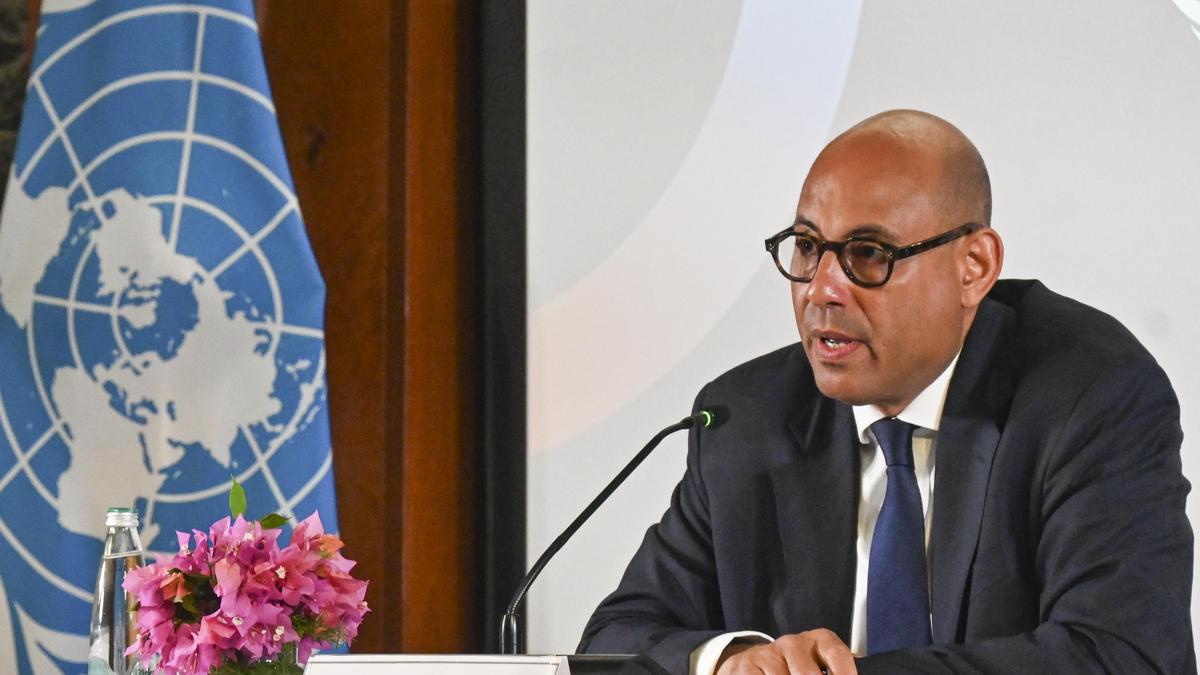
UN climate chief Simon Stiell has lauded India as a global solar superpower, noting that renewable sources now constitute half of the nation's installed power capacity. He emphasized that India's strategic focus on decarbonization and electrification is essential for overcoming transition challenges.
India's Emergence as a Global Solar Powerhouse
Simon Stiell, the Executive Secretary of the United Nations Framework Convention on Climate Change (UNFCCC), recently highlighted India’s pivotal role in the global energy transition. By labeling India a “solar superpower,” Stiell underscored the nation's rapid shift in its energy mix, where fossil-fuel-free sources now account for 50% of its total installed power capacity. This milestone is not merely a statistical achievement but a testament to India's commitment to climate goals while balancing the needs of a growing economy.
The Strategic Pivot: Decarbonization and Electrification
According to Stiell, India’s primary strategy for overcoming the inherent technical and financial complexities of moving away from traditional energy sources involves a dual approach: aggressive decarbonization and comprehensive electrification. These steps are framed as being in India's own self-interest, aligning national development goals with environmental sustainability. By prioritizing these sectors, India is effectively creating a roadmap for other developing nations facing similar transition hurdles.
Addressing Technical and Financial Hurdles
During his recent visit, Stiell engaged with top Indian ministers and industry leaders to discuss the spectrum of challenges that persist. On the technical front, the focus has shifted toward the modernization of electric grids and the expansion of energy storage capabilities. These challenges are not unique to India; they are systemic issues that major global economies are currently navigating as they integrate intermittent renewable energy into their national grids.
The Role of Public and Private Capital
Financial constraints remain a significant barrier to energy transition, but Stiell noted that India is successfully attracting both public and private capital to fuel its green initiatives. This influx of investment is critical to scaling up infrastructure, such as utility-scale solar farms and decentralized power systems. The ability to mobilize these funds signals a growing confidence among global investors in India's long-term renewable energy policy framework.
A Skilled Workforce as a Catalyst
Beyond capital and technology, the human element plays a vital role. Stiell specifically credited India's skilled workforce as a key driver of its current momentum. A trained labor force capable of managing, installing, and maintaining complex renewable infrastructure is a competitive advantage that ensures the sustainability of India's green growth model. This focus on human capital development is essential for maintaining the pace of the transition.
Future Trends and Global Implications
Looking ahead, India's trajectory suggests that it will continue to serve as a model for emerging markets. By successfully proving that high-growth economies can decouple development from fossil fuel dependency, India is influencing international climate policy. As grid storage technology matures and investment continues to flow, India is well-positioned to maintain its status as a solar superpower, potentially setting new benchmarks for global climate cooperation and energy security.
Verification Required?