'India can be bridge-builder': UN hails Iran-UAE meeting on sidelines of Brics
Source Entity
PRIYANKA JAISWAL
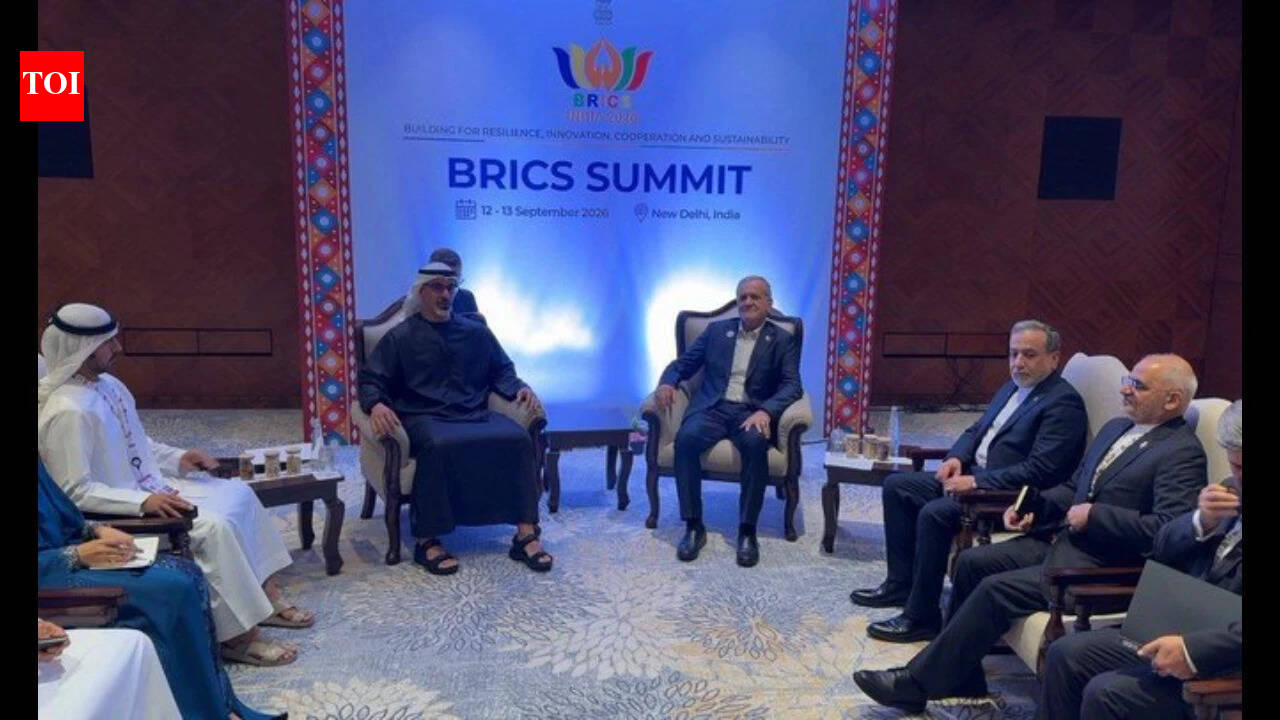
Iranian President Masoud Pezeshkian is in New Delhi for the 18th BRICS summit, where he criticized US-Israel aggression and economic sanctions. Prime Minister Narendra Modi urged for diplomatic resolutions and emphasized the critical need for secure energy supply chains through the Strait of Hormuz.
Tensions Escalate: The Iran-BRICS Dialogue in New Delhi
Iranian President Masoud Pezeshkian’s arrival in New Delhi for the 18th BRICS summit marks a pivotal moment in international diplomacy. As global leaders gather to discuss economic and regional security, the discourse has been dominated by the heightened conflict in West Asia. President Pezeshkian’s presence at the BRICS Business Forum serves as a platform to vocalize Iran’s frustration regarding what he describes as a 'dangerous phase' of economic and military aggression directed by the United States and Israel.
The Impact of Economic Sanctions and Military Aggression
President Pezeshkian has explicitly linked Iran’s domestic economic instability to the 'extensive' sanctions imposed by the United States. During his address, he emphasized that economic security is intrinsically tied to national and regional stability. The rhetoric regarding a 'far more dangerous phase' suggests that the situation has deteriorated significantly since the U.S.-Israel coalition’s military actions on February 28, which have created a volatile environment for global trade and local sovereignty.
Strategic Chokeholds and Energy Security
Prime Minister Narendra Modi’s engagement with President Pezeshkian highlights the profound impact of these conflicts on the global energy supply chain. The Strait of Hormuz, a critical maritime artery, has effectively become a 'chokehold' in the wake of recent military confrontations. PM Modi’s emphasis on the 'freedom of navigation' underscores India’s concern for the safety of seafarers and the continuity of energy supplies that are vital for the Indian economy and broader regional stability.
The Path of Diplomacy vs. Confrontation
While President Pezeshkian maintained a defiant stance, labeling the U.S. and Israel as 'bullies' and asserting that Iran will not be intimidated, Prime Minister Modi advocated for a path of 'dialogue and diplomacy.' This divergence in approach illustrates the complex role India plays as a mediator within the BRICS framework. India seeks to maintain its commercial and energy ties with Iran while navigating the precarious geopolitical divide created by the ongoing West Asian conflict.
Future Trends and Regional Implications
Looking ahead, the 2026 BRICS summit is likely to be remembered for its role in addressing the disruption of maritime trade routes. If the tensions in the Strait of Hormuz continue to escalate, the economic repercussions will likely extend far beyond the Middle East, potentially driving up global energy costs and forcing other BRICS nations to take more definitive stances on regional security. The success of these diplomatic efforts will depend on whether the involved parties can transition from the current rhetoric of 'active aggression' toward a framework of sustained, de-escalatory communication.
Multiple Citing Sources