ThinkRail from JetBrains
Source Entity
Hacker News
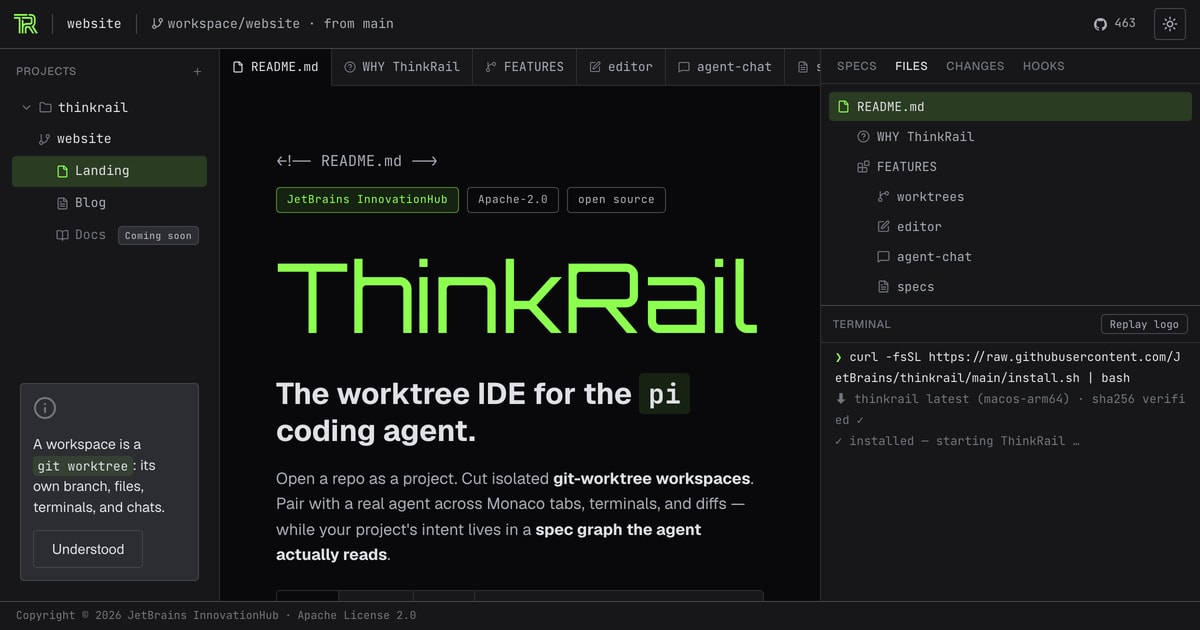
JetBrains has introduced ThinkRail, an open-source agentic IDE designed to enhance developer productivity. It leverages spec graphs and git-worktree integration to allow AI agents to better understand project intent and streamline workflows.
The Emergence of Agentic Development
The landscape of software development is undergoing a seismic shift with the introduction of ThinkRail, a new offering from the JetBrains InnovationHub. As an 'agentic' Integrated Development Environment (IDE), ThinkRail represents a departure from traditional, passive code editors. By positioning itself as an agentic tool, it signals a move toward autonomous or semi-autonomous software engineering, where the environment itself participates in the development process rather than merely acting as a canvas for the programmer.
Architectural Innovation: The Spec Graph
At the core of ThinkRail’s functionality is its ability to maintain a 'spec graph' that houses the project's intent. Unlike standard IDEs that rely on static indexers to search for symbols and definitions, ThinkRail utilizes this graph to ensure the AI agent possesses a contextual understanding of why code is written in a specific way. By bridging the gap between raw syntax and high-level architectural intent, the platform aims to reduce the cognitive load on developers, allowing the agent to provide more relevant suggestions and automated refactoring.
Workflow Efficiency and Isolation
ThinkRail leverages git-worktree technology to allow developers to cut isolated workspaces from a single repository. This is a significant advancement for project management, as it allows for simultaneous feature development, bug fixing, and experimentation without the friction of constant branch switching or local environment pollution. By automating the creation of these workspaces, the tool addresses one of the most common bottlenecks in modern software engineering: maintaining environment consistency across multiple parallel tasks.
Cross-Platform Accessibility and Open Source Philosophy
By launching under the Apache-2.0 license via the JetBrains InnovationHub, ThinkRail is positioning itself as a community-driven project. Its availability across macOS, Windows, and Linux ensures that the barrier to entry is minimal, regardless of the developer's preferred hardware ecosystem. This open-source approach is critical for the adoption of agentic tools, as it allows for transparency, community-led improvements, and the verification of how these agents interact with sensitive codebase data.
Integration with Monaco and Terminal Systems
ThinkRail’s ability to pair with an agent across Monaco tabs, terminals, and diff views suggests a deep level of system integration. By operating across these three distinct layers of the development cycle, the agent can observe not just the code written in the editor, but the commands executed in the terminal and the changes proposed in diffs. This holistic view is necessary for an agent to accurately assist in complex tasks like debugging or implementing cross-file features.
Future Trends and Concluding Thoughts
As we look toward the future of software engineering, tools like ThinkRail are likely to become the standard. The trajectory of IDE development is clearly moving toward 'agent-first' experiences where the IDE is a collaborator rather than a tool. As developers become more accustomed to working alongside agents that understand project intent, we can expect to see a significant increase in code velocity and a shift in the developer's role toward architectural oversight and high-level decision-making.