JIT Compiling Code in 5μs
Source Entity
Hacker News
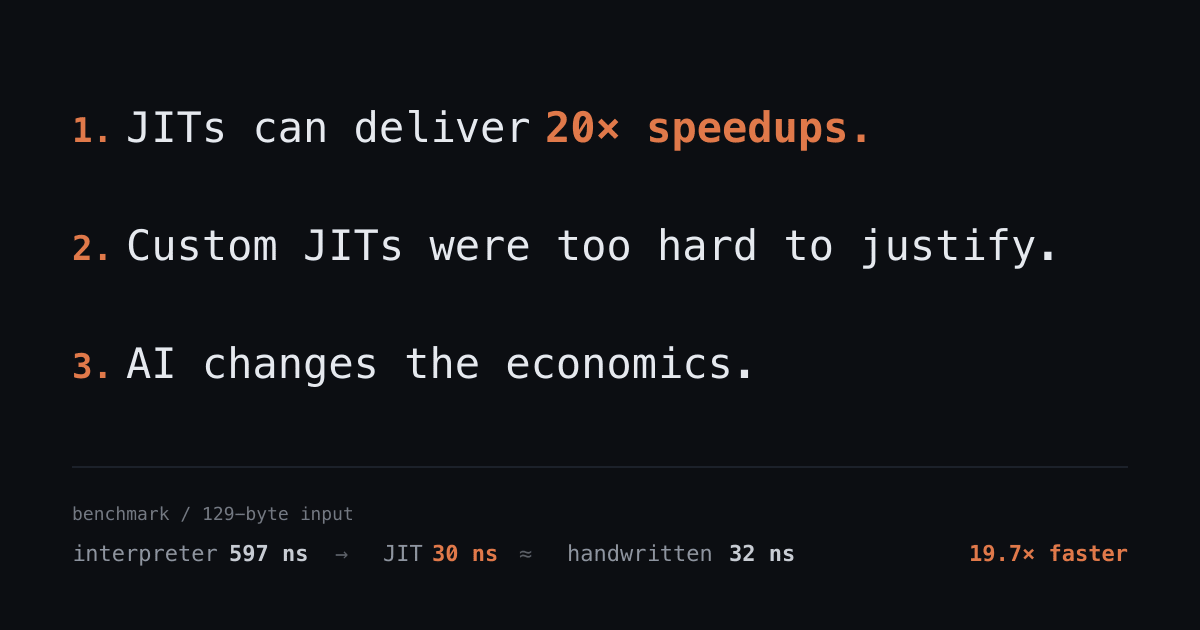
The integration of AI in compiler construction is revolutionizing database performance by enabling ultra-fast 5μs JIT compilation. This breakthrough allows new databases like pgrust to bypass traditional, slow compilation methods like LLVM.
The Paradigm Shift in JIT Compilation
Historically, the development of Just-In-Time (JIT) compilers has been viewed as a "black art," a specialized field reserved for developers with deep expertise in low-level assembly language. The complexity of mapping high-level logic into machine-executable instructions meant that most systems, including major production-ready databases, avoided building custom compilers entirely. Instead, they relied on heavy-duty infrastructure like LLVM or the generation of C/C++ code, both of which introduce significant overhead and latency during the compilation phase.
The Bottleneck of Traditional Compilers
The reliance on LLVM or intermediary C/C++ compilation has historically limited the utility of JIT engines in performance-critical database operations. These methods often suffer from high compile times, which can negate the performance gains offered by optimized execution. Because the time spent compiling code often outweighs the time saved during execution, many database architects have been forced to prioritize stability over the granular speed improvements that a custom-built, lightweight JIT compiler could provide.
AI as the New Force Multiplier
Recent advancements in Artificial Intelligence are fundamentally changing this narrative. By acting as a co-pilot for low-level programming, AI tools are lowering the barrier to entry for writing high-performance assembly code. As demonstrated by the development of the pgrust database, what was once considered an insurmountable technical challenge is now achievable with significantly reduced effort. AI-assisted development allows engineers to target assembly directly, bypassing the bloated toolchains that have historically hindered database performance.
Breaking the 5μs Barrier
The emergence of 5μs JIT compilation represents a quantum leap in execution efficiency. By achieving such low compile times, pgrust illustrates a new frontier for database architecture. This speed allows for dynamic, real-time optimization that was previously impossible, effectively allowing the database to adapt its execution path to incoming queries without incurring a noticeable performance penalty. This advancement is a direct result of the synergy between modern AI coding assistance and a more direct approach to hardware-level instruction generation.
Future Trends and Competitive Advantages
This shift creates a massive opportunity for the next generation of database systems to outperform legacy architectures. As developers continue to leverage AI to simplify the creation of bespoke JIT compilers, we can expect to see a wave of specialized databases that offer vastly superior speed compared to incumbent solutions. The ability to implement custom, high-speed compilation will likely become a key differentiator in the database market, forcing older systems to either innovate or face obsolescence in high-throughput environments.
Conclusion
The convergence of AI and compiler design is not merely a niche technical improvement; it is a fundamental shift in how we build high-performance software. By reducing the complexity of assembly-level programming, AI is enabling developers to achieve 5μs compile times, unlocking new levels of speed. As pgrust has demonstrated, the barrier to entry for high-performance engineering is lowering, signaling a future where database performance is defined by agile, AI-optimized compilation.