Robot dog adapts to terrain without human control, leaps and climbs stairs
Source Entity
The Indian Express
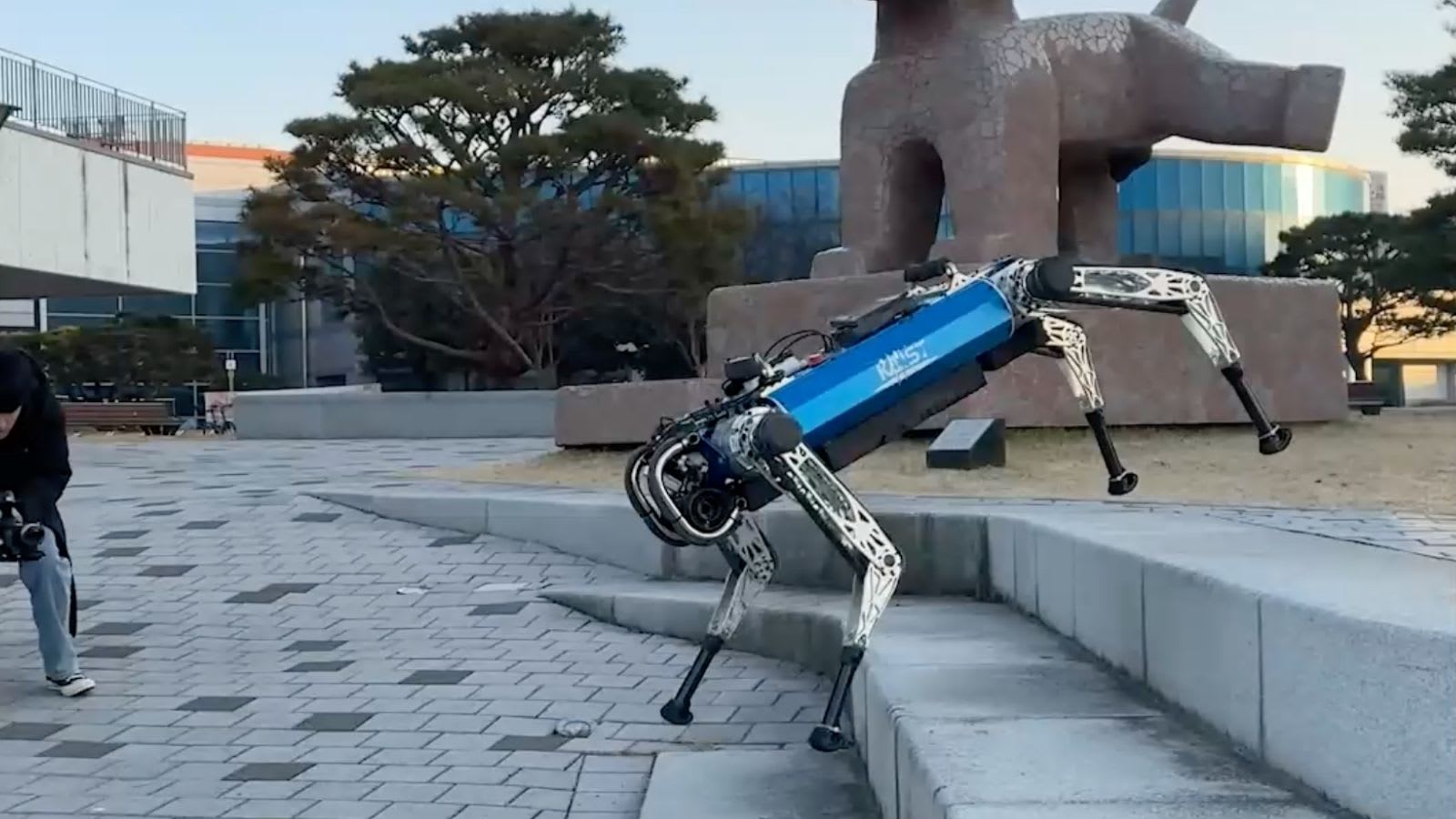
Researchers at KAIST have developed HOUND, a quadruped robot capable of autonomous navigation using a new AI framework called APT-RL. By utilizing lidar and camera sensors, the robot dynamically adjusts its gait to overcome complex terrain without human intervention.
The Evolution of Autonomous Mobility: Introducing KAIST HOUND
Recent advancements in robotics have reached a significant milestone with the development of KAIST HOUND, a 45 kg four-legged robot capable of navigating complex, unpredictable environments without the need for human input. By utilizing a sophisticated array of onboard lidar sensors and high-resolution cameras, the robot performs real-time terrain analysis to determine the most effective locomotion strategy. This leap in autonomous capability represents a transition from pre-programmed robotic movement to genuine environmental adaptability.
The APT-RL Training Framework
The intelligence behind HOUND is powered by a novel training framework detailed in Science Robotics known as Action Pretrained Transformer-Based Reinforcement Learning (APT-RL). This system merges the predictive power of transformer-based AI—commonly used in large language models—with the iterative improvement cycles of reinforcement learning. By first learning movement patterns from pre-generated data sets, the robot is able to refine its physical behavior through trial and error, creating a robust neural foundation for real-world navigation.
Dynamic Gait Switching
A critical feature of HOUND is its ability to modulate its movement patterns, specifically switching between a steady trot and a high-energy bound. This gait-switching mechanism is not merely cosmetic; it is a functional response to obstacles. The robot assesses the height and density of terrain features, opting for a trot to maintain stability on flat surfaces and a bound when it detects the need to clear significant obstacles or climb stairs. This biological mimicry allows it to operate with a level of fluidity previously unseen in autonomous quadruped platforms.
Implications for Future Robotics
The success of the APT-RL framework suggests a future where robots can be deployed in environments that are too dangerous or inaccessible for humans, such as forest navigation or disaster response zones. By removing the dependency on a human operator to joystick or program specific maneuvers, researchers have significantly lowered the cognitive load required to manage robotic assets. This shift toward autonomous decision-making in physical space is likely to accelerate the adoption of legged robots in logistics, search and rescue, and industrial monitoring.
Scaling Autonomous Systems
Looking ahead, the success of the KAIST HOUND project points toward a broader trend in robotics: the integration of advanced perception systems with highly adaptive control loops. As the APT-RL framework becomes more refined, we can expect to see smaller, faster, and more resilient robots that can handle diverse terrains with near-human agility. The ability to learn from pre-generated examples allows for a faster development cycle, potentially allowing researchers to train robots for specialized tasks—such as navigating extreme weather or urban rubble—with unprecedented efficiency.