Kimi K3.1 Pro puts open-source AI a month behind the best
Source Entity
Hacker News
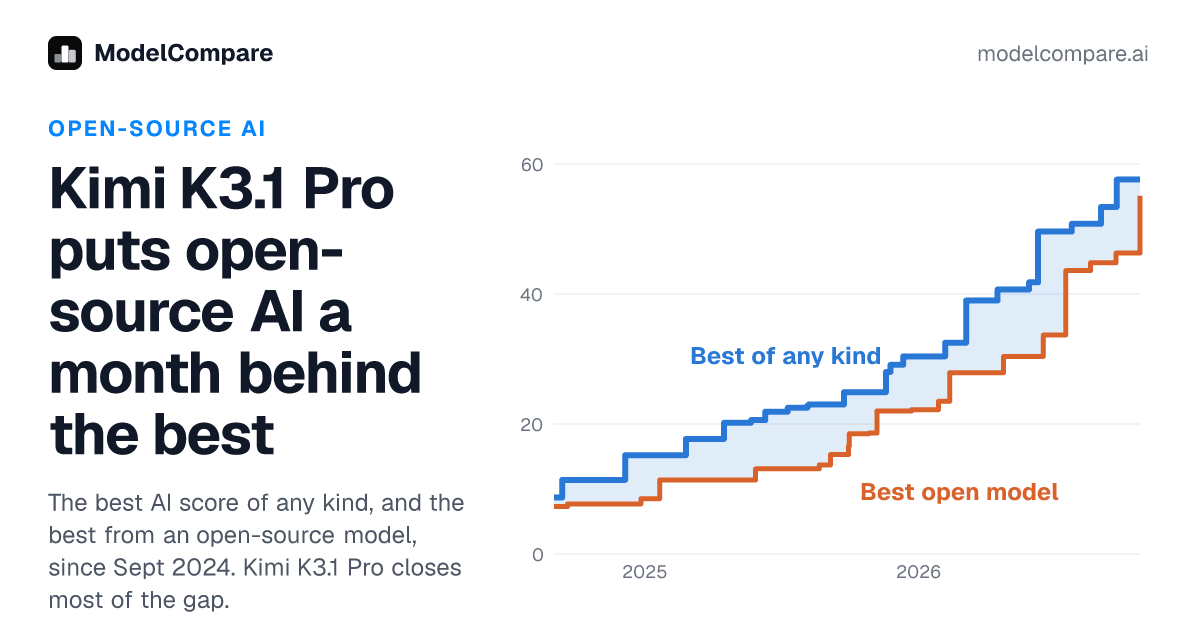
Kimi's new K3.1 Pro model has significantly narrowed the performance gap between open-source and closed-source AI to just 31 days. This development reinforces a Chinese lab's long-standing dominance in the open-source landscape.
The Narrowing Gap: Kimi K3.1 Pro and the Open-Source Frontier
The release of the Kimi K3.1 Pro on October 23, 2026, marks a pivotal moment in the evolution of artificial intelligence. By achieving a score of 55.1 on the Artificial Analysis Intelligence Index, the model has demonstrated that the performance delta between open-source models and the industry-leading closed-source systems—specifically Claude Opus 5.5—is shrinking at an unprecedented rate. Historically, open-source developers have trailed proprietary giants by roughly three months, but Kimi has effectively compressed this window to a mere 31 days.
Technical Benchmarking and Performance
The Artificial Analysis Intelligence Index provides a rigorous evaluation framework, incorporating diverse metrics such as reasoning, domain-specific knowledge, complex coding tasks, and agentic workflows. Kimi K3.1 Pro’s score of 55.1 places it within striking distance of the current market leader, Claude Opus 5.5, which leads by only 2.5 points. Furthermore, the model has significantly outperformed the previous open-source champion, Xiaomi’s MiMo-V2.6-Pro, by a margin of 8.8 points, signaling a substantial leap in architectural efficiency and capability for open-access systems.
Sustained Dominance in Open-Source Development
This release is not merely an isolated achievement but serves as a testament to the consistency of its developers. The lab behind Kimi has now maintained its position at the pinnacle of open-source AI development for 765 consecutive days. Such sustained output suggests a highly optimized research and development pipeline that allows for rapid iteration and deployment, keeping the lab ahead of global competitors in the open-source community.
Strategic Release and Accessibility
Kimi has opted for a phased rollout strategy, initially limiting access to its own API before scheduling the full release of model weights for public download on November 4. This approach allows the developers to manage initial demand while ensuring that the broader developer ecosystem can eventually integrate these weights into their own applications. By keeping the weights free, Kimi continues to lower the barrier to entry for developers who require high-performance models without the cost or restrictions associated with closed-source enterprise APIs.
Broader Implications for the AI Ecosystem
The implications of this 31-day gap are profound. As the lag between open and closed models diminishes, the commercial incentive for proprietary models faces new pressure. If high-end reasoning and coding capabilities become accessible via open-source weights within a month of a flagship model's release, developers may increasingly favor open-source ecosystems for privacy, control, and customization. This trend could accelerate the commoditization of AI capabilities, shifting the competitive landscape from raw model performance toward the surrounding tooling, integration, and user experience layers.
Conclusion
Ultimately, the Kimi K3.1 Pro represents a bridge between high-tier proprietary performance and open-source accessibility. By consistently narrowing the gap to closed-source leaders, the Kimi team is forcing a recalibration of the industry timeline. As we look toward future iterations, the critical question will be whether open-source models can eventually achieve parity or even surpass their closed-source counterparts, potentially altering the power dynamics of the global AI industry permanently.